By Neno Duplan, Founder and CEO, Locus Technologies
Reading Time: 10 minutes
TL;DR: Proven environmental software should demonstrate sustained use on the same platform across customers, regulatory cycles, growing data volumes, and periods of disruption. Locus can point to more than 1.26 million logins over 23 years, more than 446,000 EDD submissions, over 410,000 module-level interactions, nearly sevenfold growth in active record volume, over 99.992 uptime since 2009 verified by independent third-party monitoring, and a median customer tenure of 11 years in the analyzed sample. Buyers should request comparable product-specific evidence from every vendor, verify that claimed history belongs to the platform being evaluated, and test the system with their own complex data and workflows.
What proof should buyers request from an environmental software vendor?
Ask for product-specific evidence of continuous use, workload growth, customer tenure, uptime, performance during disruption, and success with comparable environmental complexity. Feature lists and analyst reports can orient a search, but they do not show how a platform behaves after years of data growth and regulatory change. Useful proof includes longitudinal usage, production volumes, renewal and tenure data, architecture continuity, customer references, migration outcomes, security evidence, and a live test using the buyer’s real data.
“Proven” is one of the easiest words in software
Every mature vendor is proven. Every new platform is future-ready. Every acquired product has decades of experience behind it.
The language sounds reassuring because it avoids a measurable claim.
Environmental software buyers should translate “proven” into a set of questions:
- Proven under what workload?
- Proven for how long?
- Proven on which current product?
- Proven with which types of environmental data?
- Proven across how many ownership, architecture, and version changes?
- Proven by continuous customer use or by a company timeline assembled from acquisitions?
- Proven uptime across all customers.
The distinction matters because environmental software hold long-lived regulatory and scientific records. A platform decision can outlast the people who selected it and, in some cases, the ownership model of the vendor.
What does longitudinal product usage reveal?
Locus examined operational activity across its platform and an anonymized customer sample. The available indicators include:
- More than 1.26 million logins since 2004
- Approximately 7% compound annual growth in logins over the most recent ten-year period analyzed
- A 35 percent increase in logins during 2020
- More than 446,000 EDD submissions since 2007
- More than 410,000 module-level interactions in the analyzed activity
- Nearly sevenfold growth in active record volume since 2007
- A median customer tenure of 11 years in the analyzed sample
- Approximately one third of sampled customers with 15 or more years of tenure.
- Third-party verified uptime of above 99.992%
No single number proves that a platform is the right fit for every buyer. Together, they describe continuity: users returned, workloads grew, records accumulated, and long-term customers continued to operate on the platform.
That is more informative than a founding date by itself.
What are the five forms of operational proof?
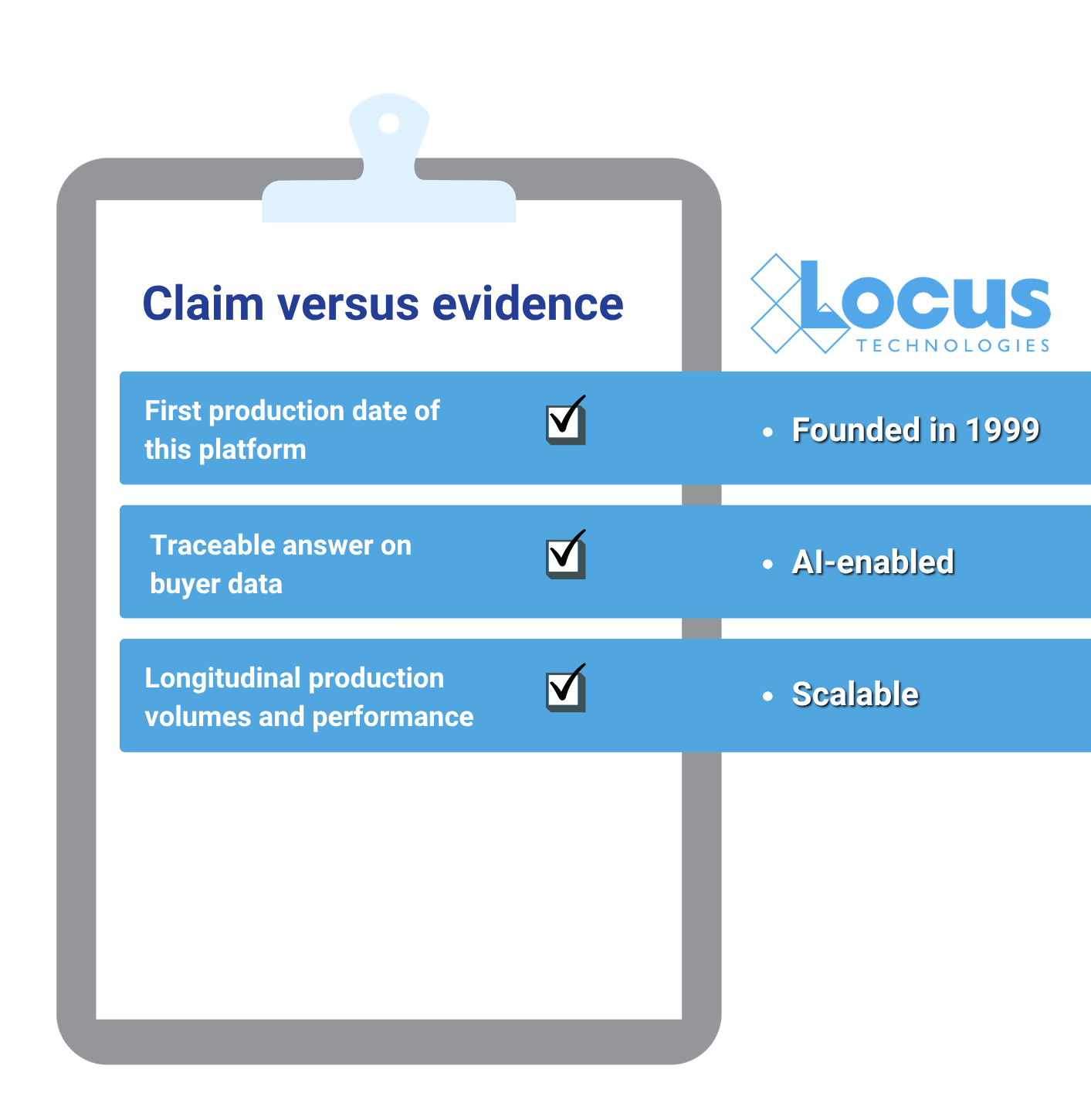
- Continuous product history
Ask the vendor to connect its history to the exact platform being evaluated.
A company may have operated for 25 years while its current flagship product is five years old. A product name may survive while the underlying codebase, database, hosting model, or ownership changes. An acquired platform may contribute its founding date to a parent company’s presentation even if customers are being migrated elsewhere.
Buyers should ask:
- When did this specific product enter production?
- Has its core data model remained continuous?
- How many major re-platforming or forced migration events have customers experienced?
- Are all customers on the same current codebase?
- Which acquired products remain strategic, and which are being sunset?
- Is specific product integrated with any other product and how?
History is useful when it belongs to the product and operating model under consideration.
- Usage depth
License counts can be misleading. A named user may never log in. A module may appear in a price sheet but see little operational use.
Ask for evidence showing what customers do:
- Active users and login frequency
- EDD or laboratory-data throughput
- Regulatory reports generated
- Queries, maps, workflows, rules, and field activities
- Use across facilities and business units
- Sustained activity after implementation.
The Locus activity mix spans reporting, self-built queries, GIS, chain-of-custody management, laboratory intake, and other tools. That breadth helps demonstrate that the platform participates in the working environmental process.
- Workload growth: Scalability
A platform can succeed in a pilot and struggle after ten years of accumulated records, facilities, and business rules.
Nearly sevenfold growth in active record volume tests more than storage. It tests query performance, indexing, validation, upgrades, reporting, security, administration, and the integrity of a growing shared data model.
Buyers should request longitudinal volume and performance evidence. A current screenshot from the largest customer is useful. A ten-year view of how that customer’s environment grew is stronger.
- Customer tenure
Renewal rates show a recurring decision. Tenure shows how long customers have continued making it.
The analyzed Locus sample has a median customer tenure of 11 years, with approximately one third at 15 years or more. Long tenure can reflect value, stability, switching costs, or some combination. It deserves validation through references and candid questions.
Ask long-term customers:
- Has the platform improved while preserving your history?
- Have upgrades required major re-implementation?
- Can you still analyze the earliest data with current tools?
- Has support quality remained consistent?
- How has the vendor responded to changing regulations and data volumes?
The best reference is often a customer whose implementation has already lived through the future the vendor is promising you.
- Performance during disruption
The 35% rise in Locus logins during 2020 offers a natural operational stress signal. Users accessed the platform more frequently during a period when many organizations shifted abruptly to remote work and disrupted operating models.
The statistic does not identify every cause for the increase. It shows that activity expanded when dependable cloud access became especially important.
Buyers should ask vendors how their systems and service teams performed during:
- Sudden remote-work transitions
- Major acquisitions or divestitures
- Regulatory deadlines
- Large data migrations
- Security events and recovery exercises
- Rapid portfolio expansion.
Resilience appears when normal assumptions stop holding.
Why are feature comparisons insufficient?
Feature matrices flatten meaningful differences.
Two vendors may both check the box for “environmental data management.” One may support validated EDD intake, laboratory portals, detection-limit logic, sample planning, GIS, and decades of structured history. Another may provide configurable forms and a document attachment field.
Both can receive the same checkmark.
The same problem appears with AI, reporting, mobile, and analytics. Presence does not establish depth. A feature should be evaluated through the environmental workflow, data model, configuration effort, output traceability, and long-term maintainability.
This is why a live proof exercise is so valuable. Give finalists:
- Representative EDDs from more than one laboratory
- Historical data with inconsistent legacy identifiers
- A report with real calculation and formatting requirements
- A query involving qualifiers, units, non-detects, and time
- A GIS or portfolio-screening question
- A change request that tests configuration
Then observe the process as well as the final screen.
How should buyers evaluate AI claims?
Ask the AI to answer a question that requires governed environmental history, then inspect the evidence.
For example:
“Identify locations where the most recent validated result is above the applicable limit and materially higher than the historical range. Explain the quality filters, unit conversions, and source records used.”
A strong response should expose:
- The records included and excluded
- The regulatory limit and effective date
- Unit normalization
- Qualifier and validation treatment
- Historical comparison period
- Source lineage
- User permissions
The demonstration should also show how the platform retains and uses long-term data. AI proof built on a tiny, curated demo set says little about performance across a customer’s full environmental record.
What should go into an environmental software RFP?
Add evidence requests alongside functional requirements:
- Provide the first production date for the exact product and architecture proposed.
- Describe every mandatory customer migration or major re-platforming event during the last ten years.
- Provide anonymized longitudinal usage and data-volume trends for the product.
- State median customer tenure and define the customer population used.
- Provide references with ten or more years on the same product where available.
- Demonstrate the earliest and newest records in one query, report, map, and AI-assisted workflow.
- Explain how complete data, metadata, audit trails, and attachments can be exported.
- Provide security, availability, recovery, and incident-response evidence scoped to the proposed service.
- Complete a live proof using buyer-supplied data and requirements.
- Identify ownership structure, acquisition history, product investment priorities, and any planned migrations.
- Provide resumes of the original app architecture development and find out whether any of them are still with the company.
- Provide software stack used to develop and run the app.
These questions do not favor an old company automatically. They favor transparent evidence.
Proven means the evidence has accumulated
Environmental programs generate their proof slowly. A platform earns credibility in the same way.
Years of login activity show continued reliance. Rising EDD volumes show growing workload. Long customer tenure shows repeated decisions to stay. Historical records remaining usable show architectural continuity. Performance during disruption shows resilience. Records growth indicates scalability of the platform.
Buyers should ask every finalist for this evidence and evaluate it with the same discipline they apply to their environmental data. A confident claim is a starting point. A traceable record makes the case.
Treat analyst rankings as claims, not proof
The same standard of evidence should apply to industry analyst rankings. If a vendor says that an analyst firm ranked it highest, named it a leader, or placed it in the upper-right quadrant of a market graphic, do not treat that placement as independent proof of product superiority. Ask immediately whether the vendor is a paying customer of that analyst firm, what commercial relationship exists, and whether participation in the evaluation, access to analysts, reprint rights, advisory services, sponsorships, or other programs involved fees. Then ask whether non-paying vendors were evaluated on the same basis and with comparable access and visibility. Analyst reports can provide useful market context, but their methodologies, inclusion criteria, commercial relationships, and depth of product validation vary substantially. A logo, badge, quadrant, or favorable ranking should therefore be treated as a marketing claim to investigate—not as a substitute for customer retention, production usage, architecture, scalability, demonstrated functionality, and other independently verifiable evidence. The more prominently a vendor uses an analyst ranking to establish credibility, the more carefully the buyer should examine how that ranking was produced.
One important test of proven environmental software is whether it keeps historical records connected and analytically available—learn how long companies should keep environmental monitoring data.
Frequently Asked Questions
What does “proven environmental software” mean?
It describes a platform with verifiable, sustained production use across relevant customers, workloads, regulatory requirements, and time. Evidence should apply to the specific product being evaluated and include usage, scale, tenure, resilience, security, and customer outcomes.
Is a high customer renewal rate enough proof?
It is useful, especially when the vendor defines the calculation clearly. Buyers should combine it with customer tenure, active usage, reference calls, product continuity, workload growth, support history, and direct technical testing.
How can buyers verify a vendor’s platform history?
Ask for the first production date of the exact product, architecture changes, acquisition history, mandatory migrations, supported versions, customer references, and proof that long-term customers still use their earliest records in the current platform.
What is the best way to test environmental software?
Use a structured proof exercise with buyer-supplied EDDs, historical data, regulatory outputs, queries, GIS needs, and configuration changes. Evaluate how the vendor handles exceptions, data lineage, quality rules, and revision requests.
Why does historical data accessibility matter in vendor due diligence?
Environmental systems often hold decades of evidence. Buyers need proof that records will remain usable through upgrades, growth, and changing analytical tools. This is also central to monitoring optimization and AI readiness.
Locus is the only self-funded water, air, soil, biological, energy, and waste EHS software company that is still owned and managed by its founder. The brightest minds in environmental science, embodied carbon, CO2 emissions, refrigerants, and PFAS hang their hats at Locus, and they’ve helped us to become a market leader in EHS software. Every client-facing employee at Locus has an advanced degree in science or professional EHS experience, and they incubate new ideas every day – such as how machine learning, AI, blockchain, and the Internet of Things will up the ante for EHS software, ESG, and sustainability.