By Neno Duplan, Founder and CEO, Locus Technologies
Reading Time: 8 minutes
TL;DR: A faraway net zero promise is easy to make. Proving what a company is doing today is considerably harder.
Credible sustainability starts with a measured baseline, near-term actions, and environmental data that can withstand scrutiny. When companies capture and validate that data at its source, they can do much more than prepare reports. They can identify waste, improve processes, lower costs, reduce risk, and give AI something trustworthy to work with. Sustainability becomes a business strategy when environmental information moves out of its reporting silo and into everyday operational decisions.
How can companies turn sustainability commitments into measurable business results?
Companies can turn sustainability commitments into business results by connecting every goal to verified environmental data and specific operational actions. That means establishing a defensible baseline, capturing emissions to air, water, and soil at their source, and tracing environmental impacts back to facilities, materials, assets, and processes. With validated data on a unified platform, organizations can find inefficiencies, change operating practices, lower costs, reduce emissions, automate reporting, and prove that reported progress reflects real activity.
Sustainability has a credibility problem
Corporate sustainability announcements tend to follow a familiar script:
- Carbon neutral by 2050
- Net zero by 2040
- Climate positive in the decades ahead
- Committed to building a more sustainable future.
They sound good. They look good in a press release. They may even be backed by sincere intentions. It reminds me of US presidents who at their state of the union addresses for decades, have promised American energy independence just over the horizon. The goal kept moving—until the United States finally became a net energy exporter in 2019.
But talk is cheap, especially when the deadline is 15 or 25 years away.
The obvious question is: What are you doing today?
What is changing inside the operation? What is the baseline? Which facilities and emission sources are included? What will happen during the next 12 months? Who owns the work? How will anyone know whether it succeeded?
Those details rarely make the headline, yet they are precisely what separates a serious environmental program from a well-written aspiration.
There is also a basic accountability problem. The executive announcing a 2050 goal is unlikely to hold the same position in 2050. In many cases, that person will not even be with the company. A distant promise can create positive attention today while leaving the hard decisions for someone else.
The United Nations Integrity Matters report calls for near-term targets, transparent transition plans, leadership accountability, and reported progress as essential elements of credible net zero commitments.
A 2050 target may be worthwhile. Its credibility, however, depends on what the organization can demonstrate in 2026, 2027, and 2028, or at an intermediate 2030 target.
When a press release starts grading its own homework
The credibility problem gets more interesting when corporate claims feed into external sustainability ratings.
Some ratings firms rely heavily on publicly available information. A company publishes an ambitious environmental promise. The ratings firm collects that promise from the web and incorporates it into a score. The company then cites the score as outside validation of its environmental leadership.
The cycle works like this:
- A company publishes a sustainability claim.
- A third party collects the claim from the web.
- The claim influences an external rating or profile.
- The company promotes that rating as independent evidence.
- The new publicity becomes another public source for future assessments.
The original claim has now made a full trip around the block. It may look more credible when it returns, but nobody necessarily verified the underlying environmental performance.
That is the sustainability equivalent of grading your own homework, then framing the report card.
A public statement is not the same thing as verified data. Repeating it does not turn it into evidence.
The Federal Trade Commission’s Green Guides make a related point for environmental marketing: claims need a reasonable basis and appropriate substantiation. Corporate sustainability communications deserve the same discipline.
A seven-question reality check for sustainability claims
Executives, customers, investors, and employees do not need to be environmental scientists to evaluate a sustainability commitment. They can start with seven straightforward questions.
| Area | Question to ask |
|---|---|
| Current performance | What is the company’s measured environmental impact today? |
| Baseline | Which year, facilities, sources, and organizational boundaries are included? |
| Near-term progress | What must be achieved during the next one, three, and five years? |
| Operating plan | Which processes, fuels, chemicals, equipment, or suppliers will change? |
| Measurement | How will reductions be calculated and monitored? |
| Data assurance | What quality control, validation, and audit procedures apply? |
| Accountability | Which current leaders and operating teams own delivery? |
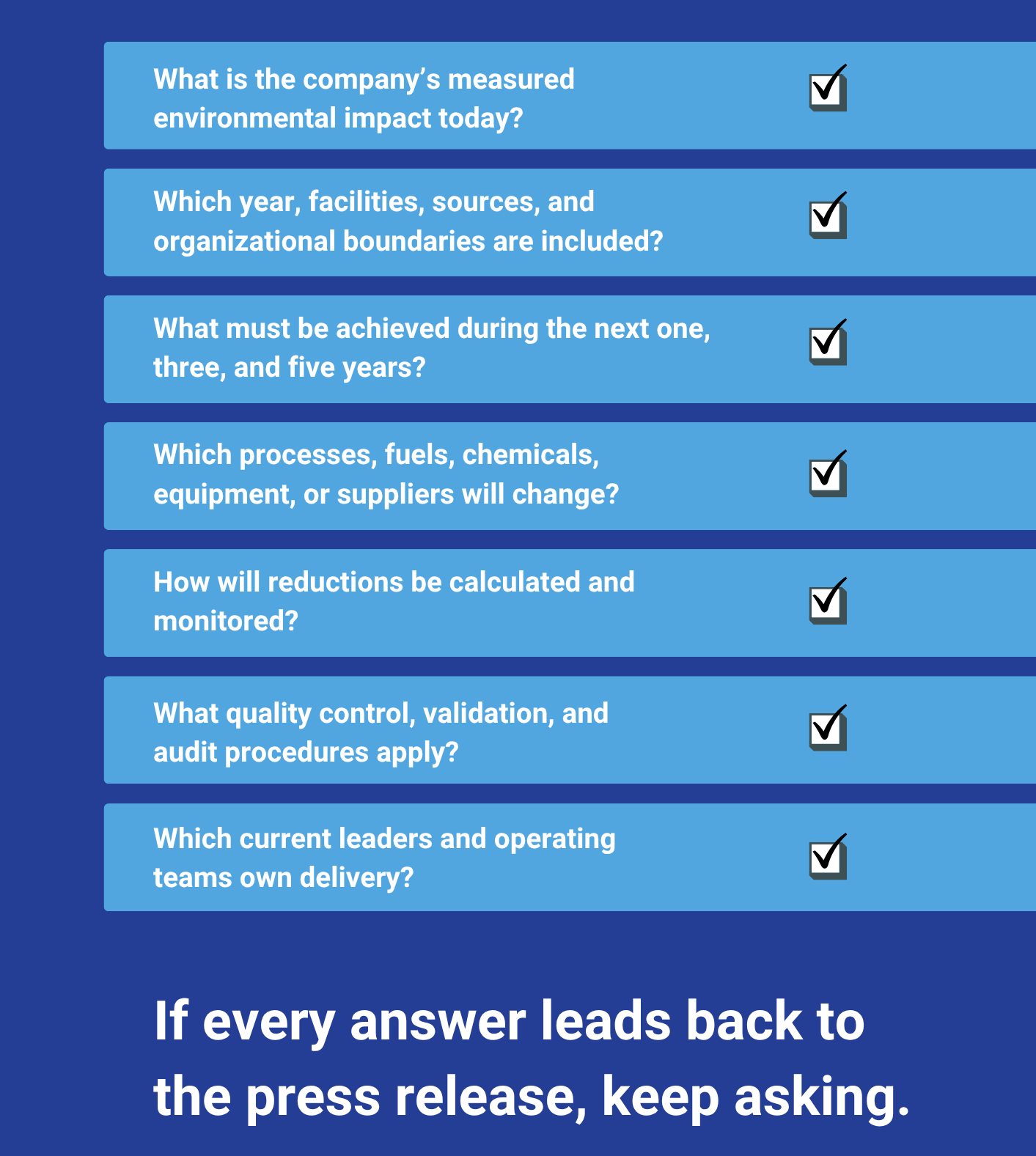
If a company can answer those questions clearly, there is probably substance behind the story.
If every answer circles back to the same glossy sustainability report, keep asking.
The real work starts at the source
A sustainability report is at the end of a data journey. It should never be the beginning.
Environmental information originates in places such as:
- Analytical laboratories
- Continuous monitoring systems (CMS)
- Meters and sensors
- Field sampling programs
- Production systems
- Utility records
- Waste manifests
- Refrigerant service records
- Mobile inspections
- Supplier and purchasing systems.
Every emission or environmental impact has a source. The closer data is captured and checked to that source, the more useful and defensible it becomes.
This is where the details matter.
A bad unit conversion, duplicate record, missing sample, incorrect emission factor, exceeded holding time of a sample in the lab, or inconsistent facility name can travel through calculations, dashboards, disclosures, and executive presentations. By the time it reaches the sustainability report, the number may look polished and authoritative.
But it can still be wrong.
The EPA’s Inventory Management Plan guidance emphasizes defined data sources, collection procedures, quality assurance, auditing, management review, and corrective action as essential elements of a high-quality greenhouse gas inventory.
That is the standard companies should aim for: environmental data that can be traced, reviewed, corrected, and defended.
Compliance data is already telling you how to improve the business
Many organizations collect environmental data because a permit, regulator, auditor, or disclosure framework requires it. Once the report is submitted, the data goes back on the shelf until the next reporting cycle.
That’s a wasted opportunity.
The organization has already paid laboratories, consultants, field teams, engineers, and employees to produce the information. Treating it as paperwork leaves much of its value untapped.
Suppose a manufacturer sees an increase in air emissions or wastewater loading. That change should lead to operational questions:
- Did production volume increase?
- Did the facility switch raw materials?
- Is a control device losing efficiency?
- Did the temperature, pressure, or flow rate change?
- Is one production line driving most of the increase?
- Could a different chemical produce the same result with less environmental impact?
- Is avoidable process loss increasing material purchases and waste costs?
Now the environmental data is doing real work. It connects emissions with production, materials, maintenance, energy use, and cost.
A process change might reduce air emissions while lowering raw material consumption. Better wastewater control might reduce treatment costs and prevent a permit exceedance. More precise monitoring might expose faulty equipment before it becomes an expensive maintenance issue.
The environmental and economic benefits often travel together:
- Lower emissions
- Lower material consumption
- Reduced waste treatment and disposal costs
- More efficient equipment
- Fewer compliance surprises
- Stronger audit readiness
- Better sustainability disclosures
- Greater resilience as regulations change
Companies do not have to choose between sustainability and growth. In many cases, environmental impact and unnecessary expense share the same root cause: an inefficient process.
Find the inefficiency, and both numbers can improve.
Environmental data should not live in the corner
Most companies would never run payroll, purchasing, inventory, or financial reporting through a patchwork of locally owned spreadsheets, consultant databases, and email attachments.
Environmental information is often another story.
It may be scattered among:
- Facility spreadsheets
- Laboratory portals
- Consultant-managed systems
- Department-specific applications
- Shared drives
- Email attachments
- Paper forms
- Standalone compliance tools
That fragmentation usually reflects the company’s organizational chart, not the way environmental information actually works.
Air emissions, greenhouse gases, water quality, waste, chemical inventories, incidents, and sustainability metrics often depend on the same facilities, assets, processes, materials, and operating activity. Managing them as unrelated subjects creates duplicate work and multiple versions of the truth. It simply extends the reporting cycle time and adds cost.
Environmental data should be treated as an extension of the enterprise technology environment, right alongside financial, human resources, operational, and asset data. A unified environmental data platform can provide a common system of record while supporting specialized workflows for compliance, EHS, sustainability, and water.
This does not mean everyone performs the same job. It means everyone works from governed, consistent information.
Safety offers a useful comparison. Workplace safety cannot be the sole responsibility of the safety director. Every employee and manager has a role. Environmental performance works the same way.
The environmental team may set standards, oversee compliance, and manage reporting. Operations, maintenance, engineering, procurement, finance, IT, and leadership all influence the result.
Going green cannot be somebody else’s department.
Decades of data are sitting there, waiting to be useful
Many companies hold years—sometimes decades—of environmental data, yet use it mainly to reproduce the same quarterly and annual reports. The conversation too often centers on reducing the cost of storing that data, rather than using it to pay for itself: improving decisions and processes in ways that reduce the need for future data collection.
There is much more intelligence buried in those records.
Historical environmental data can help answer questions such as:
- Which sources consistently create the greatest environmental impact or compliance risk?
- Which facilities are trending toward a permit limit before a violation occurs?
- Where do transcription, unit-conversion, or laboratory errors recur?
- Which control technologies have produced measurable, sustained reductions?
- Which operational changes correlate with improved environmental performance?
- What conditions tend to precede an exceedance, anomaly, or equipment problem?
- Where is consultant and internal staff time being spent on repetitive data handling rather than higher-value analysis?
- Which monitoring results are stable enough to support a revised sampling strategy, subject to regulatory approval?
- Which sites, pollutants, or programs deserve the next dollar of capital or operational attention?
- Where are different systems or reports telling inconsistent versions of the same environmental story?
This is the point where environmental data stops being a reporting byproduct and becomes an operational asset.
The company already owns the information. The question is whether it has organized that information well enough to use it.
AI cannot perform magic on a filing cabinet
AI has genuine potential in EHS and sustainability. It can detect anomalies, summarize records, assemble draft reports, identify trends, support quality control, and guide users through large volumes of technical information.
But AI does not sprinkle intelligence onto a pile of disconnected spreadsheets.
If environmental records are fragmented across paper forms, email, shared drives, laboratory portals, and outdated databases, a general-purpose AI tool will not automatically understand the relationships among facilities, permits, samples, sources, units, methods, assets, and regulatory obligations.
For environmental AI to produce trustworthy results, it needs:
- Structured and validated data
- Consistent terminology
- Defined relationships among records and assets
- Preserved source information
- Quality assurance rules
- Complete audit trails
- Domain-specific calculations
- Appropriate permissions and governance
- Human review for consequential decisions
AI can move quickly. That is valuable when the data underneath it is sound. When the data is incomplete or poorly governed, speed simply helps the error circulate sooner.
Validated environmental data is the fuel. A purpose-built platform supplies the engine, controls, and guardrails.
Decades of domain knowledge also matter. Environmental data models, validation rules, regulatory calculations, workflows, and audit histories give AI the context it needs to perform useful work in a regulated setting.
Learn more about these requirements in Locus Technologies’ guide to AI for EHS, ESG, and water.
What operational sustainability looks like in practice
A mature sustainability program connects environmental goals with everyday work through a repeatable data chain:
- Plan: Develop an overall plan for the program at hand that your company will follow from start to finish.
- Capture: Collect records from laboratories, field teams, instruments, meters, operations, and suppliers.
- Validate: Check completeness, units, methods, qualifiers, dates, limits, and expected relationships.
- Centralize: Maintain governed information in a common environmental system of record.
- Contextualize: Connect results with facilities, assets, processes, materials, permits, and production activity.
- Analyze: Identify trends, anomalies, cost drivers, environmental risks, and reduction opportunities.
- Act: Change a process, chemical, control, maintenance practice, purchasing decision, or operating procedure.
- Verify: Measure whether the action produced the intended result.
- Report: Generate regulatory and sustainability outputs from the same controlled information.
- Follow up: Review and analyze the whole process and prepare for the next round. Learn from it. Focus on reducing cycle time next time. Eliminate redundancies, improve every step to become more efficient. Check where AI can help in every step of the process in the next round.
Notice where reporting appears in that sequence. It comes last.
A sustainability report should communicate what the organization measured, changed, and accomplished. Producing the report should never become a substitute for doing the work.
The best measure of a green business
If you want to know whether a company takes sustainability seriously, look beyond the press release.
Look at its data.
Can the organization trace a reported number back to the laboratory, meter, instrument, field event, or business activity that produced it? Are facilities using consistent definitions? Can leaders explain what changed during the past year? Does environmental information influence operating decisions? Can the company identify which actions created measurable improvement?
A credible sustainability program helps satisfy regulators, strengthen reputation, lower costs, manage risk, and run the business more intelligently.
That is considerably more valuable than another long-term promise with no visible road map.
Going green becomes meaningful when a company can connect every major claim to validated data, every target to an operating plan, and every reported improvement to something that actually changed on the ground.
Frequently asked questions
What makes a corporate sustainability claim credible?
A credible sustainability claim includes a verified baseline, clearly defined organizational boundaries, near-term milestones, a specific implementation plan, consistent measurement methods, accountable owners, and transparent progress reporting. Supporting environmental data should be traceable and capable of withstanding independent review.
Why are distant net zero commitments sometimes criticized?
A distant target can create the appearance of ambition without requiring much immediate accountability. A 2040 or 2050 commitment becomes more credible when it includes current emissions data, interim reduction targets, funded projects, named responsibilities, and annual evidence of progress.
How can environmental compliance data reduce operating costs?
Compliance data can reveal excessive material use, inefficient processes, equipment problems, recurring errors, unnecessary manual work, and sources responsible for disproportionate emissions or waste. Addressing those issues can lower laboratory, consulting, treatment, disposal, energy, and raw material costs.
Should environmental data be managed in an ERP system?
Environmental data should be governed with the same discipline as other enterprise information and integrated with relevant ERP and operating systems. A purpose-built environmental platform can manage specialized calculations, validations, permits, workflows, and audit trails while exchanging information with broader business systems.
Can AI manage environmental data stored in spreadsheets?
AI can assist with limited spreadsheet analysis, but fragmented and inconsistently structured files restrict reliability, scalability, security, and auditability. Effective environmental AI requires validated, governed data with clear relationships among facilities, assets, sources, methods, units, permits, and reporting requirements.
Why is source-level environmental data important?
Source-level data preserves the connection between a reported result and the laboratory, instrument, meter, field event, or business activity that generated it. That traceability supports quality control, auditing, root-cause analysis, regulatory reporting, and operational improvement.
What is environmental greenwashing?
Environmental greenwashing occurs when a company’s communications create a stronger impression of environmental performance than the available evidence supports. Warning signs include vague terminology, distant goals without interim plans, selective reporting, unclear boundaries, and claims that cannot be traced to verified data.
How does a unified environmental platform support sustainability?
A unified platform reduces duplicate data entry, establishes consistent definitions, preserves audit trails, and connects environmental measurements with facilities, assets, processes, materials, and obligations. It also gives analytics and AI a reliable foundation for identifying risks and improvement opportunities.
Locus is the only self-funded water, air, soil, biological, energy, and waste EHS software company that is still owned and managed by its founder. The brightest minds in environmental science, embodied carbon, CO2 emissions, refrigerants, and PFAS hang their hats at Locus, and they’ve helped us to become a market leader in EHS software. Every client-facing employee at Locus has an advanced degree in science or professional EHS experience, and they incubate new ideas every day – such as how machine learning, AI, blockchain, and the Internet of Things will up the ante for EHS software, ESG, and sustainability.