
By Mark Harbin
Reading time: 7 minutes
TL;DR: Refrigerant regulations in the European Union and United States share a long-term goal of reducing emissions from high-global-warming-potential gases. The rules governing inspections, leak response, recordkeeping, phasedowns, and reporting differ significantly and continue to evolve. Locus Technologies helps global organizations address that complexity through a unified refrigerant data foundation with configurable applications, calculations, thresholds, workflows, and reports tailored to each jurisdiction.
Refrigerant compliance has never been a set-it-and-forget-it exercise.
The science surrounding fluorinated greenhouse gases is clear. Many commonly used refrigerants have a global warming potential hundreds or thousands of times greater than carbon dioxide. Finding leaks, reducing emissions, recovering refrigerants, and transitioning to lower-impact alternatives can produce meaningful environmental benefits.
The regulatory path toward those goals is considerably less predictable.
Requirements vary among the European Union, the United States, individual US states, and other jurisdictions. They can also change as political administrations reconsider timelines, technology limits, enforcement priorities, or the economic impact of previous rules.
For global companies, this creates a practical problem. Facilities may use similar cooling equipment and refrigerants while operating under very different inspection schedules, repair triggers, documentation requirements, and reporting formats.
Locus Technologies developed its new EU Refrigerant Management application for precisely this kind of operating environment. The application complements the Locus Refrigerant Management solution already adopted by major US enterprises, giving multinational organizations a way to manage regional compliance through localized tools while maintaining a consistent enterprise data foundation.
The EU and US Are Moving in the Same General Direction
The European Union and United States are both working to reduce the climate impact of hydrofluorocarbons and improve refrigerant lifecycle management.
Their regulatory frameworks reflect several common priorities:
- Reducing the supply and use of high-global-warming-potential refrigerants
- Detecting and repairing leaks
- Maintaining reliable equipment and service histories
- Improving refrigerant recovery, recycling, and reclamation
- Documenting technician and contractor activities
- Supporting credible greenhouse gas inventories
- Transitioning equipment toward lower-impact alternatives.
That broad alignment can create the impression that a single compliance template should work everywhere. Once companies reach the facility and equipment level, the differences become impossible to ignore.
How EU and US Refrigerant Requirements Differ
The EU’s revised F-gas Regulation, Regulation (EU) 2024/573, generally takes a prescriptive approach based heavily on refrigerant quantity and climate impact.
For many types of covered equipment, leak-check frequency is determined using metric tonnes of carbon dioxide equivalent. Equipment containing higher amounts of climate-weighted refrigerant must be inspected more frequently. Depending on the refrigerant charge and equipment configuration, checks may be required every 12 months, six months, or three months. The permitted interval may be extended when qualifying leak-detection systems are installed.
EU operators must repair detected leaks without undue delay, verify repairs, and maintain detailed records covering refrigerant additions, recovery, servicing, inspections, technicians, and equipment retirement. Those records generally must be retained for at least five years.
The EU is also pursuing an aggressive HFC quota trajectory. The allowable quantity placed on the EU market declines over time and reaches zero in 2050, subject to the regulation’s scope, exemptions, and review provisions.
The US framework combines several different regulatory mechanisms.
Under the federal HFC phasedown, allowable production and consumption fall to 15 percent of the established baseline beginning in 2036. Federal leak-management requirements generally use appliance charge size and annualized leak rates. Depending on the equipment category, repair obligations may be triggered when annualized – or rolling average – leak rates exceed 10, 20, or 30 percent.
Covered US equipment can require leak-rate calculations, repair deadlines, verification tests, periodic inspections, retrofit or retirement plans, and chronic leaker reporting. Federal records generally must be retained for three years, although Title V air permits and state programs can impose different or additional requirements.
A multinational organization may therefore need to answer very different questions about similar equipment:
| Compliance question | EU framework | US federal framework |
|---|---|---|
| What determines routine leak checks? | Refrigerant type, quantity, and climate impact, frequently measured in tonnes CO₂e | Appliance duty type, refrigerant type and charge size, leak history, and applicable federal requirements |
| What triggers repair activity? | Detection of a leak | Annualized or rolling average leak-rate thresholds for covered equipment |
| How quickly must repairs occur? | Without undue delay, followed by verification | Generally within 30 days, with specified exceptions |
| How long are records retained? | Generally at least five years | Generally at least three years federally |
| How are phasedowns structured? | Declining EU quota reaching zero in 2050 | Declining allowances reaching 15 percent of baseline in 2036 |
| What additional rules may apply? | Equipment-specific restrictions and Member State enforcement | EPA requirements plus state refrigerant programs |
These distinctions affect everyday work. They determine when an inspection is scheduled, what calculation is performed, when an alert is issued, which workflow begins, how a technician documents a repair, and what evidence must be available during an audit.
Regulations Can Change Faster Than Enterprise Systems
The recent US regulatory history shows why companies need flexibility.
EPA requirements under the American Innovation and Manufacturing Act expanded federal HFC management, leak repair, reclamation, and technology-transition obligations. A subsequent rule effective July 27, 2026, revised several technology-transition deadlines and limits for supermarkets, cold-storage warehouses, residential and light-commercial air conditioning, and other subsectors.
The underlying US HFC phasedown and major refrigerant-management obligations remain in place. The details surrounding which technologies can be used, in which sectors, and for how long have continued to move.
Political administrations will continue to influence the timing and implementation of environmental regulations. States may also move in a different direction from the federal government. Washington’s Refrigerant Management Program, for example, includes registration, inspection, leak repair, annual reporting, record-retention, and automatic detection requirements for covered facilities.
The lesson for regulated companies is straightforward: compliance software should accommodate rule changes without forcing the organization to rebuild its operational history.
Historical equipment records, refrigerant inventories, service events, leak histories, cylinder movements, and emissions data retain their value when a threshold changes. That information should remain intact and available for new calculations, workflows, analysis, and reports.
One Refrigerant Data Layer, Localized Compliance Tools
A global refrigerant program needs consistency and localization at the same time.
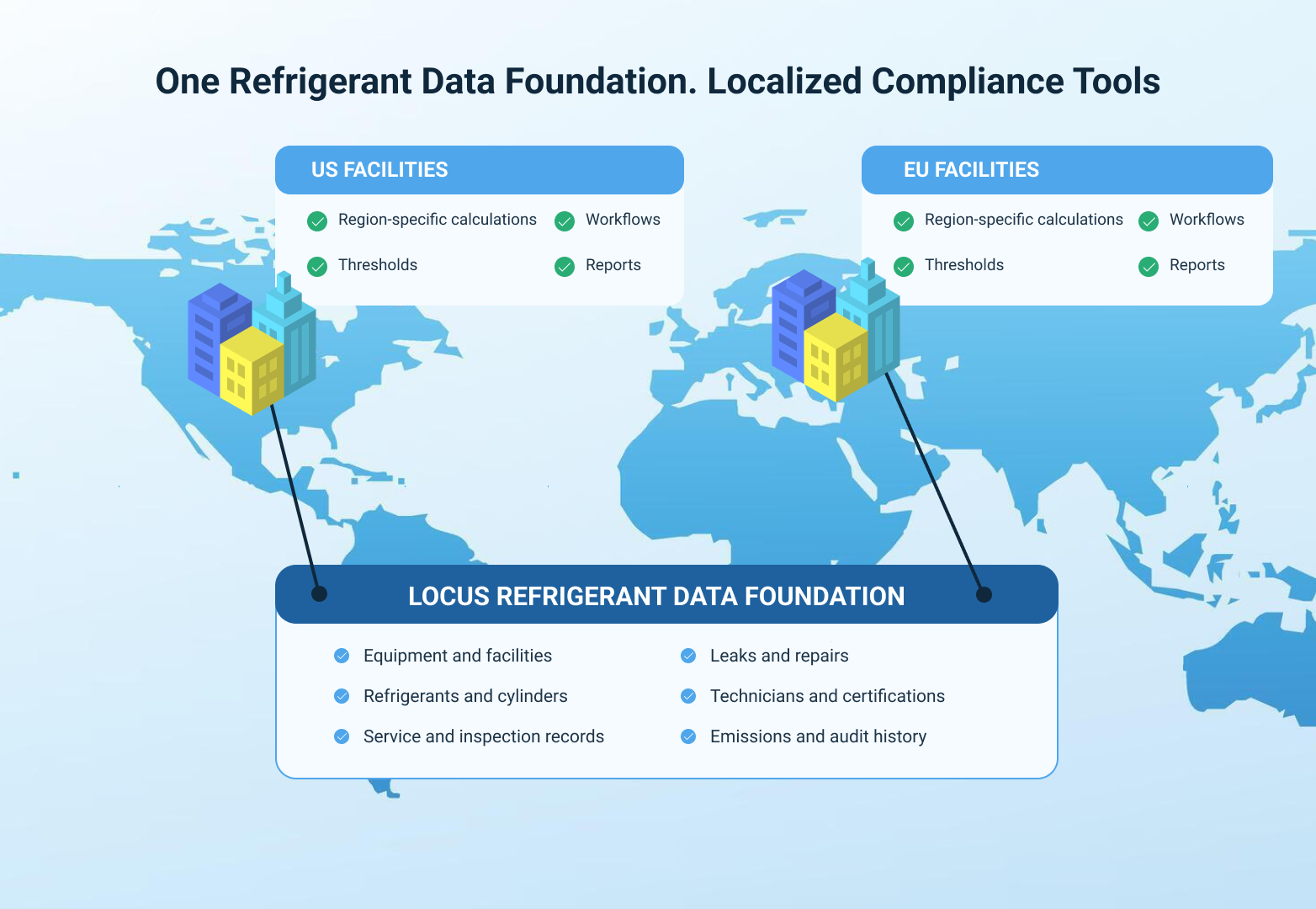
Consistency comes from maintaining one governed record for the assets and activities that exist across the enterprise:
- Facilities and equipment
- Refrigerant types and quantities
- Cylinders and refrigerant movements
- Technicians, contractors, and certifications
- Inspections and service events
- Leak detection and repair histories
- Recovery, reclamation, and disposal activities
- Supporting documents and audit trails
- Refrigerant-related greenhouse gas emissions.
Localization determines how that information is evaluated and used within each jurisdiction.
With Locus, the same governed data foundation can support jurisdiction-specific:
- CO₂e and leak-rate calculations
- Equipment applicability determinations
- Inspection frequencies
- Repair thresholds and deadlines
- Verification requirements
- Automated alerts
- Approval and escalation workflows
- Recordkeeping periods
- Regulatory and management reports
- Facility, regional, and enterprise dashboards.
A facility in Germany can follow the applicable EU F-gas inspection and documentation workflow. A facility in Texas can apply US federal requirements. A facility in Washington can incorporate federal and state obligations. Corporate teams can still view refrigerant inventories, leaks, emissions, equipment performance, and progress toward reduction goals across the full organization.
This structure gives local teams the tools they need without breaking the enterprise view into disconnected regional databases.
Locus Brings Proven US Refrigerant Experience to the EU
Locus developed its US Refrigerant Management application to help enterprises manage equipment records, service activities, leak calculations, response deadlines, verification testing, cylinder tracking, inspections, and emissions reporting.
The application provides field personnel and contractors with mobile and QR-enabled workflows, allowing service information to be associated directly with the correct appliance. Automated calculations and alerts help compliance teams identify potential exceedances and initiate the appropriate response. Dashboards give facility, environmental, HVAC, and sustainability teams access to current information without waiting for spreadsheets to be collected and reconciled.
The new EU Refrigerant Management application extends that specialized experience to organizations operating under EU F-gas requirements.
This expansion is especially relevant for multinational companies that have struggled with a familiar choice: force every facility into a generic global template or allow each region to build its own compliance system.
Locus offers another path. Companies can establish common data governance across the enterprise while configuring the operational rules around each facility’s actual obligations.
Configuration Is a Compliance Capability
Configurability sometimes gets treated as a software convenience. In environmental compliance, it is a form of risk management.
A configurable system allows organizations to respond when:
- A regulatory threshold changes
- An inspection interval is revised
- A new refrigerant or equipment category becomes subject to restrictions
- A state or Member State introduces additional requirements
- A reporting template changes
- A company adopts an internal standard that exceeds the legal minimum
- An acquisition brings facilities from a new jurisdiction into the portfolio
- Corporate sustainability goals require more frequent monitoring than regulations mandate.
Locus applications can be configured around an organization’s terminology, forms, fields, approval processes, notifications, calculations, and reports. This allows the compliance program to evolve while preserving the data, audit trail, and operating history already accumulated.
That continuity matters. Refrigerant histories can reveal recurring leaks, underperforming equipment, service patterns, replacement priorities, emissions hotspots, and opportunities to reduce refrigerant purchases. As analytics and AI capabilities advance, a longer, well-governed history becomes even more valuable.
Build for Today’s Rule and Tomorrow’s Revision
No software provider can guarantee that refrigerant rules will remain unchanged. Current regulatory experience suggests they will continue to evolve.
Companies can prepare by establishing a durable data foundation and selecting software that can translate changing rules into practical facility workflows.
For organizations operating in the EU and US, that means supporting distinct compliance logic without creating distinct versions of the truth. It means giving technicians clear local instructions while giving corporate leaders a consistent global view. It also means retaining detailed operational history so each regulatory revision begins with reliable data.
Locus Refrigerant Management brings these capabilities together through US and EU applications built on one configurable cloud platform.
Different jurisdictions can set different thresholds, schedules, and reports. Your refrigerant data can remain connected, governed, and ready for whatever comes next.
Learn more about Locus Refrigerant Management or contact Locus to discuss refrigerant compliance across your global operations.
Frequently Asked Questions
Can one software platform manage both EU and US refrigerant compliance?
Yes. A configurable platform can maintain common equipment, refrigerant, service, leak, technician, and emissions data while applying different calculations, thresholds, inspection schedules, workflows, and reports for each jurisdiction. Locus supports this model through localized refrigerant applications built on a unified data foundation.
What is the primary difference between EU and US refrigerant leak requirements?
EU requirements commonly schedule leak checks according to refrigerant quantity and climate impact, measured in tonnes of CO₂ equivalent. US federal requirements frequently rely on appliance charge thresholds and leak rates, with repair obligations triggered at different percentages based on equipment duty type. State rules may eliminate or reduce leak rate thresholds, add more scheduled inspections, and reporting obligations.
Why does refrigerant software need to be configurable?
Refrigerant requirements change as regulations, implementation schedules, technology limits, and state or national policies evolve. Configurable software allows calculations, thresholds, alerts, forms, workflows, and reports to be updated while preserving the organization’s historical data and audit trail.
How does refrigerant management support greenhouse gas reporting?
Releases of refrigerants from equipment are generally reported as Scope 1 emissions. Centralized service, leak, recharge, recovery, and refrigerant inventory data can improve the accuracy and traceability of those calculations while helping organizations identify opportunities to prevent future emissions.

Mark Harbin
CEA, CRCM Senior Implementation Consultant
Mark Harbin is the Senior Implementation Consultant at Locus Technologies and the company’s in-house expert on refrigerant management and compliance. Mark contributes to the development of Locus Refrigerant Management software and advises Locus clients on their implementation of environmental and sustainability software. He also leads the Certified Refrigerant Compliance Manager (CRCM) course in partnership with the National Registry of Environmental Professionals (NREP), and he is a frequent author and speaker on ozone depleting substances and high global warming potential (GWP) refrigerants.
Mark spent 14 years in the commercial/industrial HVAC industry, and he has contributed to numerous energy retrofit and refrigerant conversion projects across the US. He later pivoted to a career in refrigerant management product development, consulting, training, and certification for organizations in all sectors, and joined Locus Technologies in early 2024. Mark earned a business degree from Arizona State University, and he is a licensed HVAC contractor in Arizona, an EPA Certified Technician – Universal, a Certified Environmental Auditor (CEA), a Certified Environmental and Safety Compliance Officer (CESCO), and a CRCM through the NREP.