By Neno Duplan, Founder and CEO, Locus Technologies
Reading Time: 10 minutes
TL;DR: Environmental data scalability means preserving performance, validation, metadata, reporting logic, security, and lineage as programs grow in size and complexity. Record capacity alone is an incomplete measure. In an anonymized sample of 50 Locus EIM customers, average record volume per nuclear account was approximately 16 times as many records as water utility or manufacturing accounts, while all three sectors used the same underlying EIM architecture. Buyers should evaluate scalability across facilities, monitoring locations, analytes, methods, laboratories, jurisdictions, users, spatial relationships, and historical depth, using their own data and projected growth.
How can buyers tell whether environmental software will scale?
Test whether the same architecture can manage increasing data volume and increasing scientific complexity without losing validation, context, performance, security, or traceability. Ask for comparable production examples, long-term growth evidence, and a proof exercise using realistic EDDs, queries, reports, maps, and historical records. A database row limit says little about how the system performs when millions of results carry different methods, qualifiers, limits, locations, regulatory rules, and access controls.
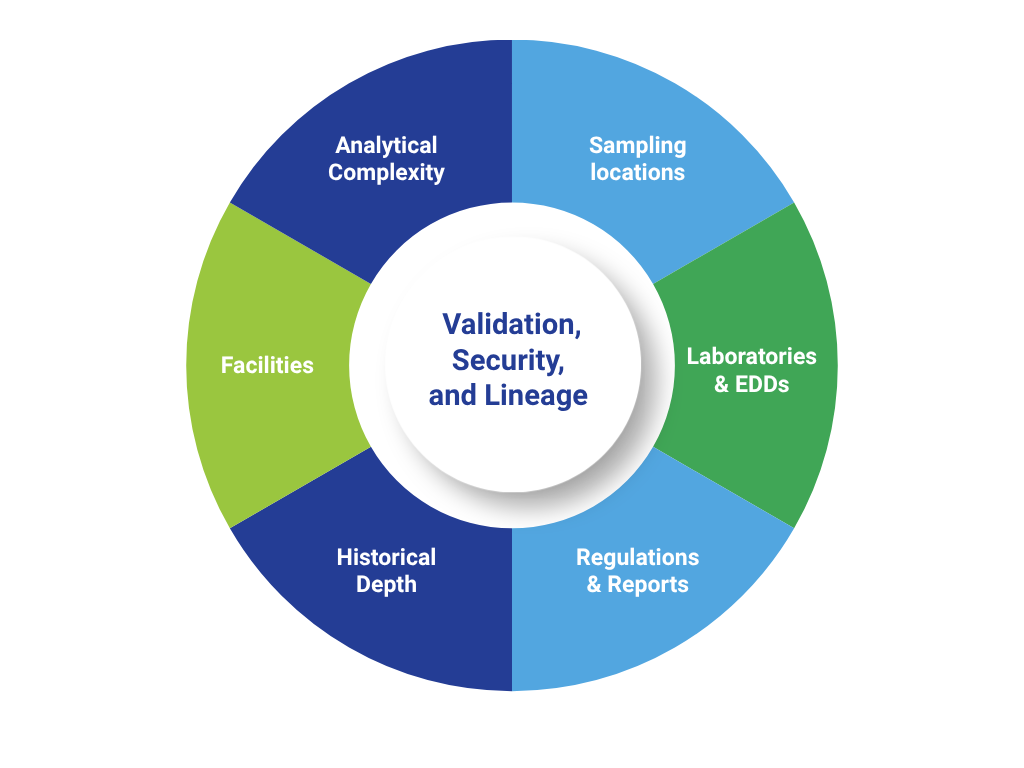
Environmental scale is multidimensional
“How many records can it hold?” is a fair question. It is also the question most vendors are prepared to answer.
Modern databases can store very large numbers of rows. Environmental programs become difficult because every row participates in a scientific and regulatory system.
A result may need to remain connected to:
- A facility, project, station, well, outfall, stack, or other location
- Coordinates, elevation, depth interval, and spatial relationships
- A sample, field event, chain of custody, and laboratory batch
- An analyte, fraction, matrix, method, unit, qualifier, and detection limit
- Quality-control samples and validation decisions
- Permit limits and regulatory effective dates
- User roles, client access, and confidential business information
- Reports, maps, calculations, and prior versions.
Scale applies to all of these relationships.
What does a 16-fold difference in customer record volume reveal?
Locus analyzed an anonymized sample of 50 EIM customers. Six heavily regulated industries accounted for 82% of the sample’s total record volume.
Nuclear customers represented approximately 10% of accounts and 32.8% of volume. Oil and gas represented about 14% of accounts and 26.5% of volume. Average record volume per nuclear account was approximately 16 times higher than for water utility or manufacturing accounts in the sample.
The sample does not represent the whole market, and record volume does not capture every dimension of complexity. It does, however, show that customer programs with substantially different record volumes operate on the same underlying Locus EIM platform. That is useful evidence of the range of workloads the platform supports, though it does not establish equivalent performance across those workloads.
For buyers, this raises a practical scalability question:
Can the platform support a smaller program today without placing it on a product track that becomes a dead end when the program adds facilities, contaminants, methods, or decades of history?
Why do high-volume nuclear programs test the data model?
Nuclear environmental programs can involve large networks of sampling locations, radionuclide-specific measurements, multiple media, long histories, low detection levels, complex quality requirements, and significant regulatory scrutiny.
The challenge extends beyond storing many results. The platform must preserve:
- Radionuclide and decay-related context
- Method, uncertainty, and detection information
- Sample context, including medium, location, and depth
- Long-lived location and facility relationships
- Rigorous validation and review workflows
- Detailed audit trails and data lineage
- Secure access across large stakeholder groups
- Reliable performance across decades of structured data.
In the analyzed sample, nuclear customers have an average tenure of 16.4 years, compared with 12.1 years for oil and gas customers. These figures indicate sustained use by data-intensive programs, although tenure alone does not prove scalability.
Long-running programs provide a meaningful test of whether a platform can accommodate accumulating records and evolving requirements while preserving historical context. Data grows, rules change, and history remains.
What are the dimensions of environmental data scalability?
Facility and portfolio scale
The platform should support growth from one program to many facilities without forcing separate databases, inconsistent configurations, or manual consolidation for enterprise reporting.
Buyers should test portfolio queries such as:
“Show every active location across all facilities with a validated exceedance during the previous quarter, normalized to the reporting unit and grouped by permit.”
Sampling-location scale
Locations have histories, coordinates, elevations, relationships, construction details, and status changes. A scalable system must preserve those attributes while supporting mapping and time-based analysis.
Chemical and analytical scale
An environmental platform may manage thousands of analytes, synonyms, fractions, methods, units, limits, and compound groups. PFAS has made this problem easier to see, but the same need appears across metals, organics, nutrients, radionuclides, and emerging contaminants.
Laboratory and EDD scale
More laboratories and file formats increase validation and mapping complexity. Buyers should test simultaneous EDD intake, error routing, project-specific rules, duplicate handling, and traceability to the original file.
Regulatory scale
A growing organization may report under different permits, agencies, jurisdictions, and effective periods. The system needs reusable data with controlled reporting logic rather than one-off spreadsheets for every facility.
User and security scale
Enterprise scale adds internal teams, consultants, laboratories, regulators, and partners. Access should be governed at appropriate levels without duplicating the underlying data or creating unmanaged exports.
Historical scale
Time is a dimension of complexity. Total active record volume in the analyzed Locus sample grew approximately 6.8 times. The system must keep early and recent records available together while maintaining query, reporting, GIS, and AI performance.
Historical scale is particularly important because organizations should retain more data for longer periods. An architecture that manages current operations by pushing history offline has transferred its scalability problem to the future.
What is the difference between one architecture and several product tiers?
Product tiers may differ in features, capacity, or support while sharing the same underlying architecture. The scalability question is whether growth requires a customer to move to a different product or data model.
Some vendors serve different customer sizes with separate products, databases, or acquired platforms. That can create a growth boundary. A customer may begin on a smaller edition and later face a migration when volume, complexity, or enterprise needs increase.
A shared architecture can reduce that risk. The same core data model, validation framework, security model, and analytical tools can support programs with different configurations and workloads.
Buyers should verify what remains consistent as a deployment grows:
- Does the smaller deployment use the same core codebase and data model?
- Which features or scale thresholds trigger a product migration?
- Can the program grow while retaining its configurations, history, reports, and integrations without reimplementation?
- Do high-volume customers use the same release family and upgrade path?
- If the vendor maintains separate acquired products, would expansion require moving between them?
“Enterprise-ready” should describe capabilities the platform can demonstrate, not merely the name of a license package.
How should buyers test environmental scalability?
Use representative data
Provide EDDs from multiple laboratories, several years of history, realistic qualifiers and detection limits, spatial data, and a regulatory output. Synthetic rows that repeat the same structure test throughput without testing environmental complexity.
Test growth scenarios
Ask the vendor to model:
- Five times the current facilities
- Ten additional years of retained history
- New contaminants and methods
- An acquisition with different identifiers and laboratory formats
- Hundreds of concurrent users during reporting periods
- Portfolio-wide AI and statistical screening
Measure complete workflows
Time the process from file receipt through validation, correction, loading, querying, mapping, and reporting. Measure administrative effort as well as computer response.
Inspect data lineage
Select a result in a report or AI response and trace it back through calculation, validation, EDD, method, laboratory, and sample. Scale that breaks lineage creates risk.
Speak with customers at both ends of the range
Reference calls should include a program similar to the buyer’s current size and a customer that reflects expected future complexity. Ask each how performance, administration, upgrades, and support changed as the dataset grew.
Why does scalable history matter for AI?
AI-assisted environmental analysis creates queries that span more dimensions than a typical fixed report. A user may ask for a portfolio-wide comparison across facilities, years, analytes, regulatory limits, quality status, and spatial conditions.
To support a reliable answer, the platform must retrieve relevant data and context efficiently while preserving access controls and traceability. That requires:
- Access to relevant historical records
- Consistent definitions, with changes documented over time
- Efficient filtering and aggregation
- Retrieval that respects user permissions
- Environmental logic for non-detects, units, and qualifiers
- Regulatory limits appropriate to the location and time period
- Traceable source records and analytical steps
Historical depth alone does not make AI reliable. Records must remain interpretable, comparable, and available to authorized users.
Deleting older data or placing it in disconnected archives can reduce the size of an active database, but it can also limit longitudinal analysis. A scalable platform keeps relevant history accessible so AI-assisted tools can help users investigate long-term trends, compare programs, and verify answers against the underlying evidence.
Scale should expand the questions you can ask
Environmental scalability succeeds when growth expands analytical possibilities without eroding trust.
A small utility and a nuclear research program may differ dramatically in record volume, complexity, and regulatory requirements. They still need the same fundamentals: validated data, reliable context, preserved history, dependable performance, controlled access, and defensible outputs.
A scalable platform should allow a program to grow into harder questions. It should never require the organization to forget its past to make room for its future.
Frequently Asked Questions
What is environmental data scalability?
Environmental data scalability is the ability to maintain performance, data quality, metadata, scientific logic, reporting, security, and data lineage as record volumes grow, programs add facilities, monitoring locations, users, and methods, and regulatory requirements evolve. It also means preserving access to an expanding historical record.
Is database capacity a good measure of environmental software scale?
It is one measure. Buyers also need evidence of EDD throughput, validation performance, complex-query response, GIS behavior, reporting speed, administrative effort, concurrent users, historical access, security, and successful operation in comparable programs.
Why are nuclear environmental programs data-intensive?
Nuclear environmental programs can involve large monitoring networks, radionuclide measurements, multiple environmental media, decades of monitoring records, strict quality requirements, complex metadata, and extensive regulatory scrutiny. The exact workload varies by facility and program.
Can a smaller organization benefit from an enterprise environmental platform?
Yes, when the platform can be configured to the organization’s needs without imposing unnecessary complexity or requiring a future product migration. Buyers should verify pricing, administration, implementation effort, and architectural continuity.
How much historical data should be included in a scalability test?
Include enough history to test long-term queries, changes in methods and identifiers, and expected future growth. For mature programs, several years may be insufficient. Use the full historical dataset where practical. If using a subset, include older formats, unusual records, and changes in relationships, and separately test performance at current and projected data volumes.
Locus is the only self-funded water, air, soil, biological, energy, and waste EHS software company that is still owned and managed by its founder. The brightest minds in environmental science, embodied carbon, CO2 emissions, refrigerants, and PFAS hang their hats at Locus, and they’ve helped us to become a market leader in EHS software. Every client-facing employee at Locus has an advanced degree in science or professional EHS experience, and they incubate new ideas every day – such as how machine learning, AI, blockchain, and the Internet of Things will up the ante for EHS software, ESG, and sustainability.