By Neno Duplan, Founder and CEO, Locus Technologies
Reading Time: 8 minutes
TL;DR:LocusAI Report Agent prepares compliance report drafts from prior approved reports and current monitoring data, updating tables and calculations while flagging exceptions for professional review. It is one of five AI tools Locus has launched in 2026, demonstrating momentum through AI integrated directly into environmental workflows. Architectural decisions made more than 15 years ago provide established data relationships, reusable services, and controls for developing additional capabilities. That foundation, combined with environmental expertise and founder ownership, positions Locus to quickly expand what agents can accomplish while professionals retain responsibility for investigation, judgment, and final approval.
How will AI agents change the work of environmental professionals?
Consider the start of another quarterly reporting cycle. An environmental professional has new monitoring results, a previously accepted report, and a deadline. Much of the report will resemble the last submission, but someone still has to carry forward the right information, update tables, check calculations, and identify the results that deserve closer attention.
Across a portfolio of sites, that recurring preparation becomes a substantial burden. It also competes with the work that requires the professional’s experience: understanding why a concentration changed, deciding whether additional investigation is warranted, and determining what the findings mean for the site.
We built LocusAI Report Agent for EIM to take on that preparation. Announced in June 2026, LocusAI Report Agent retrieves a prior approved report, brings in current monitoring data, updates tables and calculations, and flags results requiring review. The professional receives a report draft and a focused set of issues to examine, with final review and submission remaining under human control. [5]
For me, this illustrates a much larger opportunity. Environmental software can increasingly handle the repetitive preparation that people have traditionally had to assemble within it, giving professionals more time to investigate findings, recommend action, and help their organizations prevent the next problem. That is the direction we are setting for Locus as we move from an application-based SaaS company toward an agent-driven company.
We envision a future in which LocusAI expands and enriches the value environmental and compliance professionals contribute to their organizations. Their expertise, accountability, and understanding of conditions in the field remain essential. Our goal is to give these professionals greater capacity to apply that expertise, with people continuing to lead the investigations and decisions that protect their organizations and the environment.
From a report draft to an investigation ready for review
Reporting is a useful starting point because the task is familiar and its output is recognizable. The next opportunity is to connect more of the work that happens before a report or management review.
Imagine an environmental director preparing for a monthly refrigerant review across a national facility portfolio. The director wants to understand where refrigerant additions have increased, which equipment accounts for the change, and what the team needs to investigate. Today, answering that question can require several rounds of filtering, exporting, comparing records, and following up with site personnel.
Now imagine asking a Locus-connected AI agent:
“Compare refrigerant added during servicing this year with the same period last year. Show the facilities with the largest increases, identify the equipment contributing to those changes, and prepare a dashboard with the records we need to review.”
We are exploring this kind of workflow. A useful result could show that several increases coincide with newly added equipment, while another facility’s increase is concentrated in repeated service visits to one existing system. The director could examine those service records directly and decide whether the pattern warrants investigation. If records were missing or incomplete, the review package would identify those gaps.
The agent would have helped the team move from a broad portfolio question to a specific piece of equipment and the evidence needed to decide. It would also leave a suspected explanation open for professional investigation rather than presenting it as an established cause. With the records assembled, the director could work with the maintenance team to establish what happened, assess whether repair or replacement is warranted, and recommend changes that reduce recurring losses. That is where the professional’s knowledge becomes action and where the organization gains value beyond a faster dashboard.
This is why conversational access matters. OpenAI’s plugin ecosystem and standards such as Model Context Protocol make it possible to connect specialized software tools and data with an AI environment. [1] For Locus Technologies, that creates a route for customers who want to describe the task and have our capabilities brought together around it. The conversational dashboard described here is a prospective use case, building on capabilities we are already developing and evaluating.
The work becomes possible because the foundation is connected
The refrigerant example depends on relationships that already have to be understood: which equipment belongs to which facility, which service event affected that equipment, what quantity was added, and which period the record represents. If those relationships are inconsistent, the team must resolve them before it can trust the comparison.
The architectural decisions we began making more than 15 years ago put Locus Technologies in an unusually strong position to move quickly on this opportunity. We invested in a unified software foundation that connects environmental records and the workflows that use them. Today, that foundation gives us a substantial head start: we can build agents on established data relationships and operational capabilities. Shared data definitions and connected records provide context across environmental workflows, so an agent working within that context has less reconciliation to perform before it can begin a useful task. [2]
Locus Platform also contains capabilities needed to act on those records. Calculations, rules, permissions, and workflow controls provide a foundation for agent execution. As we make those capabilities available through tested tools and APIs, we can define how an AI agent retrieves information, applies an established method, or prepares work for review.
Our metadata-driven architecture helps us adapt that foundation to different customer needs. Forms, rules, and workflows can be configured on Locus Platform, so a customer’s requirements can inform the agent workflow we design. [3] Multitenancy gives us a shared software foundation we can keep improving while maintaining separation between customers. [4]
These choices have a practical consequence for development. Much of the foundation an environmental AI agent needs is already in place at Locus Technologies. When we identify another useful agent task, we can build on established services and controls instead of recreating the surrounding software for each use case. Our in-house environmental specialists can help define the task, our engineers can connect the necessary capabilities, and the team can test the result against the work a customer actually needs completed. Decisions made long before today’s agentic AI opportunity are now shortening the path from a promising idea to useful software.
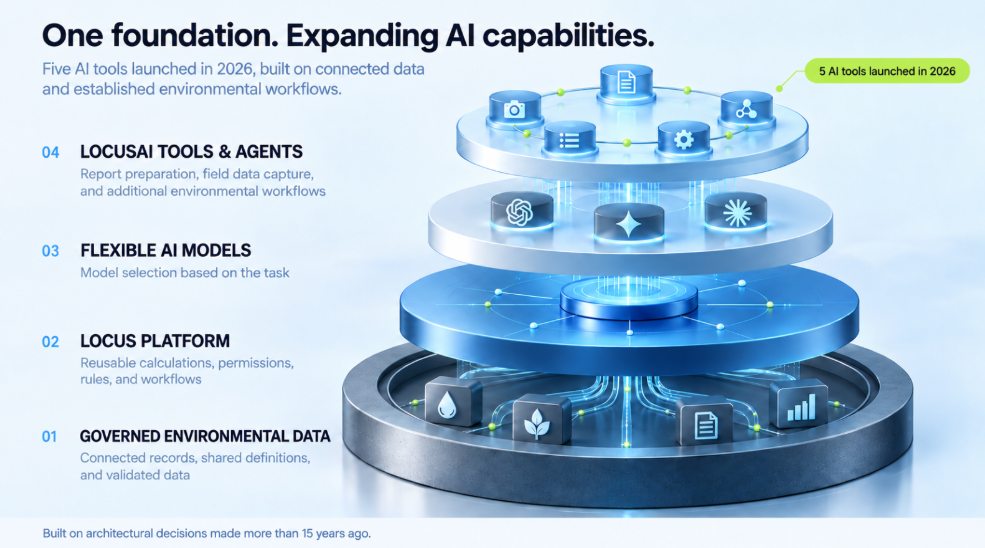
Locus Technologies organizes this approach into four layers: governed environmental data, the Locus Platform, flexible model selection (ChatGPT, Gemini, Claude), and purpose-built LocusAI agents. Each supports the next. Records supply context; Locus Platform supplies operational capabilities and controls; models help interpret the request and information; agents bring those elements together to perform defined work.
That separation also lets Locus take advantage of advances in AI without making our strategy depend on one model provider.
Each practical advance can unlock the next opportunity
Our September 2026 introduction of AI photo interpretation for Refrigerant Management shows how this approach can extend from one task to another. A technician can photograph an equipment nameplate or service record and have information extracted into the appropriate structured data fields in Locus software. Confidence scores help the technician identify values that require closer review before saving the record. [6]
This matters to the larger refrigerant scenario because the quality of a portfolio analysis begins with the information collected at individual pieces of equipment. Helping the technician capture that information reduces repetitive transcription at the source, leaving more time to inspect the equipment, recognize unusual conditions, and document observations that require experience in the field. Once reviewed and saved, those structured records become part of the information available for subsequent analysis.
The same announcement describes a reusable AI framework and flexible model selection. We can evaluate models against the work they need to perform and apply the framework to additional image and document workflows. [6]
This is how I expect meaningful progress to develop: one well-defined capability makes a real task easier, and that capability becomes part of a more complete workflow. Report preparation and field data capture give us concrete places to begin. Over time, connecting capabilities like these could allow agents to carry a customer’s request further, with fewer manual handoffs along the way.
Why independence matters when successful products evolve
An architecture that supports change is valuable only if the company building it is willing to make the change.
Locus remains founder-owned and self-funded. [7] That gives us direct control over where we invest and how we respond to this opportunity. We can align our product direction, environmental expertise, and engineering work without an outside owner’s or investor’s exit timetable. We can focus on extending our software foundation without making the integration of acquired product portfolios the central task of our strategy.
The deeper advantage is that we can question the way we have delivered value for years. We have built applications that customers trust, and we have every reason to be proud of them. Yet if an agent can prepare a report or assemble an investigation package without requiring a customer to navigate every step, we want to make that possible. Our attachment to a successful interface should never become an obstacle to a better customer experience.
Locus Technologies has ridden the wave of game-changing technical advances before. In 1999, Locus announced Internet-based environmental software with wireless data input and retrieval through devices such as the Palm Pilot. [8] Those early field tools reflected a simple conviction: information should reach the people who need it without unnecessary delay or repeated handling.
Agentic AI gives us another opportunity to pursue that conviction. The customer may interact with an agent while the software we have developed over decades performs more of the work behind the scenes. Our independence gives us the freedom to pursue that transition, and our history gives us the experience to recognize when the next form of software deserves serious investment.
Locus has spent nearly three decades building software around consequential environmental information. We now have an opportunity to put that foundation to work in a new way, combining our domain knowledge and architecture with agents that can carry out increasingly useful tasks. I believe our next chapter will be shaped by how decisively we pursue that opportunity and how much real work we help our customers accomplish.
Frequently Asked Questions
What is agentic AI in environmental software?
Agentic AI uses AI models and authorized software tools to perform defined tasks, such as preparing a report draft or assembling records for review. It can coordinate multiple steps within the workflow’s established permissions and review requirements.
How does agentic AI differ from a conversational search tool?
A conversational search tool helps find information. An agent workflow can use that information to perform further actions, such as applying a calculation, updating report tables, or preparing a review package. Its usefulness depends on the tools and controls available to it.
Why does environmental software architecture matter for AI agents?
Connected records supply the context needed to interpret information, while platform services provide calculations, permissions, and workflows. Together, these give an agent a foundation for performing work that can be checked against source records and established methods.
What AI capabilities has Locus announced?
Locus announced LocusAI Report Agent for EIM in June 2026 and AI photo interpretation for Refrigerant Management in September 2026. Both include human review. The broader conversational refrigerant review package described in this article is a prospective workflow. [5, 6]
Will AI agents replace environmental professionals?
Locus is developing agents to support environmental professionals in their jobs and expand their capacity. Professionals continue to lead investigations, interpret findings, recommend corrective action, and make accountable decisions. The announced Report Agent workflow retains human control over final review and submission. Our intent is to strengthen the professional’s role as routine preparation becomes easier.
Footnotes
[1] OpenAI, Plugins: https://developers.openai.com/plugins
[2] Locus, A Unified Foundation for EHS, Compliance, and Sustainability: https://www.locustec.com/locus-platform-unified-foundation-ehs-compliance-sustainability/
[3] Locus, Make It Your Own: https://www.locustec.com/make-it-your-own/
[4] Locus, Multitenant Architecture: https://www.locustec.com/locus-at-25-years-locus-platform-multitenant-architecture/
[5] LocusAI Report Agent announcement, June 23, 2026: https://www.locustec.com/press-release/locusai-report-agent-for-eim/
[6] AI Photo Interpretation announcement, September 22, 2026: https://www.locustec.com/press-release/locus-technologies-introduces-ai-photo-interpretation-for-refrigerant-management/
[7] Neno Duplan, 29 Years Ahead of the Curve, April 23, 2026: https://www.locustec.com/29-years-ahead-of-the-curve-environmental-compliance/
[8] Locus Internet-based software announcement, December 17, 1999: https://www.locustec.com/press-release/locus-announces-internet-based-environmental-software-suite/
Locus is the only self-funded water, air, soil, biological, energy, and waste EHS software company that is still owned and managed by its founder. The brightest minds in environmental science, embodied carbon, CO2 emissions, refrigerants, and PFAS hang their hats at Locus, and they’ve helped us to become a market leader in EHS software. Every client-facing employee at Locus has an advanced degree in science or professional EHS experience, and they incubate new ideas every day – such as how machine learning, AI, blockchain, and the Internet of Things will up the ante for EHS software, ESG, and sustainability.