By Neno Duplan, Founder and CEO, Locus Technologies
Reading Time: 12 minutes 52 seconds
There is a moment in nearly every EHS software evaluation when a vendor presents an analyst ranking, badge, quadrant position, market guide mention, or “vendor to watch” designation. The implication is clear: an “independent third party” has validated the vendor as a leader, strong performer, or emerging platform worth serious consideration.
I have watched this happen many times. Analyst reports can be useful, but buyers should understand what they measure, what they omit, and how the analyst business model may shape the final output. The problem is not that analyst reports have no value. The problem is that buyers often treat them as a substitute for architecture review, product due diligence, customer references, security assessment, and live proof of capability.
When I raised this point during a recent session with EHS practitioners, the follow-up question was predictable: “So what should we do with these reports?” The answer is not to ignore them. The answer is to read them correctly. Analyst reports are market orientation tools. They can help buyers understand vendor categories, terminology, market direction, and broad positioning. They should not be treated as evidence that a platform is the right fit for your regulatory complexity, data architecture, cybersecurity requirements, AI strategy, or long-term operating model.
What Analyst Reports Actually Measure
Reports such as the Gartner Market Guide for EHS Software and the Verdantix Green Quadrant for EHS Software are produced by reputable firms whose analysts spend significant time tracking the EHS software market. They provide useful orientation: a subset of which vendors exist, what they broadly offer, how they position themselves, and where they appear to be investing.
The methodologies behind these rankings typically consider several factors: market presence, customer base, geographic reach, product breadth, revenue scale, module coverage, financial resources, innovation narrative, strategic partnerships, and in some cases customer satisfaction scores from surveys or references.
Those inputs have value, but buyers should understand what they do not fully measure. Analyst reports generally do not test the depth of the underlying data model, the quality of environmental data validation, the maturity of configuration tools, the true deployment architecture, the number of active customer versions in production, the defensibility of regulatory calculations, or the recoverability of the platform after a cybersecurity event.
They also tend to emphasize market visibility. Large vendors with broad product portfolios, active analyst-relations teams, frequent briefings, customer-reference programs, and larger marketing budgets are naturally easier to evaluate and more visible in these reports. That visibility may indicate market momentum, but it should not be confused with architectural superiority or long-term fit.
For EHS buyers, this is the critical distinction: analyst reports can help you understand the market, but they cannot select the platform for you. They do not replace technical due diligence, live product configuration tests, security review, SOC 2 scope review, customer reference checks, data migration analysis, or proof that the vendor can manage your specific regulatory and operational complexity.
A vendor with a large sales organization, a recently announced AI roadmap, and a dedicated analyst relations team will score well on vision. A vendor that has been quietly processing enterprise-scale environmental data for 29 years but invests less in analyst relations may score lower despite being a more capable and stable platform for the use cases that matter most.
The Participation Problem
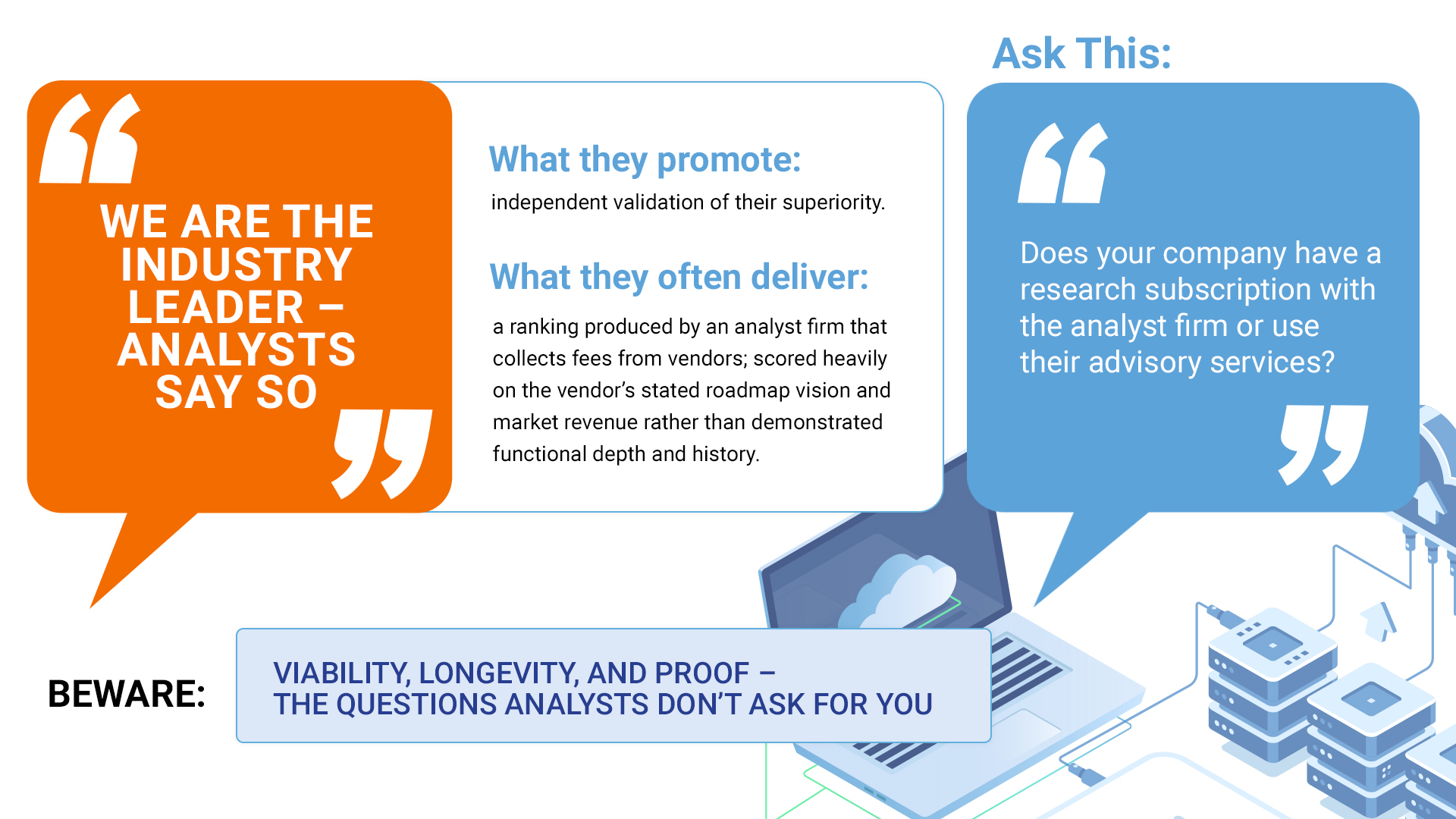
Most major EHS analyst evaluations depend heavily on vendor participation. Vendors provide briefings, submit questionnaires, share documentation, arrange customer references, and in some cases pay participation, sponsorship, or related fees to be included in the broader analyst ecosystem. The process is not automatically biased or invalid, but buyers should understand what it rewards.
It tends to reward vendors that are organized around analyst relations: companies with dedicated staff, frequent briefings, polished submissions, large marketing teams, and customer-reference programs designed for this purpose. Vendors that invest heavily in analyst engagement can improve their visibility and positioning, sometimes regardless of whether their product architecture, data model, configurability, or implementation model is the best fit for a specific buyer.
This creates an important distinction. Analyst reports often measure market presence as much as product capability. They may capture who is visible, who participates, who has the broadest narrative, who has the largest installed base, and who can produce the most complete submission package. Those are relevant inputs, but they are not the same as proving technical depth, deployment discipline, environmental data maturity, cybersecurity resilience, or regulatory defensibility.
Locus Technologies has appeared in several respected analyst evaluations. We were ranked in the top three out of more than 200 software companies evaluated in the Verdantix Smart Innovators: ESG and Sustainability Reporting and Data Management Software report. We have also been recognized in the Verdantix Green Quadrant: EHS Software report. We are not dismissing analyst recognition. We are saying buyers should understand what goes into these reports and what does not.
That distinction matters because a strong analyst position should be the beginning of due diligence, not the end of it. A ranking, badge, quadrant placement, or “vendor to watch” designation should prompt better questions: What exactly was evaluated? Was the product tested live? Was the architecture reviewed? Were customer environments inspected? Were security controls validated? Was regulatory data lineage examined? Were AI claims traced back to governed source data?
The practical advice is simple: use analyst reports as one of many maps, not as the destination. They can help buyers identify a subset of the vendors worth considering, but they cannot determine which platform will perform best under the buyer’s actual regulatory, operational, data, and security requirements. That judgment requires direct technical evaluation, live product demonstrations, reference calls, security review, and proof that the system can support the buyer’s real-world use cases.
The Five Year Stability Test
The most useful question to apply to any analyst report is not whether the report names a vendor as a leader, innovator, challenger, or strong performer. The more important question is: will this vendor still exist in its current form five years from now?
The EHS software market has gone through significant consolidation over the past decade. Platforms that ranked highly in earlier analyst reports have since been acquired, merged into larger suites, sunset in favor of replacement products, or materially altered after ownership changes. In several cases, customers selected a vendor based partly on analyst recognition, only to find themselves later facing product migrations, roadmap changes, support disruption, or forced movement from one acquired platform to another.
This is not a criticism of analysts. It is a structural feature of the market. Private equity-backed consolidation has accelerated, and the time between a vendor’s favorable position in an analyst report and a material change in ownership, strategy, product direction, or support model can be shorter than a typical EHS software contract term.
That creates a real buyer risk. EHS platforms are not disposable applications. They hold regulatory records, incident histories, environmental data, audit trails, permits, inspections, emissions calculations, discharge reports, sustainability metrics, and sometimes decades of defensible compliance evidence. Once implemented, they become part of the organization’s operating infrastructure. A change in vendor ownership, product strategy, or platform roadmap can therefore affect much more than software licensing. It can affect compliance continuity.
Buyers should ask stability questions directly. Who owns the vendor? Has the company changed ownership in the last five years? Is the vendor private equity-backed? Has it acquired other EHS products, and if so, which platform is strategic going forward? Are customers being migrated from older products to newer ones? What percentage of R&D is being spent on the evaluated platform versus legacy products? What is the vendor’s long-term roadmap, and is it contractually meaningful or merely aspirational?
The five-year stability test is simple: if you select this platform today, can you reasonably expect the same product, company, architecture, support model, and roadmap to remain intact through the life of your implementation and first renewal cycle? If the answer is unclear, the analyst ranking should carry less weight. A strong report position may help a vendor get on the shortlist, but long-term stability should determine whether the vendor belongs in your enterprise architecture.
What Analyst Reports Cannot Tell You
There are several dimensions of vendor quality that analyst reports cannot reliably assess and that buyers must evaluate directly:
- Ownership stability and investment horizon. Whether the vendor is founder-led, private equity-backed, or part of a larger portfolio is not typically disclosed in analyst reports in a way that reflects buyer risk. It is among the most consequential facts for any buyer signing a multi-year contract.
- Long-term customer renewal rates.Analyst reports can reference customer satisfaction surveys, but they do not systematically report the percentage of customers who have continuously renewed for five, seven, or ten years. That is one of the clearest measures of whether a platform delivers on its promises over time, especially outside the typical term of a private equity acquisition and subsequent resale cycle.
- Technical architecture depth.The difference between a true multitenant platform and a single-tenant hosted platform, or between a unified data layer and a set of integrated legacy products, is rarely evaluated with sufficient technical rigor. Buyers must test architecture directly, not assume it from a report.
- Module depth versus module coverage.Analyst reports often confirm that a vendor offers a module in a given area. They do not consistently assess the depth of that module. A vendor may offer an environmental module, but that does not mean it has native laboratory data integration, regulatory calculation engines, PFAS compound management, water quality data infrastructure, or long-term environmental record defensibility.
- The experience level of the individual analyst.Buyers should ask who performed the evaluation and what direct experience that analyst has with EHS software, environmental compliance, safety operations, ESG reporting, SaaS architecture, and enterprise implementations. Analyst firms can have short employee tenure, and the person scoring the vendors may be applying a spreadsheet or evaluation framework created by someone else. That does not make the work useless, but it should make buyers cautious. A report is only as strong as the judgment, experience, and technical understanding behind it.
- The analyst’s ability to test real-world implementation risk.A report may compare vendors at a market level, but it usually cannot determine how well a specific platform will perform after data migration, configuration, integration, user adoption, regulatory reporting, and operational change management. Those risks show up during implementation and long-term use, not in a vendor briefing.
Buyers should ask analyst firms the same type of due-diligence questions they ask software vendors: Who conducted the review? How long has that analyst covered EHS software? What was their prior operational or technical experience? Did they test the product live, or rely primarily on vendor briefings and questionnaires? Did they validate customer claims independently? Did they evaluate architecture, data quality, AI readiness, and cybersecurity resilience, or mainly score features and market presence?
That does not mean analyst reports should be ignored. It means they should be treated as informed market inputs, not as final answers. In EHS software, the buyer still has to perform the hard work: evaluate the platform, test the architecture, verify the data model, inspect security evidence, challenge the roadmap, and speak with long-term customers.
A More Useful Approach to Analyst Input
Use the Gartner Market Guide for EHS Software and the Verdantix Green Quadrant: EHS Software report to accelerate your initial research and develop a broad view of the market. These reports can help buyers understand which vendors are active, how vendors position themselves, how to identify similar vendors not showcased in the report, what product categories are converging, and where the market appears to be heading.
But analyst reports should be treated as inputs, not conclusions. A leadership position, favorable profile, or “vendor to watch” designation does not prove that the platform is the right fit for your organization’s regulatory complexity, data architecture, cybersecurity requirements, AI strategy, or long-term operating model.
The claims that analyst reports reward — platform breadth, vision, market presence, customer references, innovation narrative, and module coverage — are not the same claims that determine whether a platform can produce a defensible discharge monitoring report, manage PFAS data across decades, maintain a validated environmental system of record, recover from ransomware, or keep all customers on the same current production version.
Buyers should also remember that analyst reports do not cover every vendor, every capability, or every implementation reality. The vendor that is best for your organization may not be positioned where you expect, and in some cases may not be referenced prominently in the report at all. Absence from a quadrant or limited analyst visibility should not automatically disqualify a vendor, just as strong placement should not automatically qualify one.
The better approach is to use analyst input to form better questions. If a vendor is highly ranked, ask what was actually evaluated. Was the architecture tested? Was the product configured live? Were regulatory calculations reviewed? Was the environmental data model inspected? Was the SOC 2 Type 2 scope examined? Were long-term customers interviewed? Were AI claims traced back to validated source data? Were disaster recovery and ransomware recovery capabilities verified?
Analyst reports can tell you how a vendor appears in the market. They cannot tell you whether that vendor will perform inside your enterprise. That determination still requires direct technical due diligence, live demonstration, customer reference checks, security review, implementation planning, and proof that the platform can support your real data, real workflows, real regulatory obligations, and real risk profile.
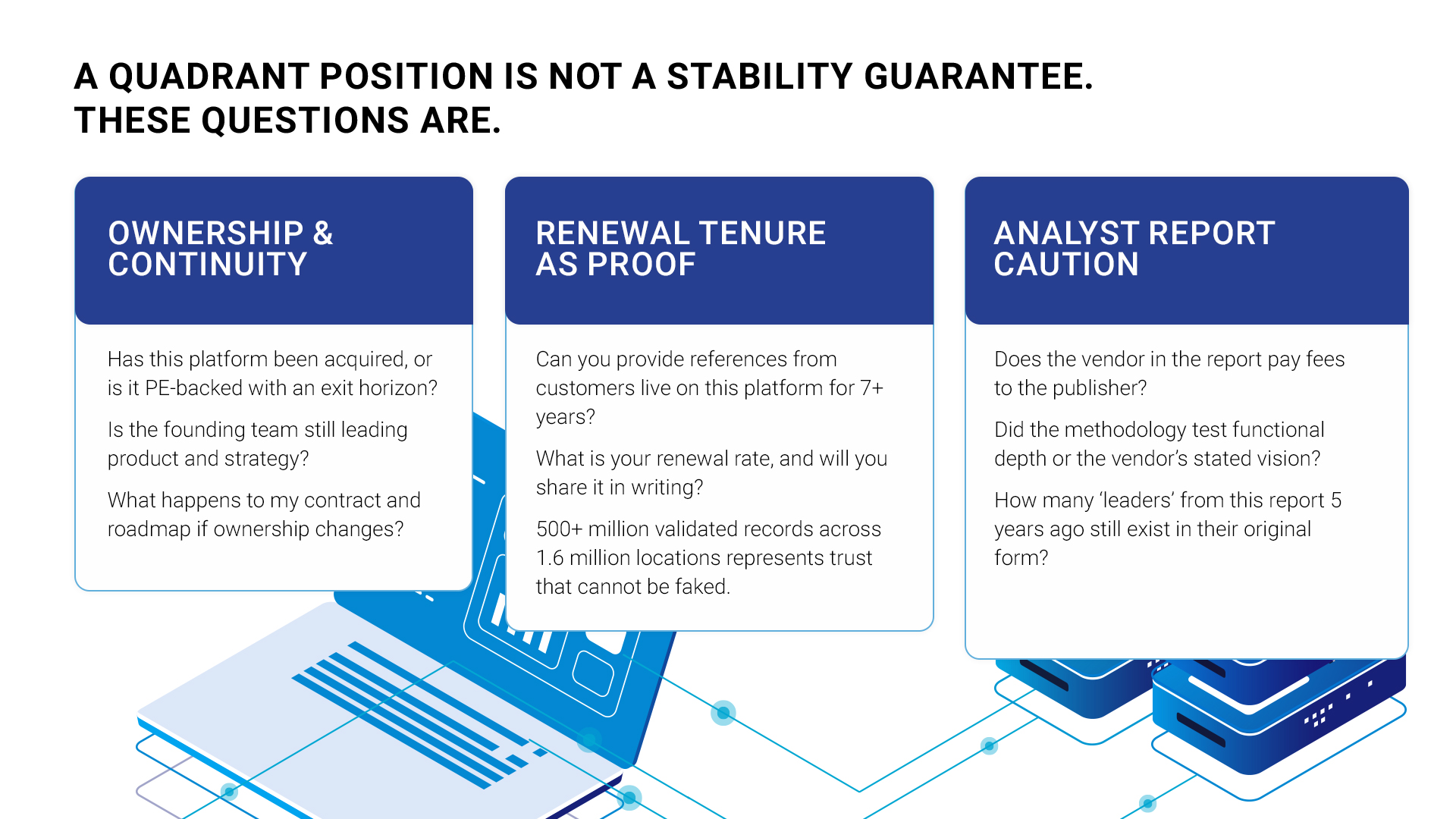
Questions to Ask Before You Buy
- “Does your company subscribe to the analyst firm’s research service or engage the firm’s advisory services?”
- “How many of the companies ranked in the same tier as you in that report five years ago still exist in their original form, with the same product and ownership structure?”
- “Has your company been acquired, or are you currently backed by private equity? What is the investment plan and timeline?”
- “Can you provide three references from customers who have continuously renewed on this specific platform for seven or more years — not on any version of the product, but this platform?”
- “What is your net revenue retention rate over the past three years, and are you willing to include that metric in the contract discussion?”
A Call to Action for Serious Buyers
The complete EHS software buyers guide at locustec.com includes a full section on vendor stability evaluation — the ownership, tenure, and financial health questions that analyst reports do not answer and that belong in every serious RFP. If you are comparing top EHS SaaS providers and want a framework that goes beyond market positioning to operational reality, the guide is a useful starting point. To get a copy via email, send us a note at info@locustec.com.
Frequently Asked Questions
Are the Gartner Market Guide for EHS Software and the Verdantix Green Quadrant: EHS Software report useful for EHS software buying decisions?
Both reports are useful for getting a baseline understanding of how a subset of vendors position themselves in the market. They are less useful for assessing technical architecture depth, data governance quality, and vendor stability — the dimensions that most affect platform performance over a multi-year contract. Use these reports as orientation tools, then apply technical and financial due diligence questions to your shortlist, inclusive of products identified through other sources.
What is the difference between a vendor’s analyst ranking and its actual platform capability?
Analyst rankings reflect a combination of market presence, product breadth, stated roadmap, and the quality of the vendor’s analyst engagement. They do not systematically assess architectural depth, data validation infrastructure, module-level technical capability, or the vendor’s financial stability and ownership structure. These latter factors require direct evaluation.
How has EHS software market consolidation affected the reliability of analyst rankings?
Consolidation has shortened the time between a vendor’s peak analyst ranking and a materially changed product or ownership situation. Several platforms that were prominent in analyst reports five years ago have since been acquired, rebranded, or restructured in ways that changed the product roadmap significantly. Buyers should ask specifically about ownership history and stability, how their contracts will be affected if vendor ownership changes, and they should review references from customers who signed contracts at least five years ago.
What questions should I ask an EHS vendor that cites an analyst report as evidence of quality?
Ask whether the vendor subscribes to the analyst firm’s research service or advisory service. Ask what methodology was used to assess functional depth, how many of the vendors ranked alongside them in that report still exist in their original form, and whether the ranking reflects demonstrated capability or stated roadmap. Then ask the vendor for evidence of long-tenure customer renewals, which is a more direct measure of delivered value than any analyst placement.
How do I evaluate vendor stability when comparing top EHS SaaS providers like VelocityEHS, Cority, Intelex, Enablon, Sphera, and Locus Technologies?
Ask each vendor directly about their ownership structure, investment history, and any pending acquisition or funding activity. Request the names of customers who have continuously renewed for seven or more years and ask those references specifically about changes they experienced in product direction, support quality, or roadmap focus following any ownership changes. A founder-led, self-funded company with no acquisition history presents a meaningfully different stability profile than a PE-backed platform in its third ownership cycle.
What should buyers ask if a vendor is not highly ranked or not included in an analyst report?
Ask why. The vendor may be smaller, more specialized, less active in analyst relations, less willing to participate in pay-to-play ecosystems, or focused on technical depth rather than market visibility. Lack of strong analyst placement should not automatically disqualify a vendor. It should prompt the buyer to perform direct due diligence and compare evidence, not reputation.
How do I evaluate vendor capability when comparing top EHS SaaS providers like VelocityEHS, Cority, Intelex, Enablon, Sphera, and Locus Technologies?
Evaluate each vendor against your actual risk profile, not against generic market categories. If your primary need is safety workflow, incident management, audits, and training, workflow breadth may matter most. If your risk includes environmental compliance, PFAS, water quality, air emissions, waste, permits, regulatory reporting, ESG disclosures, and long-term liability, environmental data architecture becomes far more important. Buyers should require live demonstrations, architecture proof, customer references, SOC 2 review, data-model depth, configuration testing, and evidence that the platform can support their real regulatory obligations over many years.
Locus is the only self-funded water, air, soil, biological, energy, and waste EHS software company that is still owned and managed by its founder. The brightest minds in environmental science, embodied carbon, CO2 emissions, refrigerants, and PFAS hang their hats at Locus, and they’ve helped us to become a market leader in EHS software. Every client-facing employee at Locus has an advanced degree in science or professional EHS experience, and they incubate new ideas every day – such as how machine learning, AI, blockchain, and the Internet of Things will up the ante for EHS software, ESG, and sustainability.