By Sara Zekić
Reading Time: 7 minutes
TL;DR: EU F-gas compliance starts with accurate equipment-level data. Refrigerant type, charge, GWP, equipment category, hermetic status, and leakage detection determine whether an asset requires leak checks and how often. Those determinations must then flow into inspections, repairs, verification, technician records, recovery, and record retention. Purpose-built refrigerant management software can calculate key obligations, schedule recurring work, standardize mobile field records, and preserve the evidence operators need for internal reviews and regulatory inspections.
What does the EU F-Gas Regulation require from equipment operators?
The European Union has set an ambitious direction for fluorinated greenhouse gases. Regulation (EU) 2024/573 strengthens emissions prevention, expands the gases and equipment covered, accelerates the HFC phasedown, and extends lifecycle responsibilities. The European Commission says HFCs are scheduled to be phased out in the EU by 2050, with stricter rules intended to prevent releases during transport, installation, service, and disposal.
For an equipment operator, however, the regulation rarely arrives as one simple task. It comes as hundreds or thousands of asset-level decisions. Does this chiller require leak checks? Which interval applies? Does a leakage detection system change that interval? Who may perform the work? What must be documented after a repair? How long must the records remain available?
Those questions are hard to answer consistently when equipment information lives in spreadsheets, contractor files, maintenance systems, paper logbooks, and individual inboxes. A company may know that it owns a cooling asset and still lack the data needed to determine what the asset requires.
What equipment data determines F-gas leak-check requirements?
Six data points do much of the regulatory heavy lifting:
- The refrigerant and its classification under the regulation
- The refrigerant charge in kilograms
- The refrigerant’s global warming potential, or GWP
- The equipment category and use
- Whether the equipment is hermetically sealed
- Whether a qualifying leakage detection system is installed.
For Annex I gases, tonnes of carbon dioxide equivalent are calculated as:
tonnes CO₂e = refrigerant charge in kg × GWP ÷ 1,000
That calculation matters because a small charge of a high-GWP gas can create a larger regulatory obligation than a greater quantity of a lower-GWP gas. Article 5 leak-check requirements generally begin at 5 tonnes CO₂e for Annex I gases and at 1 kilogram for gases listed in Section 1 of Annex II. Hermetically sealed equipment and electrical switchgear require additional logic.
Once equipment is in scope, the standard inspection interval depends on the amount of gas. For Annex I gases subject to leak checks, the main bands are 5 to less than 50 tonnes CO₂e, 50 to less than 500 tonnes CO₂e, and 500 tonnes CO₂e or more. These generally correspond to checks every 12, 6, or 3 months. A qualifying leakage detection system can extend those intervals to 24, 12, or 6 months. Section 1 of Annex II uses similar intervals with mass-based bands.
This is exactly where manual management becomes fragile. A field change to the refrigerant, charge, equipment status, or detection system can alter the required schedule. The asset record, calculation, and task calendar must remain connected.
Why recurring deadlines create disproportionate risk for F-gas compliance
The inspection interval is only one clock. The regulation also creates related events that can be easy to overlook across a large facility network.
- After a leak repair, covered stationary equipment generally must be checked after at least 24 operating hours and no later than one month after the repair to verify that the repair was effective.
- Qualifying leakage detection systems on covered stationary equipment generally require their own recurring functional checks.
- Equipment records must capture gas quantities, additions, refrigerant recovery, service providers, leak checks, repairs, and decommissioning activity.
- Refrigerant record retention is generally required for at least five years for operators and service undertakings.
- Work involving covered equipment must be assigned to certified technicians or other appropriately certified natural persons and, where applicable, certified legal persons.
- Recovered gases must be documented for recycling, reclamation, or destruction when equipment is decommissioned.
One missed date can reveal a broader problem during an audit: incomplete equipment records, an expired credential, a disconnected service history, or a process that depends on one person’s calendar. The operational challenge is maintaining continuity from the first regulatory determination through every later service event.
How can refrigerant management software support F-gas compliance?
A strong workflow carries the regulatory logic into daily work instead of leaving facility teams to interpret it repeatedly.
- Build the asset record. Capture equipment identity, location, category, refrigerant, charge, GWP, hermetic status, leakage detection, and other characteristics required to evaluate the asset.
- Calculate the obligation. Use the refrigerant and charge to calculate tonnes CO₂e where applicable, determine whether leak checks apply, and assign the proper inspection frequency.
- Create the schedule. Convert the result into tasks, due dates, alerts, and visible action lists for facilities, technicians, and environmental teams.
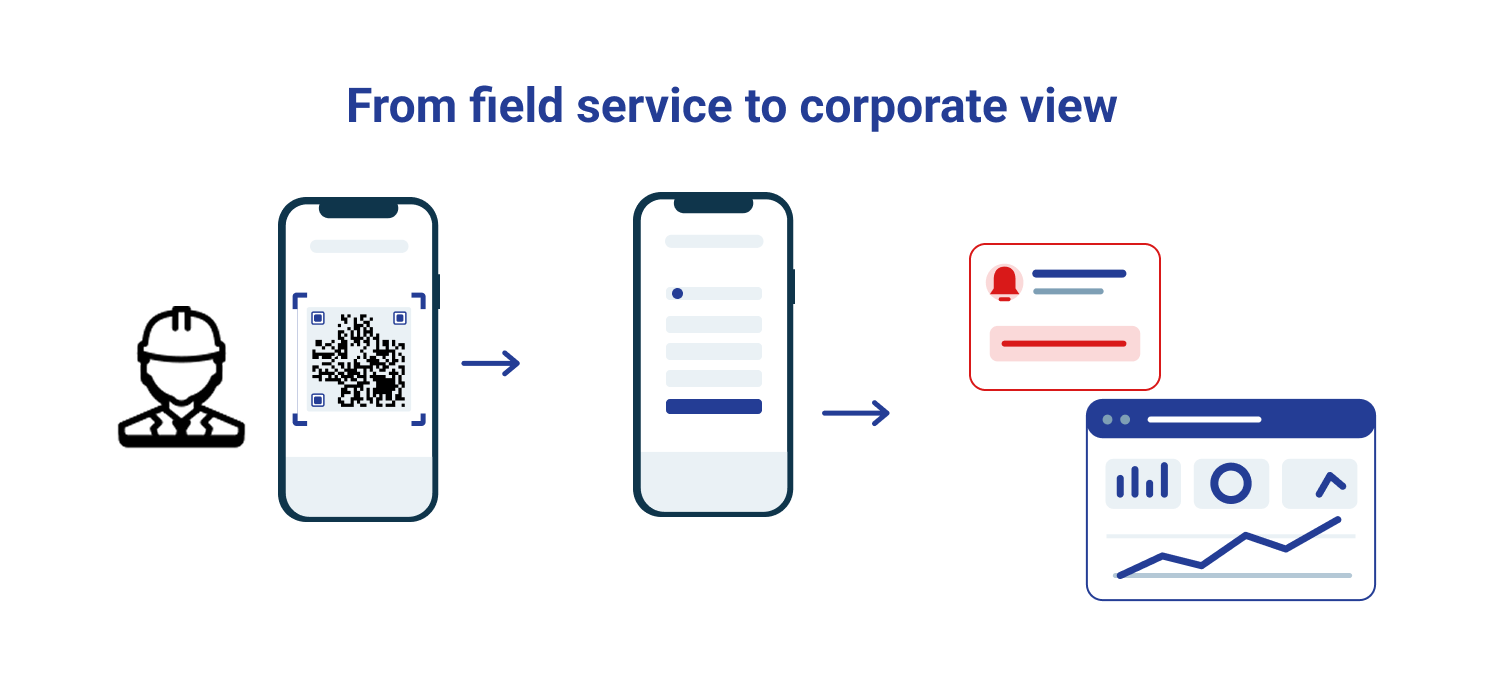
- Standardize field work. Give technicians and contractors mobile service forms tied to the correct asset. QR code scanning can open the equipment record, while optical character recognition can accelerate capture of nameplate data.
- Preserve the evidence. Connect leak discovery, repair, verification, refrigerant additions and recovery, technician credentials, documents, approvals, and decommissioning to one audit trail.
Locus Refrigerant Management follows this model. Its EU configuration calculates tonnes CO₂e, evaluates leak-check applicability, assigns inspection frequencies, and connects the result to service schedules, dashboards, and records. It also supports refrigerant inventory and cylinder movement, technician and contractor certifications, automatic leakage detector records, and emissions reporting.
For repair verification, the EU configuration states the requirement, records verification dates, and allows users to schedule the follow-up task manually.
Why localization changes the regulatory logic
EU localization reaches far beyond kilograms, date formats, and terminology. It changes the calculations, classifications, inspection triggers, exceptions, credential records, and logbook content that govern the workflow.
The initial Locus EU configuration supports the common operator framework under Regulation (EU) 2024/573, particularly the equipment and facility activities addressed in Articles 4 through 8. An individual deployment must also consider national enforcement, registrations, reporting systems, penalties, and other Member State requirements. Locus can configure forms, terminology, approvals, escalations, internal standards, and additional local workflows as customer needs are defined.
This distinction matters as requirements evolve. When regulatory logic is maintained through controlled configuration, teams can assess a change, update the applicable rule matrix, test threshold scenarios, document the effective date, and communicate the update without rebuilding the entire system. The same configurability can support internal company standards that are more stringent than a legal minimum.
How does mobile refrigerant tracking improve F-gas records?
The compliance record is only as reliable as the information captured in the field. Paper logs create transcription work. Generic maintenance notes may omit the gas quantity, recovery disposition, certificate number, or verification result needed later. Contractor formats can vary from one facility to the next.
Locus Mobile gives facility teams and contractors access to standardized forms from the equipment location. A QR code can associate a service entry with the correct asset, and required fields can prompt the user for the details that matter. Once submitted, the information becomes available to the same dashboards, schedules, reports, and audit history used by environmental and corporate teams.
That continuity reduces duplicate entry and gives each organizational level an appropriate view of the same underlying data, from the technician recording a repair to the leader reviewing open leaks, refrigerant losses, and emissions across facilities.
The same data can guide emissions and equipment decisions
Reliable refrigerant records have value beyond the compliance calendar. Refrigerant losses can support Scope 1 fugitive-emissions calculations. Leak history can identify assets that consume excessive service time or refrigerant. GWP, age, repair frequency, and availability of lower-impact alternatives can inform conversion and replacement plans.
How can multinationals manage EU and US refrigerant requirements?
For multinational companies, a common data foundation also makes regional programs easier to compare. EU and US operations can use jurisdiction-specific calculations and workflows while maintaining a consistent equipment hierarchy and a consolidated global view. The result is local execution supported by shared corporate visibility of global refrigerant tracking.
The practical goal is simple: turn each legal criterion into reliable data, turn that data into the right action, and preserve the evidence that the action occurred. When those steps stay connected, refrigerant compliance becomes easier to manage, explain, and improve.
Explore Locus Refrigerant Management to see how purpose-built software can support EU refrigerant compliance workflows across facilities.
Frequently Asked Questions
What data is needed to determine EU F-gas leak-check requirements?
Operators typically need the refrigerant, charge, GWP, regulatory annex classification, equipment category, hermetic status, and leakage detection status. Together, these facts determine whether an asset is in scope, which exceptions may apply, and how often it must be checked.
How are tonnes of CO₂ equivalent calculated for refrigerants?
For Annex I gases, multiply the refrigerant charge in kilograms by the refrigerant’s GWP, then divide by 1,000. The result is tonnes CO₂e. This value is central to determining leak-check thresholds and inspection frequency for many covered assets.
How often are F-gas leak checks required?
For Annex I gases subject to leak checks, the standard intervals are generally every 12 months from 5 to less than 50 tonnes CO₂e, every 6 months from 50 to less than 500 tonnes CO₂e, and every 3 months at 500 tonnes CO₂e or more. A qualifying leakage detection system can extend the intervals to 24, 12, or 6 months. Applicability thresholds, equipment categories, and exceptions must also be evaluated.
Can one refrigerant management system support both EU and US operations?
Yes, if the system maintains a common equipment and refrigerant data foundation while applying separate regulatory logic for each jurisdiction. Locus offers EU and US configurations on one platform, allowing local teams to follow the appropriate workflows while corporate users view consolidated data across regions.
Regulatory note: This article provides general information about Regulation (EU) 2024/573 and software-supported workflows. It does not constitute legal advice or replace an operator’s responsibility to evaluate applicable EU and Member State requirements.
Locus is the only self-funded water, air, soil, biological, energy, and waste EHS software company that is still owned and managed by its founder. The brightest minds in environmental science, embodied carbon, CO2 emissions, refrigerants, and PFAS hang their hats at Locus, and they’ve helped us to become a market leader in EHS software. Every client-facing employee at Locus has an advanced degree in science or professional EHS experience, and they incubate new ideas every day – such as how machine learning, AI, blockchain, and the Internet of Things will up the ante for EHS software, ESG, and sustainability.