By Neno Duplan, Founder and CEO, Locus Technologies
Reading Time: 10 minutes
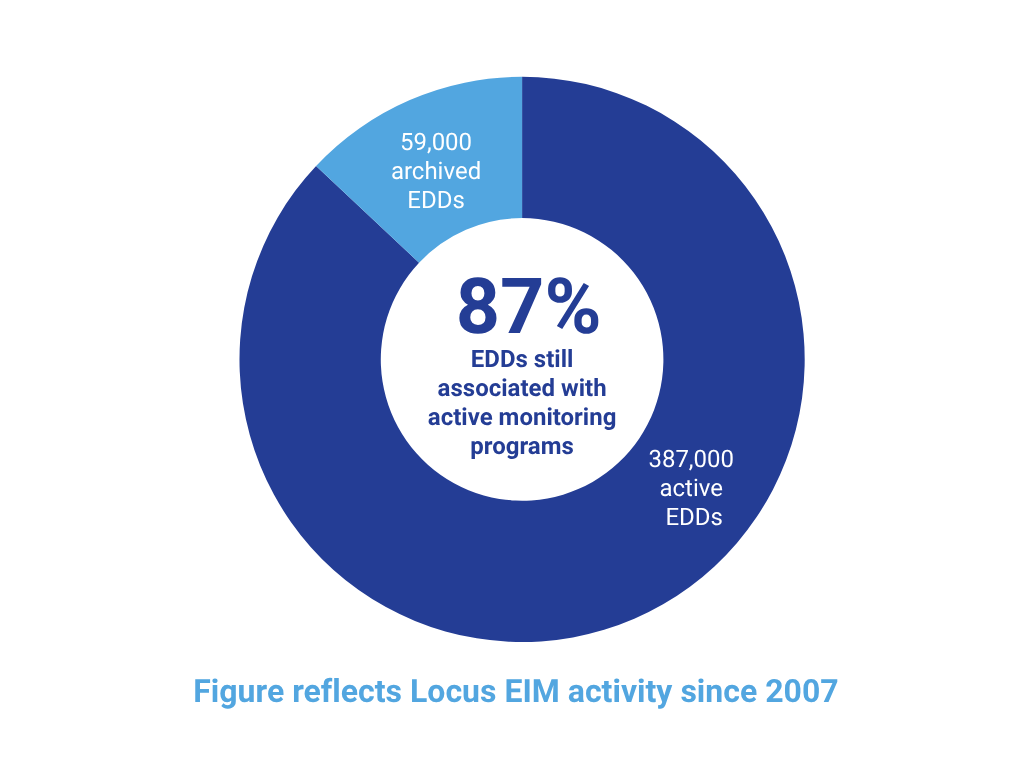
TL;DR: Companies should retain as much validated environmental monitoring data as practical for as long as practical, subject to applicable legal, contractual, privacy, and records-management requirements. They should also keep that history accessible to current analytical tools. Approximately 87% of the 446,000-plus EDDs submitted through Locus EIM since 2007 remain associated with active monitoring programs. Long records strengthen trend analysis, regulatory defensibility, remediation decisions, litigation response, monitoring optimization, institutional memory, and AI performance. Moving older results into an inaccessible archive may save a modest amount while removing the context that creates much of the data’s future value.
Should older environmental data remain available after the report is filed?
Yes. Environmental data often becomes more useful as the record grows. A current result gains meaning when it can be compared with prior seasons, methods, locations, operating conditions, and regulatory thresholds. Companies should keep as much high-quality environmental data as is practical, retain it for as long as practical, and preserve active analytical access. Legal minimums should be treated as the floor for compliance, not an automatic definition of analytical value.
Environmental data does not age like an expense report
Some business records have a short, useful life. A travel receipt may serve its accounting and audit purpose, pass its retention period, and contribute little to future decisions. An environmental result is different.
A groundwater chemical concentration measured in 2009 can help explain whether a 2026 result represents a new release, a seasonal fluctuation, a laboratory difference, plume migration, rebound after treatment, or part of a long decline. Its value comes from comparison, and comparison improves with time.
This is visible in Locus EIM activity. Of more than 446,000 EDDs submitted since 2007, approximately 387,000, or 87%, remain associated with active monitoring programs. Four independently maintained datasets in the analyzed population span 15 to 23 years. Active record volume has grown nearly sevenfold since 2007.
The number does not establish a universal retention rule. It does show how often old data remains relevant to current environmental work.
What does “87% still active” mean?
It means the data continues to participate in monitoring programs rather than sitting as a closed historical artifact. The records may support current querying, reporting, mapping, validation context, remediation analysis, or ongoing program management.
This distinction is important. A backup is not the same as an active historical record. A PDF report may preserve a conclusion while losing the structured results needed for a new analysis. A cold archive may technically retain the data while making it too slow, expensive, or difficult to use.
For historical environmental data to remain an asset, it should stay:
- Searchable across current and prior periods
- Connected to stable locations, samples, analytes, methods, units, and facilities
- Accompanied by qualifiers, detection limits, validation status, and quality-control context
- Traceable to its source file, laboratory, sampling event, and review history
- Available to the same reporting, statistical, GIS, and AI tools used for current data.
How does historical environmental data create value?
It makes trends more defensible
Three points can draw a line, but they rarely establish a reliable environmental trend. Longer records help scientists evaluate seasonality, autocorrelation, outliers, step changes, method transitions, and the difference between a temporary fluctuation and a persistent direction. EPA describes consistent, high-quality long-term monitoring data as a cornerstone for assessing whether environmental programs are producing their intended effects.
The principle applies at the facility and portfolio level. More years of comparable data create a stronger baseline and improve the ability to detect meaningful deviation.
It supports monitoring optimization
Historical depth can reveal locations and constituents that have produced stable, declining, or consistently non-detect results over many sampling events. That evidence can support a technical review of whether every existing monitoring frequency remains necessary.
This is a crucial distinction for data strategy. Organizations should retain the accumulated data even when analysis later supports collecting some future samples less frequently. The history is what makes the optimization case possible.
The goal is to collect future data more intelligently while preserving the evidence already earned.
It improves regulatory and legal defensibility
Audits, enforcement questions, permit negotiations, property transactions, and litigation rarely arrive on the schedule anticipated when a sample was collected. A long record can show what the organization knew, when it knew it, how a result was validated, what actions followed, and whether conditions changed.
A table copied into an old report may not preserve enough detail to reconstruct that chain. Structured data with lineage can.
It protects institutional memory
The median customer tenure within the analyzed Locus sample is 11 years, and approximately one third of customers have 15 or more years of tenure. Individual employees, consultants, laboratories, owners, and regulators may change several times over a program’s life. Historical data serves as a form of operational memory. Stable identifiers, annotations, validation decisions, and linked documents preserve context that otherwise leaves with people.
It gives AI enough context to be useful
AI excels at recognizing patterns, retrieving relevant context, and making complex datasets easier to interrogate. Its answer can only reflect the evidence it can access.
Suppose an environmental manager asks:
“Which locations show a statistically meaningful increase relative to their historical range?”
A system with twelve months of data may find the highest recent values. A system with twelve years can evaluate typical variability, seasonality, prior excursions, method changes, and persistent movement.
Long-term data also allows AI-assisted systems to:
- Compare current results with location-specific history
- Identify recurring laboratory or data-quality problems
- Screen a portfolio for monitoring optimization candidates
- Find analogous conditions at other facilities
- Summarize how a plume or discharge profile changed over time
- Retrieve the evidence behind a regulatory response.
More history provides value when it is governed, relevant, and high quality. Those conditions expand what a dependable system can learn and explain.
What is the hidden cost of an inaccessible archive?
The savings from a storage invoice are clear. The lost value from limited analytical options is not.
An organization may archive historical records to reduce database size, simplify a migration, or avoid paying a vendor for higher capacity. Years later, a team may need that history for a permit renewal, claim, trend analysis, acquisition, emerging-contaminant review, or an AI initiative.
The organization then pays again to locate, extract, interpret, clean, remap, and reload its own data. Some context may never be recovered.
Common losses include:
- Detection limits separated from results
- Qualifiers flattened or inconsistently translated
- Location identifiers changed during migration
- Method and laboratory fields omitted
- Rejected results mixed with usable results
- Chain-of-custody and validation records stored elsewhere
- Historical units converted without retaining the original value.
The cheapest archive can become the most expensive source for a future analysis.
How should retention rules and analytical value work together?
Environmental record-retention requirements vary widely. They can be defined by statutes, regulations, permits, consent decrees, grants, contracts, corporate policies, litigation holds, and site-specific obligations. Legal counsel and qualified records professionals should determine the controlling requirements.
The strategic decision sits alongside that legal analysis: how much history should remain available because it continues to create scientific, operational, and evidentiary value?
A sensible framework has three layers.
1: Preserve required records
Meet every applicable retention, preservation, legal-hold, and privacy obligation. Maintain authorized disposition controls and document the policy.
2: Retain the analytical record beyond minimum periods where value persists
For environmental monitoring, remediation, water quality, emissions, waste, and exposure data, value often persists for decades. Keep the structured history when it supports trend analysis, future regulatory questions, site management, optimization, or AI.
3: Govern data quality and accessibility
Retention without governance creates a data swamp. Preserve authoritative records, provenance, metadata, quality status, and stable identifiers. Remove verified duplicates and temporary processing artifacts under controlled rules. Keep the scientific record intact.
What should companies ask during a data migration?
Migration projects are a common point of historical loss. Scope and pricing can quietly encourage the organization to move only “active” years, recent facilities, or summarized results.
Prospective buyers should ask:
- Can the platform migrate our complete structured history, including qualifiers, detection limits, methods, validation status, and source lineage?
- Will historical and current records use the same master-data model?
- Can users query all years through the same interface without restoring an archive?
- How will changed location names, analyte codes, units, methods, and laboratory formats be reconciled without erasing original context?
- Can the vendor prove that high-volume customers maintain decades of usable data with acceptable performance?
- If we leave, can we export the complete record in a documented, reusable structure?
A migration that saves money by abandoning history may undermine the monitoring optimization, analytics, and AI business cases used to justify the new platform.
The compounding return on environmental history
Every validated result has immediate value. It supports a decision, report, investigation, or obligation. When retained with comparable historical data, it also adds another point to a larger picture.
That larger picture becomes more capable over time. It can reveal slow change, support a stronger optimization case, reconstruct a decision, train a better screening model, or answer a question nobody had thought to ask when the sample was collected.
Environmental teams should be selective about future sampling when the science supports it. They should be ambitious about preserving the resulting knowledge.
Keep the data. Keep the context. Keep both within reach.
A long-term record creates the context professionals need to investigate conditions, identify trends, and make better decisions—see what environmental professionals are actually doing with their data. Keeping environmental history accessible is only valuable if the platform can reliably manage, validate, and analyze it at scale—see how buyers can tell whether environmental software is truly proven.
Frequently Asked Questions
How long are companies legally required to keep environmental records?
There is no single retention period for all environmental data. Requirements vary by law, regulation, permit, program, contract, consent decree, jurisdiction, and legal circumstance. Organizations should obtain qualified legal and records-management guidance for the specific record class.
Should environmental data be kept longer than the legal minimum?
Often, yes. Legal minimums address required preservation. Historical environmental data may continue to support trend analysis, remediation, optimization, audits, claims, transactions, AI, and institutional memory long after a minimum period ends.
Is cold storage enough for old environmental data?
Cold storage can be part of a resilient architecture, but the data should remain discoverable and reusable. If older records cannot be queried with current data, retain their metadata and lineage, or be restored promptly without reconstruction, much of their analytical value is lost.
Does keeping more data make AI analysis better?
More relevant, validated, well-governed data generally gives AI and statistical tools more context. Volume alone is insufficient. Quality status, metadata, stable identifiers, temporal depth, and source traceability determine whether the additional history improves the analysis.
Should companies keep every environmental file forever?
They should preserve the authoritative scientific and compliance record according to legal requirements and long-term value. Controlled governance can remove duplicates, temporary files, and non-record artifacts. The objective is a complete, trustworthy record, rather than indiscriminate accumulation.
Locus is the only self-funded water, air, soil, biological, energy, and waste EHS software company that is still owned and managed by its founder. The brightest minds in environmental science, embodied carbon, CO2 emissions, refrigerants, and PFAS hang their hats at Locus, and they’ve helped us to become a market leader in EHS software. Every client-facing employee at Locus has an advanced degree in science or professional EHS experience, and they incubate new ideas every day – such as how machine learning, AI, blockchain, and the Internet of Things will up the ante for EHS software, ESG, and sustainability.