By Neno Duplan, Founder and CEO, Locus Technologies
Reading Time: 9 minutes
TL;DR: Environmental reporting remains essential, yet Locus EIM usage shows that professionals increasingly begin their work by asking their own questions. The share of sessions starting with a self-built Expert Query rose from approximately 9% in 2014 to nearly 28% in 2025. Formatted reports still account for roughly one quarter to one third of landing-page activity, while work is distributed across querying, mapping, chain-of-custody management, field logistics, and regulatory reporting. This measured shift toward self-service investigation creates a strong foundation for AI-assisted analysis, provided the underlying data is validated, governed, and historically complete.
Are environmental teams mainly running reports, or are they analyzing data themselves?
They are doing both, and the balance is changing. Reporting remains a core environmental workflow, accounting for approximately 25% to 30% of Locus EIM landing-page activity. At the same time, the share of sessions beginning with a user-built Expert Query increased from about 9% in 2014 to nearly 28% in 2025. The pattern suggests growing demand for direct, self-service investigation alongside standard compliance outputs.
The first click tells us something
Software usage data cannot tell us everything a scientist was thinking. It can show where the work began.
For years, environmental data systems were often evaluated by the reports they produced. Could the system generate the required table? Could it format a discharge monitoring report? Could it export the laboratory results? Those questions remain important because compliance work ends in documented outputs.
The opening move is changing, however. A growing share of Locus EIM sessions begins with Expert Query, a tool that allows users to construct their own searches across environmental data on a single site or portfolio of sites.
In 2014, approximately 9% of sessions started there. By 2025, the share was nearly 28%.
That is more than a threefold increase in the proportion of sessions that begin with a self-directed question.
What does growth in custom environmental queries mean?
It does not prove that users are demanding generative AI. It demonstrates something more fundamental: environmental professionals increasingly expect direct access to their data and the ability to investigate without waiting for a new fixed report.
That behavior can support several interpretations.
Users are asking questions that templates cannot anticipate
Standard reports answer recurring questions. Custom queries answer the question that emerged ten minutes ago:
- Which PFAS results exceeded a selected threshold at active locations during the last eight quarters?
- Which wells show rising concentrations after accounting for qualifiers and detection limits?
- Which laboratory deliverables are late or contain recurring validation failures?
- Which locations have five or more years of stable non-detect results?
- Which analytes appear in one business unit’s program and not another’s?
Environmental work is full of exceptions, comparisons, and changing lines of inquiry. A finite report library cannot anticipate all of them.
Data literacy is moving closer to the practitioner
When users can filter, join, group, and retrieve their own data, investigation moves closer to the person who understands the site, method, permit, or process. This can reduce the time between noticing a problem and testing a hypothesis.
It also changes the role of the environmental data and compliance manager. The job becomes less about producing every answer manually and more about maintaining the governed structures that allow others to explore safely.
The platform is becoming a workspace
The broader usage distribution matters. Formatted Reports continue to account for approximately 25% to 30% of landing-page activity. GIS maintains a steady 6% to 8% share. Chain-of-Custody pages received nearly 99,000 visits. Activity also spans field logistics, data intake, validation, discharge reporting, and other operational tasks.
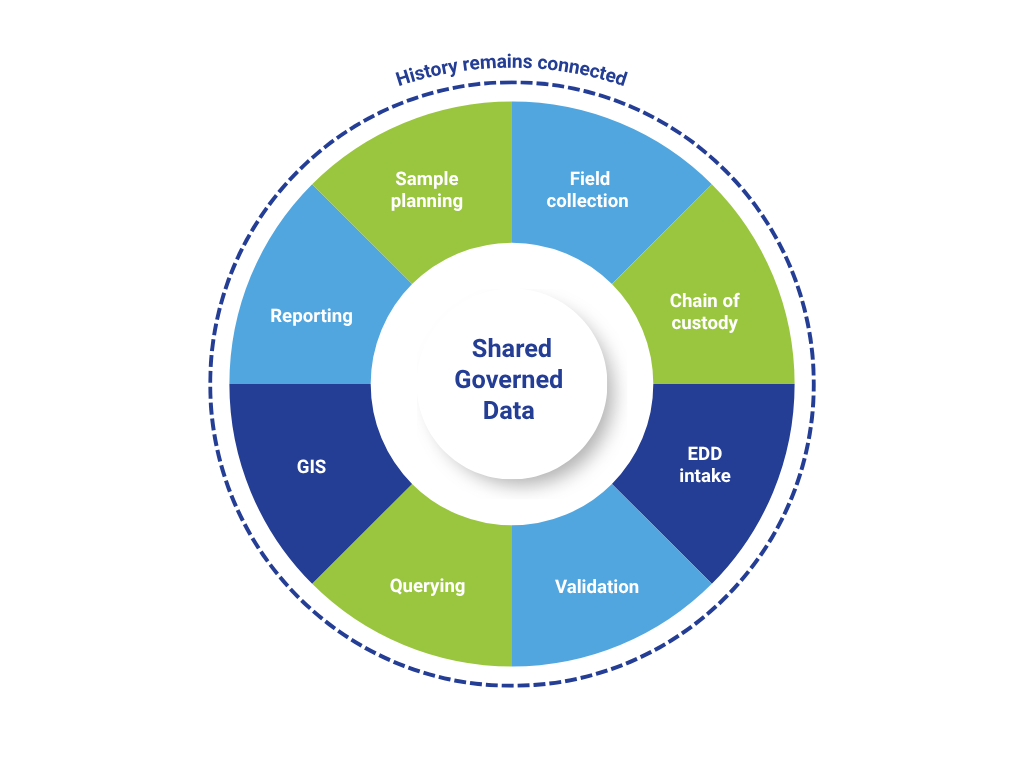
This is the footprint of a working environment rather than a digital filing cabinet. Users prepare sampling events, manage custody, receive laboratory data, resolve quality issues, ask questions, map results, and produce regulatory outputs within a connected system.
Why did the DMR share fall?
The share of sessions associated with Discharge Monitoring Report activity declined from 38.5% to approximately 10% over the measured period.
That does not necessarily mean users produced fewer DMRs. Share describes the portion of a growing and diversifying activity mix. DMR work can remain important while querying, laboratory workflows, GIS, and other use cases grow faster around it.
This distinction matters when evaluating software. A vendor may describe a platform as “unified” because several modules share a menu or sign-on. Usage across a connected data workflow is stronger evidence. Buyers should ask whether sampling plans, chains of custody, EDDs, validated results, locations, maps, calculations, and reports operate on the same governed environmental record.
What does this have to do with AI for environmental data?
AI changes the interface to a question. It does not remove the need for trustworthy data beneath the answer.
The rise of Expert Query suggests that users already value self-directed investigation. Natural-language AI can make that behavior accessible to more people by translating a plain-language request into governed queries, summaries, charts, or screening logic.
Consider a prompt such as:
“Show active groundwater locations where PFOA or PFOS concentrations increased across the last four sampling events, exclude rejected results, preserve non-detect logic, and group the findings by facility.”
The language model can help interpret the request. The environmental system still needs to know:
- Which locations are active and which media they represent
- Which compound identifiers and synonyms apply
- How rejected and qualified results are encoded
- How non-detect values should be treated
- Which time fields define a sampling event
- Which facilities the user is authorized to see
- Where every returned value came from
Without that governed context, a fluent answer can still be wrong.
Why should historical data remain in the AI-ready environment?
Many of the questions environmental professionals care about are longitudinal:
- Is this result unusual for this location?
- Is the apparent increase in a trend or a seasonal pattern?
- Did the change begin before or after a process of modification?
- Which sites are candidates for monitoring optimization or reduction?
- Has this laboratory reported the same quality issue before?
A model working from only the current year can summarize the current year. A model working from a complete, well-attributed history can compare, contextualize, screen, and identify change.
This is why organizations should keep more environmental data, keep it longer, and keep it connected to active analytical tools. Historical depth is part of AI readiness. The useful unit is a result situated within years of comparable evidence.
What should buyers look for in self-service environmental analytics?
A governed semantic layer
Users should be able to ask questions using recognizable concepts such as facility, location, sample, analyte, method, exceedance, permit, and quality status. The system must map those concepts consistently to the underlying data.
Transparent filtering and traceability
Every chart, summary, or AI response should disclose the filters, assumptions, and source records behind it. Users need a path from conclusion to result, EDD, laboratory, method, and sampling events.
Environmental data logic
Generic business-intelligence tools can count rows and plot values. Environmental analysis requires careful handling of units, detection limits, qualifiers, non-detects, duplicates, methods, matrices, and changing regulatory thresholds.
Reusable queries and controlled sharing
A useful investigation can become a recurring screen, dashboard, alert, or report. The platform should allow teams to reuse logic without copying uncontrolled spreadsheets.
Current and historical data together
Buyers should test whether the same query can span recent results and decades of history without exports, offline archives, or a separate legacy application.
From report production to continuous environmental intelligence
Reports remain the formal output of many environmental obligations. The usage pattern suggests that professionals want more from the time between reports. They want to explore the record, investigate anomalies, prepare decisions, and answer questions that no template anticipated.
That progression creates the practical bridge for AI-assisted environmental work. The bridge begins with validated data, governed by identifiers, a complete history, and users who already expect to ask their own questions.
The most promising AI interface may feel new. The behavior beneath it has been growing for more than a decade.
To understand why environmental data is becoming more complex and voluminous in the first place, read Why Does Environmental Data Volume Keep Growing?. As teams rely more on self-service analysis, preserving the full historical record becomes even more important—learn how long companies should keep environmental monitoring data.
Frequently Asked Questions
What is self-service environmental analytics?
Self-service environmental analytics allows authorized users to query, filter, visualize, and investigate governed environmental data without depending on a developer or data administrator for every question. Strong implementations preserve environmental rules, security, data quality, and lineage.
Does increased use of custom queries prove demand for generative AI?
No. It shows increased use of self-directed analysis. That behavior creates a logical foundation for AI-assisted querying, but the usage data alone does not establish why each user chose the query tool or which interface they prefer.
Why are fixed environmental reports still important?
Fixed reports support recurring operational and regulatory needs, provide consistent formats, and reduce reinvention. They work best alongside flexible analysis tools that help users investigate conditions and prepare the evidence behind the report.
Can a general-purpose AI tool analyze environmental data safely?
It can assist, but dependable analysis requires governed access to validated results, metadata, quality indicators, units, methods, detection limits, location context, security permissions, and source lineage. A general model without those structures may produce plausible answers that mishandle environmental meaning.
How does historical data improve AI-assisted environmental analysis?
History provides baselines, seasonal patterns, prior anomalies, method changes, and long-term trends. It helps an AI system distinguish a new signal from ordinary variation and supports portfolio screening for optimization or emerging risk.
Locus is the only self-funded water, air, soil, biological, energy, and waste EHS software company that is still owned and managed by its founder. The brightest minds in environmental science, embodied carbon, CO2 emissions, refrigerants, and PFAS hang their hats at Locus, and they’ve helped us to become a market leader in EHS software. Every client-facing employee at Locus has an advanced degree in science or professional EHS experience, and they incubate new ideas every day – such as how machine learning, AI, blockchain, and the Internet of Things will up the ante for EHS software, ESG, and sustainability.