Locus Technologies provides a Chemical Inventory application that allows users to maintain dynamic chemical inventories from receiving to disposal, streamline regulatory reporting with built-in templates for EPCRA Tier II and Toxic Release Inventory submissions, and monitor consumption data and other key performance indicators in a purpose-built dashboard.

01 // Blog
Rising Chemical Costs in Water and Wastewater Treatment: Why Smarter Data Management Matters
TL;DR: Common bulk chemicals used in water and wastewater treatment have increased dramatically in cost over the past five years, with pH adjusters up 63.6 percent, corrosion control agents up 52.8 percent, and disinfectants up 30.7 percent based on producer price index data. Supply chain disruptions, stricter regulatory requirements, and emerging contaminant pressures are adding to the challenge. Smarter chemical inventory management, including real-time tracking, predictive purchasing, and integrated compliance reporting, gives utilities the visibility they need to control costs and stay compliant.
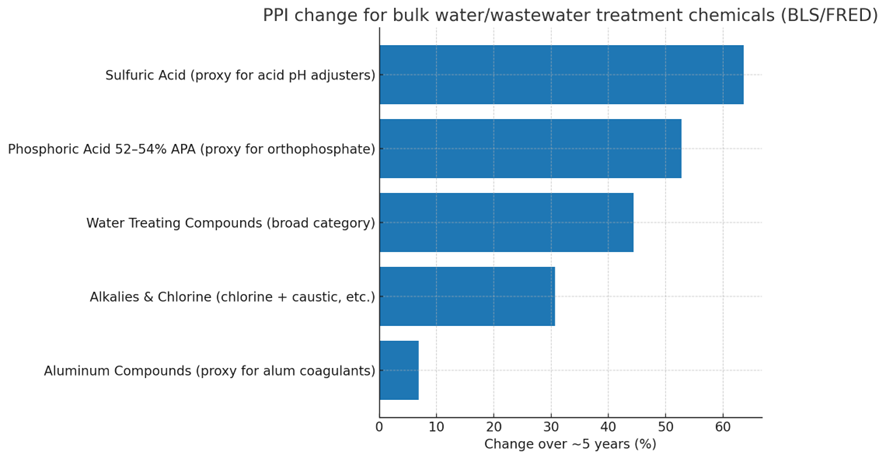
Across the water sector, utilities are facing mounting pressure from rising operational costs. One of the biggest drivers apart from inflating energy costs is the increasing price of bulk chemicals used in conventional water and wastewater treatment. In the past five years, common bulk chemicals such as coagulants (+6.8%), disinfectants (30.7%), pH adjusters (63.6%), and corrosion control agents (52.8%) have increased dramatically (Figure 1). These chemicals are essential to meeting regulatory requirements and ensuring safe, reliable water services. Yet, their growing expense poses financial, operational, and compliance challenges.
Figure 1 – plot indicating how prices for various bulk water and wastewater treatment chemicals have risen since 2020 according to producer price index (PPI) values as a proxy.
Several factors are fueling this trend. Global supply chain disruptions have created volatility in chemical availability and pricing. Transportation costs remain high, and raw material shortages continue to be felt across the market. On top of that, stricter regulatory requirements such as more stringent nutrient removal requirements in wastewater and changes to disinfection byproduct control and emerging contaminant mitigation in the water market are expected to lead to higher chemical consumption, adding to utilities’ operating expenses. Together, these pressures put utilities in the difficult position of balancing affordability with the obligation to protect public health and the environment. For utilities managing NPDES permit compliance alongside chemical cost pressures, see Managing NPDES Compliance for Industrial Wastewater for a deeper look at how purpose-built data management supports both obligations.”
The stakes go beyond budgets. Bulk chemical handling also carries inherent safety and environmental risks. Improper storage, dosing, or monitoring can result in compliance violations, equipment damage, worker safety hazards, or accidental releases. For utilities operating under increasingly tight margins, a mismanaged chemical program can quickly become both a financial liability and a regulatory risk.
This is why utilities are turning to better strategies for chemical management. Approaches such as improved inventory tracking, predictive purchasing, automated dosing controls, and data-driven optimization can help reduce waste, improve safety, and ensure compliance while curbing costs. At Locus Technologies our Chemical Inventory application allows users to maintain dynamic chemical inventories from receiving to disposal. Users can streamline regulatory reporting with built-in templates for EPCRA Tier II and Toxic Release Inventory (TRI) submissions and monitor consumption data and other KPIs in a purpose-built dashboard.
Ultimately, the challenge of rising chemical costs is a reminder that water and wastewater treatment is not only about technology—it’s about management. By treating bulk chemicals as strategic assets rather than commodities, utilities can protect their bottom line, safeguard workers and communities, and continue to meet the vital responsibility of delivering clean, safe water.
It is worth noting that since this article was published, tariff-related pressures on chemical supply chains have added another layer of cost volatility for water and wastewater utilities, reinforcing the case for tighter chemical inventory controls and data-driven purchasing strategies.


Bringing more than two decades of leadership in the water and environmental sectors to Locus Technologies, Laura Underwood leads market segmentation, product development, and revenue growth for the company’s water business unit. Prior to joining Locus, Underwood was the Senior Director of Strategy & Innovation at Veolia. She has also held key roles in water utility management, including serving as the Director of Water Quality & Environmental Compliance. Underwood’s career spans research and development, environmental services, policy, technology, and compliance management. A long-time contributor to the American Water Works Association (AWWA) and a passionate advocate for digital transformation, Laura has built a national reputation for advancing smart, sustainable water practices. Underwood earned a doctoral and master’s degrees in environmental engineering from the University of Edinburgh and a bachelor’s degree in chemistry from the College of Wooster in Ohio, USA.
Frequently Asked Questions
02 // FAQ
The Locus Chemical Inventory application includes built-in templates for EPCRA Tier II and TRI submissions, meaning the inventory data tracked for operational purposes flows directly into regulatory reporting without a separate data entry step. The article frames this as part of a broader strategy of treating bulk chemicals as strategic assets rather than commodities, which protects the bottom line and safeguards compliance.
According to this article, common bulk chemicals used in water and wastewater treatment have risen sharply since 2020 based on producer price index data: pH adjusters increased approximately 63.6 percent, corrosion control agents approximately 52.8 percent, and disinfectants approximately 30.7 percent. The article identifies several contributing factors: global supply chain disruptions, elevated transportation costs, raw material shortages, and stricter regulatory requirements including more stringent nutrient removal requirements and changes to disinfection byproduct control and emerging contaminant mitigation.