By Dorian A. Bailey, Vice President, Alliances and Customer Success s
Reading Time: 7 minutes
TL;DR: Replacing a legacy EHS system safely requires equal attention to data, workflows, integrations, continuity, and the people expected to use the new platform. In one Locus engagement, an environmental engineering and testing firm needed to move beyond a 20-year-old proprietary system without losing critical history or disrupting its work. Our teams mapped the processes users depended on, addressed migration and integration risks, tracked meaningful milestones, and introduced value early. The result was 100% user adoption within 90 days.
What Is the Safest Way to Replace a Legacy EHS System?
The safest approach begins with structured discovery: understand which data, workflows, reports, and integrations matter most before configuring or migrating anything. From there, the implementation and Customer Success teams can preserve business continuity, validate historical records, test connected systems, and give users clear evidence that the transition is working. Adoption grows when sound technology is paired with a process and result that people trust.
I have seen the same concern surface in many conversations about environmental, health, safety, and sustainability software. An organization knows its aging system is slowing the business down, yet the prospect of replacing it feels even more disruptive than living with it.
The questions come quickly. What happens to 10 or 20 years of environmental data? Will the new system accommodate the workflows people have refined over decades? Can it connect with laboratory systems, IoT sensors, SCADA, GIS, ERP, and reporting tools? How long will the transition take? Who keeps the project moving when technical, operational, and organizational issues collide?
Those are reasonable questions. Environmental professionals understand the consequences of a poor transition. They are protecting regulatory records, scientific context, recurring reporting obligations, and the institutional knowledge embedded in everyday processes. They need more than assurances that the software works. They need to see how the team behind it will guide the transition.
One Locus customer engagement shows what that looks like in practice.
The Legacy System Was Holding the Customer Back and Felt Difficult to Leave
The customer, a prominent environmental engineering and testing firm, had relied on a proprietary software system for approximately 20 years. Leadership could see that the system had become an operational bottleneck and would not support the scale the company wanted to achieve. Even so, the decision to move forward had stalled.
The users’ hesitation made sense once we looked closely at their situation. Over two decades, the system had accumulated complex historical data, custom configurations, familiar routines, and workarounds that people relied on to get their jobs done. Some processes were formally documented. Others lived in the experience of employees who knew exactly which step to take, which field to check, or which workaround would produce the right result.
The customer was concerned about data loss and disruption, of course. The deeper concern was whether a new system could reflect the realities of its work. Users needed confidence that the team leading the transition understood what was valuable, what was fragile, and what could be improved safely.
Our Customer Success team began by leveraging our Customer Success Onboarding Framework to help make those concerns explicit. We kept business leaders, operational users, technical specialists, and the Locus implementation team aligned around the same questions and desired outcomes. That cross-functional connection was important because a legacy-system migration cannot be understood from a database schema alone. The people who use the data know where its meaning resides.
This is a common practice in our work. We want the users closest to the process involved early, while there is still time for their knowledge to shape discovery, configuration, migration, testing, and training. Their participation also gives us a much more accurate picture of what must remain uninterrupted.
We Mapped the Work Before Trying to Recreate It
In this engagement, workflow mapping became one of the first ways we reduced uncertainty. Our team worked with the customer to understand how information entered the legacy system, how it was reviewed and corrected, which calculations and approvals mattered, and how the data eventually supported client deliverables and business decisions.
We also looked for work happening around the system. Longstanding platforms often collect unofficial companion processes: a spreadsheet maintained by one team, an email approval that exists outside the formal workflow, or a manual check that only an experienced user knows to perform. Those details can become invisible during a software demonstration, yet they are often where implementation risk hides.
The goal was to identify the business purpose behind each process. We replicated critical custom workflows when they protected quality or served a genuine operational need, while redesigning those that existed primarily because of limitations in the old technology. We did not want to preserve a 20-year-old bottleneck simply because it was familiar.
That philosophy is central to the broader Locus implementation approach. We use discovery to protect what matters, expose what is causing friction, and design a better future state. We take the customer’s complexity seriously while looking for opportunities to simplify it.
For organizations considering a similar transition, this is one of the most important early distinctions to make. Ask which workflows are truly essential, which exist because of the old system, and which reports or regulatory activities cannot pause. Those answers establish the priorities for configuration, testing, and deployment.
We Treated Historical Data as an Asset That Had to Keep Its Meaning
Moving legacy environmental data involves far more than transferring rows from one database to another. Older records may include inconsistent units, duplicate locations, retired parameters, changing valid values, unexplained qualifiers, and relationships that make sense only when viewed in the context of the original program.
For this customer, the migration conversation was tied closely to workflow discovery. We needed to understand how the data had been created and used before we could determine how it should be mapped, validated, and presented in the new environment. Our teams worked through what should be retained, which transformations were needed, how exceptions would be documented, and which representative records and outputs had to reconcile before users could trust the result.
That validation work is part of preserving continuity. When customers can compare critical records and reports before and after migration, they gain concrete evidence that the history survived the transition accurately. Issues can be surfaced and resolved before they affect day-to-day work.
We also encourage organizations to think carefully before discarding historical environmental data simply because it is difficult to move. A long, connected record can support trend analysis, regulatory defensibility, long-term monitoring optimization, institutional knowledge, and future analytics or AI applications. The right objective is to retain valuable history while improving its quality, accessibility, and context.
Customer Success plays a practical role here. We keep technical migration decisions connected to the people who rely on the information. A successful data load is one milestone. The customer also needs to recognize the data, understand how it has been handled, and feel prepared to use and defend it.
We Planned Centralization Around the Systems the Customer Still Needed
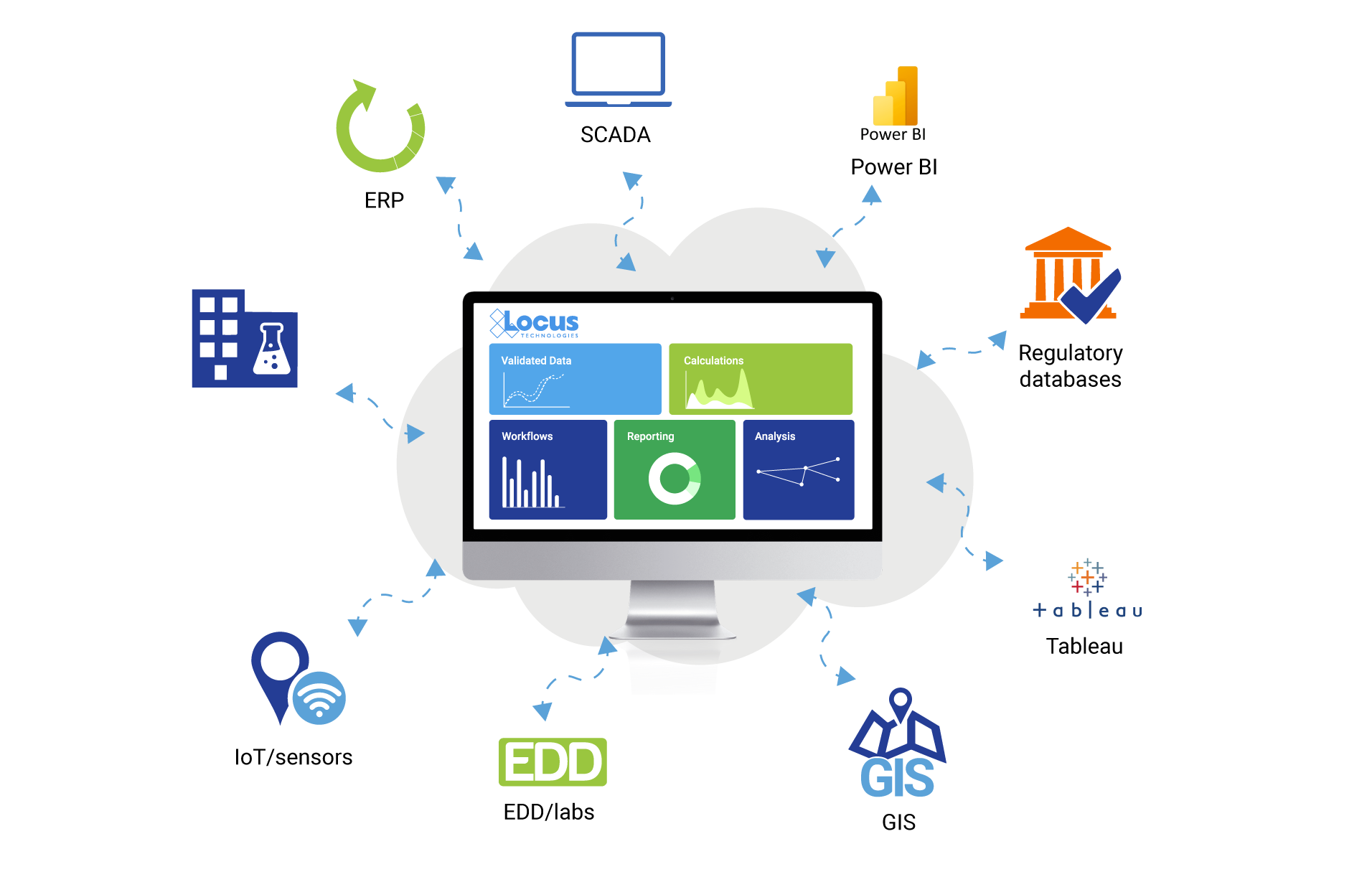
Another common misconception is that centralizing environmental data requires an organization to replace every specialized system at once. In practice, a LIMS may remain the appropriate source for laboratory results. IoT devices, meters, and SCADA systems may continue generating operational readings. ERP and GIS platforms may supply business and location context. Business intelligence tools may consume validated data for broader analysis.
Our job is to understand the role each system plays and design dependable exchanges around it. During an implementation, our teams ask which system owns each data element, what needs to move into or out of Locus, how frequently the exchange should occur, which validation rules should apply, and how errors or corrections will be managed.
Locus can then serve as a connected environment for environmental and EHS data, workflows, calculations, reporting, and analysis while the appropriate source systems continue doing their specialized jobs. Depending on the customer’s architecture, connections may use REST APIs or other established data-loading methods.
This is where careful planning protects both operations and deployment speed. An integration that merely moves data can still create headaches if ownership, update logic, validation, exception handling, and support responsibilities are unclear. We bring the right technical and customer stakeholders together early so those decisions are made deliberately and tested before go-live.
We Made Progress Visible Instead of Asking Users to Take It on Faith
When an implementation feels like a long sequence of technical activities happening behind the scenes, uncertainty grows. We counter that by establishing visible milestones, owners, decisions, and success measures.
For this customer, proactive milestone tracking helped everyone see what had been completed, what required attention, and which decisions could affect the schedule. The team could monitor data mapping and validation, workflow readiness, integration testing, training, and adoption as connected parts of the same transition.
We also focused on accelerating time to value by identifying where users could experience meaningful utility early enough to build confidence. A priority workflow, critical report, representative dataset, or initial user group can provide that proof while the broader rollout continues. The required configuration and validation still receive the care they deserve.
At each stage, we proactively aligned product capabilities and configuration decisions with the customer’s core business goals. That kept the implementation focused on operational scaling, dependable data, and usable workflows, rather than treating technical completion as the only measure of success.
This approach is also the most honest way to talk about deployment speed. There is no responsible universal timeline for replacing a legacy EHS system. Data condition, workflow complexity, integrations, configuration needs, stakeholder availability, and release scope all influence the schedule. A well-run project makes those variables visible, breaks the work into measurable stages, and adapts through a controlled process when new information emerges.
Structured governance and flexibility can work together. Customer needs may evolve as users see the configured system, new facilities enter scope, or data reveals an unexpected condition. Our teams document decisions, evaluate the effect on continuity and outcomes, and manage the change without allowing the project to drift.
The Customer Reached 100% User Adoption Within 90 Days
The technical work and the customer’s decision to use the new system were inseparable. Our Customer Success team supported that outcome through continuous cross-functional alignment, workflow mapping, proactive milestone tracking, structured change management, and a deliberate focus on early value.
Together, these practices mitigated the practical switching costs of leaving a 20-year-old system, including the time, uncertainty, workflow disruption, and loss of confidence that can slow adoption.
Within 90 days, the firm achieved 100% user adoption.
That result belongs to this customer’s specific engagement and should not be read as a universal timeline. It does demonstrate what can happen when users see their concerns reflected in the plan, participate in the transition, and receive evidence that the new platform can support their work.
Go-live is one event in that process. Our work continues through stabilization as users put the platform into daily practice, questions surface, and priorities become clearer. We track usage, gather feedback, help route configuration or product needs, and keep the technology connected to the business outcomes that justified the change.
When I look back at this engagement, the lesson is straightforward: resistance often contains useful information. People worry about losing data because the data matters. They worry about custom workflows because those processes may carry years of expertise. They worry about integrations because their work depends on an ecosystem of systems. A good implementation team listens closely enough to turn those concerns into requirements, tests, milestones, and informed decisions.
That is how we help customers move beyond a legacy system with greater confidence. We make the risk understandable, keep people connected to the process, and stay engaged until the new environment is delivering value in real work.
+++++++++++++++++
Frequently Asked Questions
How can an organization reduce disruption during an EHS software implementation?
Begin by identifying the workflows, reports, integrations, and regulatory activities that cannot pause. During discovery, assign owners, define validation and acceptance criteria, document decisions, and build milestone-based plans around those continuity requirements. Test migrated data and critical outputs before go-live, prepare users for their actual roles, and continue support through stabilization.
Can legacy environmental and EHS data be migrated into Locus?
Yes. Locus can migrate data from legacy databases, spreadsheets, PDFs, and even paper forms or photos thanks to recent advancements, including AI technology. The process may include profiling, mapping, transformation, quality review, validation, reconciliation, and documentation of exceptions. The exact approach depends on the source data’s structure, condition, volume, relationships, and business importance.
How does Locus connect with LIMS, IoT sensors, SCADA, ERP, GIS, and other enterprise systems?
Locus supports REST APIs and other data-loading methods. During discovery and integration design, the team defines the authoritative source, transfer direction, frequency, update logic, validation rules, error handling, testing, and support responsibilities for each connection. Specialized systems can remain in place while Locus centralizes validated environmental and EHS information and workflows.
How long does it take to replace a legacy EHS system?
Implementation timing depends on the condition and volume of data, workflow complexity, integration requirements, configuration, stakeholder availability, and rollout scope. A credible schedule follows structured discovery and includes measurable milestones. In the engagement described here, the customer achieved 100% user adoption within 90 days, though results and timelines vary.
Should an organization migrate all of its historical environmental data?
Organizations should retain data that supports regulatory obligations, scientific interpretation, trend analysis, monitoring decisions, institutional knowledge, or future analytics. Migration is also an opportunity to correct or document known quality issues. Older records should be evaluated for their value and context rather than discarded only because they are difficult to move.
Locus is the only self-funded water, air, soil, biological, energy, and waste EHS software company that is still owned and managed by its founder. The brightest minds in environmental science, embodied carbon, CO2 emissions, refrigerants, and PFAS hang their hats at Locus, and they’ve helped us to become a market leader in EHS software. Every client-facing employee at Locus has an advanced degree in science or professional EHS experience, and they incubate new ideas every day – such as how machine learning, AI, blockchain, and the Internet of Things will up the ante for EHS software, ESG, and sustainability.