By Brenda Mahedy (reviewed by Neno Duplan, PhD)
Reading Time: 4 minutes 6 seconds

Europe’s CSRD and California’s SB 253 are reshaping how large enterprises, even those not subject to either mandate, think and act about environmental and sustainability data. While the scopes of the two differ, together they expose a deeper truth: regulatory volatility is now the norm, not the exception. For U.S. companies evaluating new EHS, ESG, or water data platforms, the real buying question is no longer “What do we need to report today?” but rather, “What system will still serve us when the rules change tomorrow?”
Converging Signals from Different Sources
CSRD is expansive, touching on governance, environmental impact, double materiality, and auditable disclosures across global operations and value chains. SB 253 is narrower but no less consequential, mandating emissions transparency for companies doing business in California. (Keep in mind: California is the 4th largest economy in the world, ahead of Germany, and the EU as whole ranks third after US and China.) Together, the two mandates establish three enduring signals for software buyers:
- Auditability is non-negotiable. Whether driven by EU assurance requirements or U.S. climate disclosures, regulators are converging on defensible, traceable data.
- Operational data matters more than narrative reporting. Emissions, water metrics, incidents, and environmental samples must originate from primary systems, not spreadsheets.
- Scope expands over time. Today’s carbon disclosure becomes tomorrow’s water stewardship, supply chain transparency, or biodiversity reporting.
Even organizations outside the formal scope of these laws are feeling indirect pressure from investors, customers, insurers, and global partners to demonstrate credible environmental data governance.
Buying Software in an Era of Regulatory Uncertainty
Adding complexity, the U.S. regulatory landscape is in flux. Policy shifts and enforcement variability from agencies like the Environmental Protection Agency create a moving target for compliance leaders. Requirements tighten, loosen, or reinterpret with political cycles. This instability creates a paradox: companies must invest now yet they cannot rely on static requirements.
In this environment, durable software investments share a defining trait: regulatory adaptability. The most resilient platforms are built around configurable data models, extensible workflows, and schema-level flexibility. They allow organizations to pivot away from one disclosure framework to another without rebuilding their data architecture.
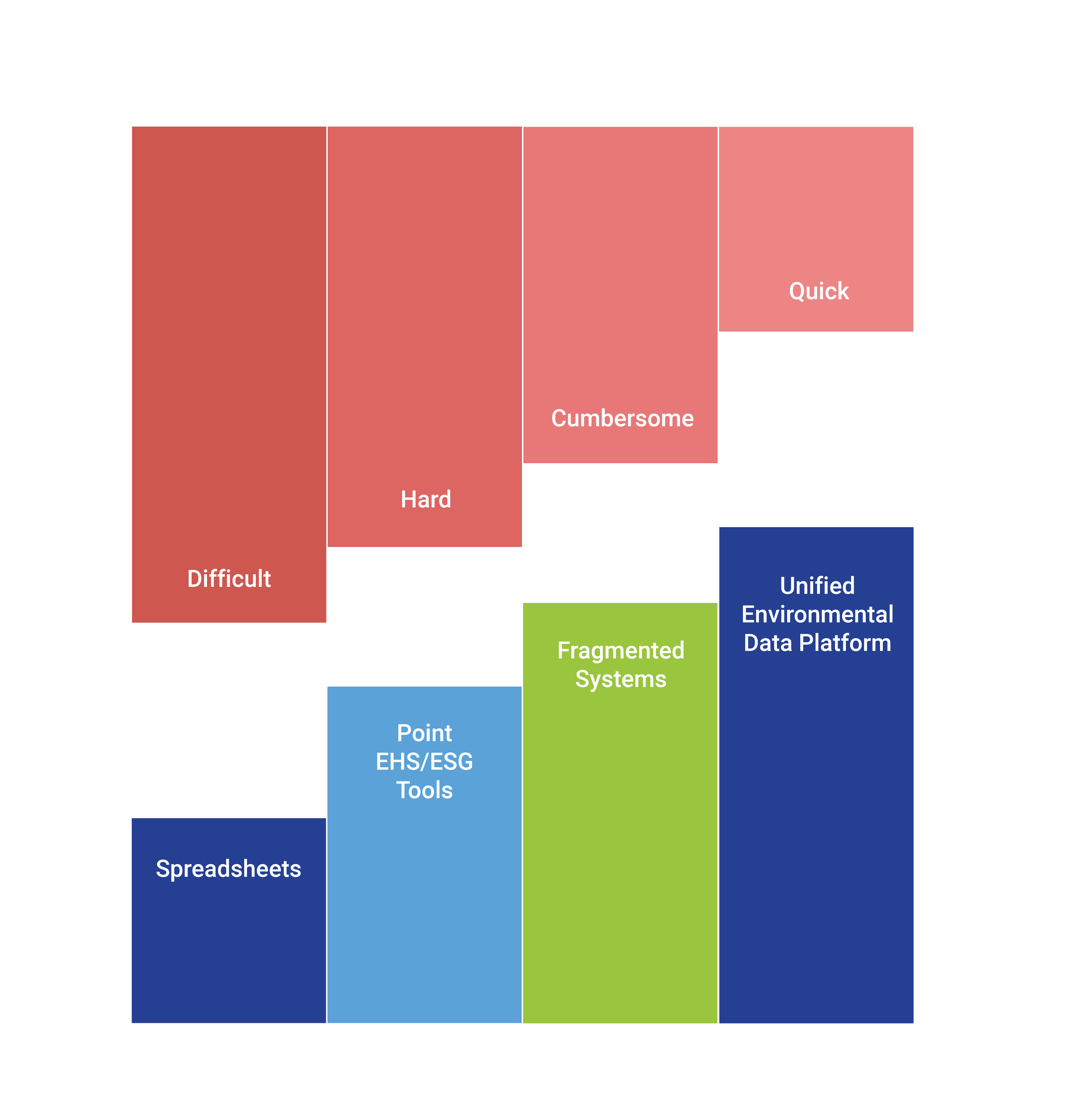
In contrast, rigid reporting tools, particularly those built around a single regulatory framework, rapidly become liabilities as mandates evolve and geopolitical requirements shift. Even prior to the regulatory uncertainty introduced over the past year, many global enterprises were forced into a fragmented model: one system for European GHG reporting, another for U.S. disclosures, and often yet another for other jurisdictions. This patchwork approach is inherently inefficient. It multiplies costs, increases reconciliation risk, and delivers compliance outputs without generating operational insight. Organizations end up producing reports, but they fail to build the integrated data foundation needed to drive performance improvement, capital allocation decisions, or enterprise-wide governance.
From Point Solutions to Environmental Data Infrastructure
Historically, many enterprises assembled fragmented stacks: EHS compliance tools for permits and incidents, ESG platforms for disclosures, and separate systems for water or laboratory data. CSRD and SB 253 expose the fragility of that model.
Regulations now demand:
- Cross-domain traceability (e.g., linking water use to ESG disclosures)
- Multi-site aggregation with local granularity
- Evidence-backed audit trails across years and frameworks.
This pushes buyers toward unified environmental platforms that collapse silos and create a single source of truth across EHS, ESG, and water domains.
The strategic shift mirrors what finance underwent decades ago. Remember when they moved from disconnected ledgers to integrated ERP systems capable of surviving accounting standard changes? Déjà vu.
The Global Operator’s Challenge
For U.S. enterprises operating internationally, the stakes are even higher. Multinationals must reconcile:
- Divergent jurisdictional rules (EU, U.S., APAC, regional water authorities)
- Localized operational realities (site-level sampling, permits, discharges)
- Global reporting consistency (corporate ESG narratives and metrics).
This tension creates a fundamental architectural requirement: local fidelity with global coherence. Systems must support multilingual deployments, jurisdiction-specific workflows, and regional reporting formats while maintaining harmonized enterprise data models.
Organizations that succeed here will eliminate data silos not by centralizing everything physically, but by unifying it logically.
What Forward-Looking Buyers Are Prioritizing
Across industries, a new set of buying criteria is emerging that is largely illuminated by CSRD and SB 253 but applicable far beyond them:
- Audit-grade data lineage
Immutable records, versioning, and evidence management that stand up to assurance. - Configurability over customization
Platforms that adapt through configuration rather than costly redevelopment or software recompiling. - Operational depth
Native support for environmental sampling, water data, emissions factors, data validation, and incident workflows — not just disclosure layers. - Global scalability
Multi-site, multi-language, multi-regulation support from a unified architecture. - Future regulatory portability
The ability to map data to new frameworks without rebuilding everything.
These criteria reflect a maturation in the mindset of buyers: software is no longer a compliance accessory; it is a long-term data asset. It is compliance infrastructure.
Designing for the Unknown Future
Perhaps the most important insight from SB 253 and CSRD is philosophical. Regulations will continue to evolve, expanding in scope, shifting geographically, and deepening assurance expectations. Attempting to predict the exact trajectory is less useful than preparing structurally for impending change.
This is where platform philosophy matters. Systems designed around science-backed, validated environmental data as a durable enterprise asset rather than a reporting obligation provide strategic insulation against volatility. They enable companies to respond to new mandates with configuration, not reinvention.
That distinction increasingly separates tactical tools from enduring platforms.
An Aspirational Path Forward
For large U.S. enterprises, the goal should not be mere compliance with today’s rules. It should be building an environmental intelligence backbone that:
- Integrates EHS, ESG, and water data into a single source of truth
- Supports global operations without sacrificing local nuance
- Maintains audit-ready lineage regardless of framework
- Evolves as regulations shift.
Vendors that deliver cloud-native, highly configurable platforms with deep operational roots (such as those pioneered by Locus Technologies) are well positioned to meet this moment. Their emphasis on unified environmental data models, scalability across global sites, and regulatory flexibility aligns directly with the structural needs emerging from both CSRD and SB 253.
From Reactive Compliance to Strategic Resilience
If there is a unifying lesson from these regulatory forces, it is this: the era of reactive compliance tooling is ending. In its place there is a new expectation: environmental software as resilient infrastructure.
Organizations that invest with this mindset will not just survive regulatory turbulence; they will convert it into competitive advantage. They will move faster when new disclosures emerge, speak more credibly to stakeholders, and operate with greater environmental clarity.
And when the next regulation arrives, as it inevitably will, they will be ready.
Locus is the only self-funded water, air, soil, biological, energy, and waste EHS software company that is still owned and managed by its founder. The brightest minds in environmental science, embodied carbon, CO2 emissions, refrigerants, and PFAS hang their hats at Locus, and they’ve helped us to become a market leader in EHS software. Every client-facing employee at Locus has an advanced degree in science or professional EHS experience, and they incubate new ideas every day – such as how machine learning, AI, blockchain, and the Internet of Things will up the ante for EHS software, ESG, and sustainability.