Tag Archive for: SaaS

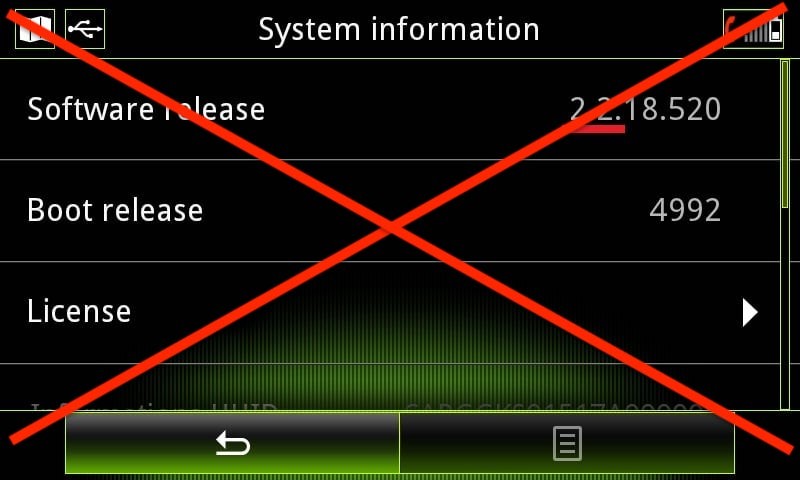
Does your EHS software have a version number?

Freedom from product release tyranny

I love the article by Geoffrey Moore on the power of software as a service (SaaS) business model published on LinkedIn. In SaaS’s Real Triumph he writes: “by far the greatest contribution of SaaS is to free the enterprise from the tyranny of the product release model.”

He cites the operational burden, enterprise-wide distraction and associated cost to roll out an enterprise software and then the subsequent hesitation to repeat that when a new release of that software becomes available as that deployment model is not sustainable nor affordable. Companies spend big dollars buying and then deploying EHS software that they know will be outdated in just a few years. Only IT personnel benefits from that model as it may extend their employment for a few years before IT department goes out of business for good. Moore points out the painful truth, stating: “you have paid maintenance of 18 to 20% per year for anywhere from five to ten years for the express purpose of not availing yourself of the innovation created during that time period.”

Probably the main benefit of SaaS multi-tenancy (that is frequently overlooked during the software selection process) is no software versioning. This is because multi-tenant software typically provides a rolling upgrade program: incremental and continuous improvements. It is an entirely new architectural approach to software delivery and maintenance model. Companies have to develop applications from the ground up for multi-tenancy. Legacy client-server or single-tenant software cannot qualify for multi-tenancy. Let’s take a look at definitions:

No version number

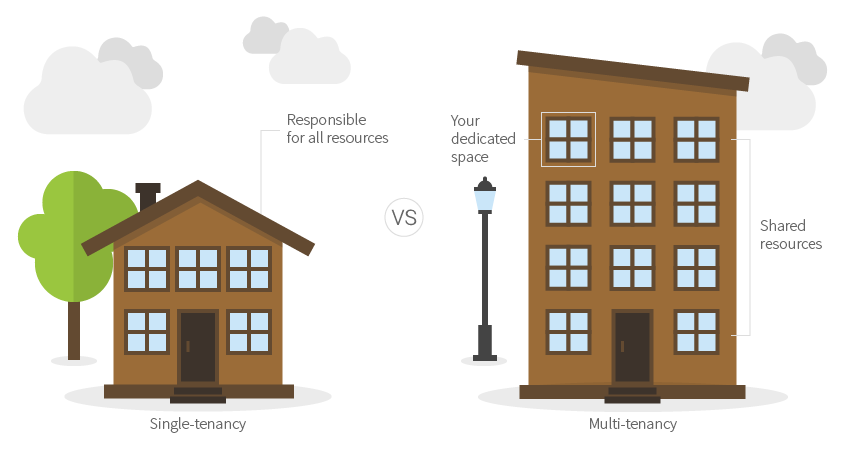
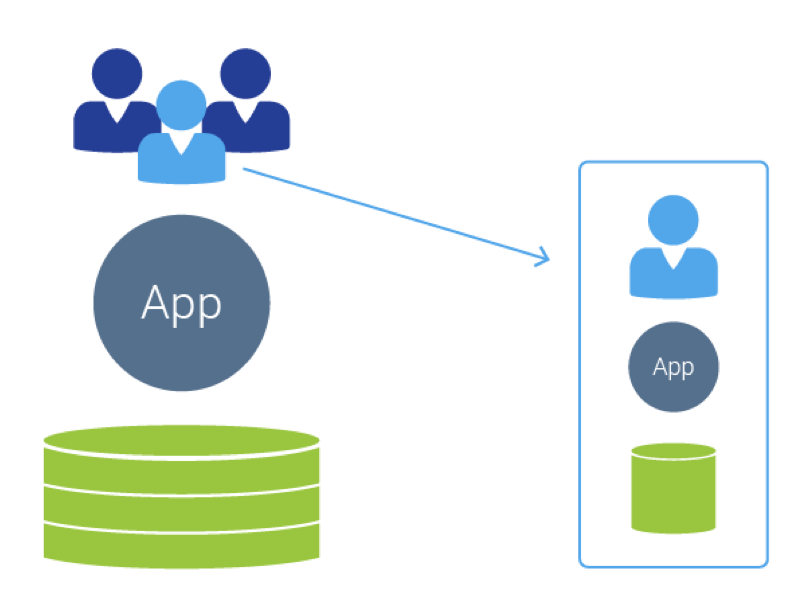
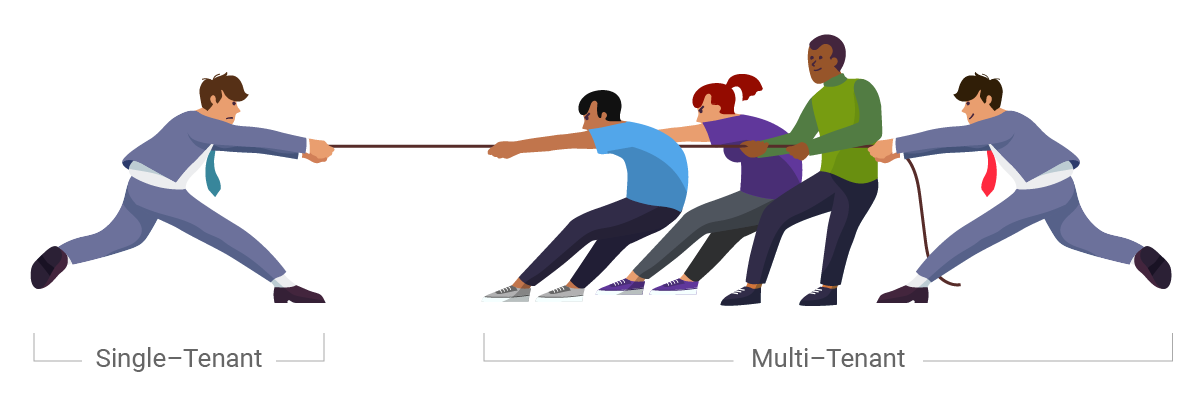
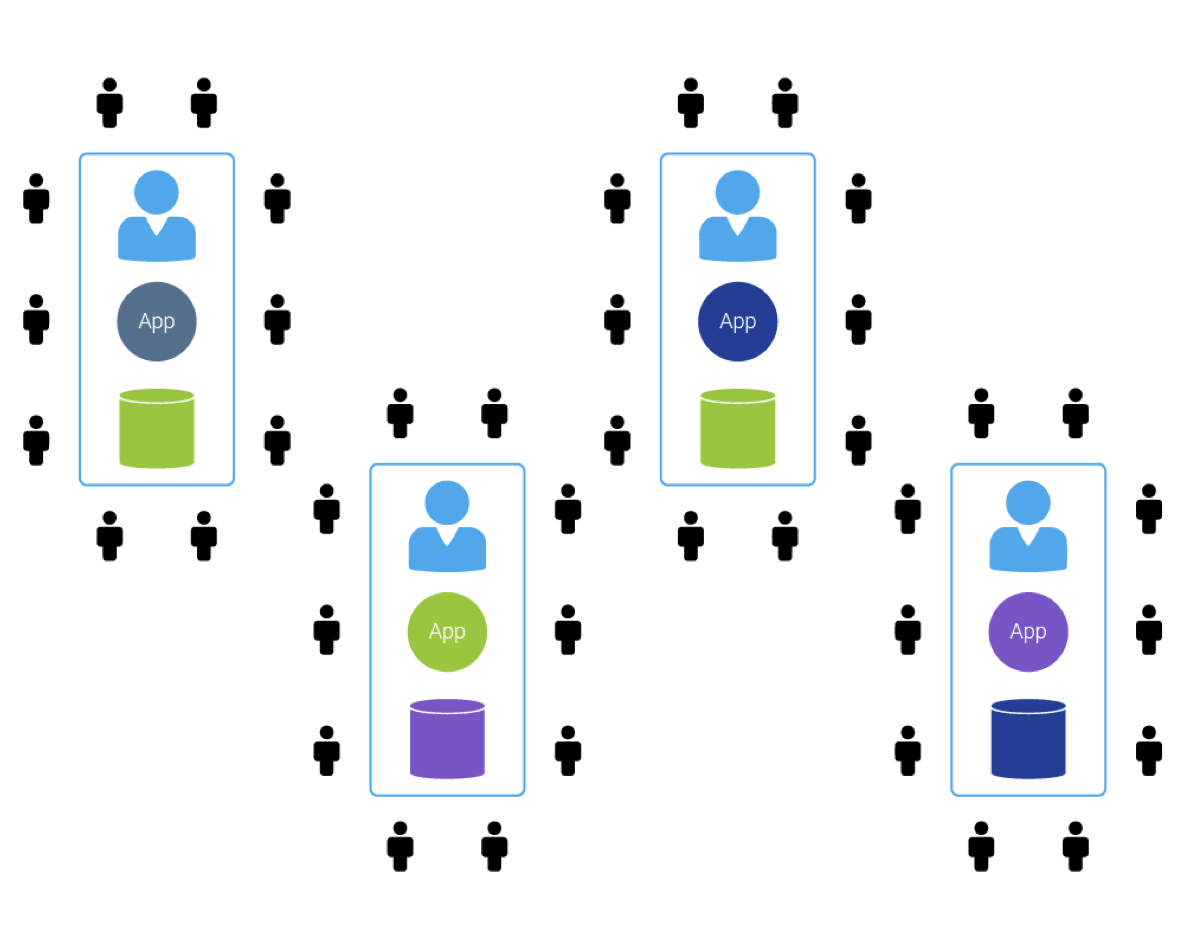
Single-Tenant – A single instance of the software and supporting infrastructure serves a single customer. With single-tenancy, each customer has his or her own independent database and instance of the software. Essentially, there is no sharing happening with this option.

Multi-Tenant – Multi-tenancy means that a single instance of the software and its supporting infrastructure serves multiple customers. Each customer shares the software application and also shares a single database. Each tenant’s data is isolated and remains invisible to other tenants.

Benefits of SaaS Multi-Tenant Architecture

The multi-tenant architecture provides lower costs through economies of scale: With multi-tenancy, scaling has far fewer infrastructure implications than with a single-tenancy-hosted solution because new customers get access to the same software.

Shared infrastructure leads to lower costs: SaaS allows companies of all sizes to share infrastructure costs. Not having to provision or manage any infrastructure or software above and beyond internal resources enables businesses to focus on everyday tasks.

Ongoing maintenance and updates: Customers don’t need to pay costly upgrades to get new features or functionality. 

Configuration can be done while leaving the underlying codebase unchanged: Single-tenant-hosted solutions are often customized, requiring changes to an application’s code. This customization can be costly and can make upgrades expensive and time-consuming because the upgrade might not be compatible with customers changes to the earlier software version.

Multi-tenant solutions are designed to be highly configurable so that businesses can make the application perform the way they want. There is no changing the code or data structure, making the upgrade process easy.

Multi-tenancy ensures that every customer is on the same version of the software. As a result, no customer is left behind when the software is updated to include new features and innovations. A single software version also creates a unique sense of community where customers and partners share knowledge, resources, and learning. Smart managers work with their peers and learn from them and what they are doing. A multi-tenant SaaS provider’s resources are focused on maintaining a single, current (and only) version of the application, rather than spread out in an attempt to support multiple software versions for customers. If a provider isn’t using multi-tenancy, it may be hosting thousands of single-tenant customer implementations. Trying to maintain that is too costly for the vendor, and those costs, sooner or later, become the customers’ costs.

A vendor who is invested in on-premise, hosted, and hybrid models cannot commit to providing all the benefits of a true SaaS model due to conflicting revenue models. Their resources are going to be spread thin, supporting multiple versions rather than driving innovation. Additionally, if the vendor makes the majority of their revenue selling on-premise software, it is difficult for them to fully commit to a true SaaS solution since the majority of their resources are allocated to supporting the on-premise software.

Before you engage future vendors for your enterprise EHS software, assuming you already decided to go with SaaS solution, ask these questions:

  1. Does your software have version numbers? 
  2. Do you charge for upgrades and how often do you upgrade?

If the answer is yes to any of these two questions, you should not consider that vendor as they are not true multi-tenant SaaS. You should not select that vendor if they answer “we are in the process of switching to multi-tenancy.” Multi-tenancy train departed a long time ago, and no EHS vendor who is single-tenant is not going to make that switch in time to make it work.

And if they suddenly introduce a “multi-tenant” model (after selling an on-premises version for 10+ years) who in the world would want to migrate to that experimental cloud without putting the contract out to bid to explore a switch to well established and market-tested true multi-tenant providers? The first-mover advantage when it comes to multi-tenancy is a huge advantage for any vendor.

Multi-tenant architecture


Artificial Intelligence and Environmental Compliance–Revisited–Part 2: IoT

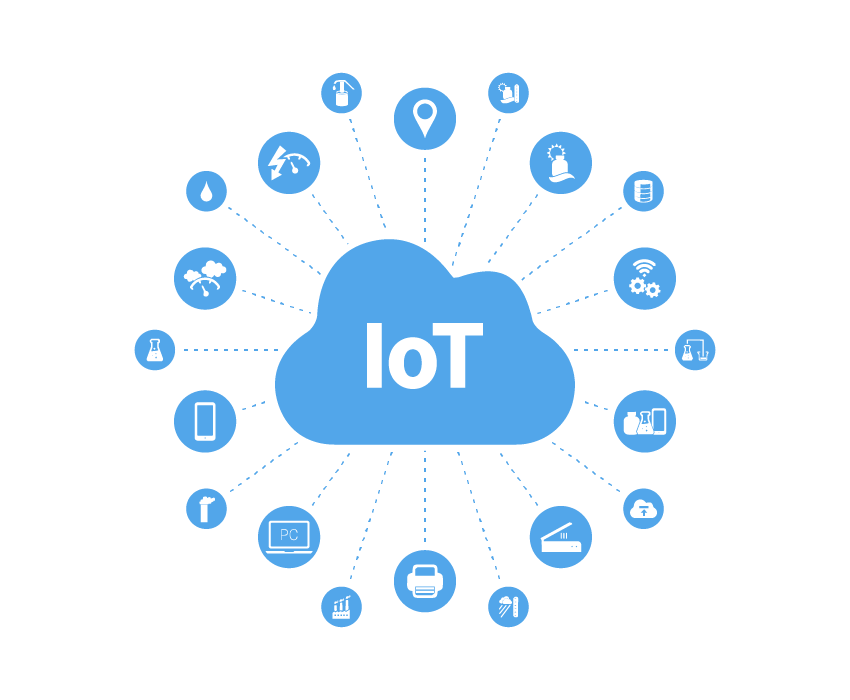
More recently, big data has become more closely tied to IoT-generated streaming datasets such as Continued Air Emission Measurements (CEMS), real-time remote control and monitoring of treatment systems, water quality monitoring instrumentation, wireless sensors, and other types of wearable mobile devices. Add digitized historical records to this data streaming, and you end up with a deluge of data. (To learn more about big data and IoT trends in the EHS industry, please read this article: Keeping the Pulse on the Planet using Big Data.) 

In the 1989 Hazardous Data Explosionarticle that I mentioned earlier, we first identified the limitation of relational database technology in interpreting data and the importance that IoT (automation as it was called at the time) and AI were going to play in the EHS industry. We wrote: 

“It seems unavoidable that new or improved automated data processing techniques will be needed as the hazardous waste industry evolves. Automation (read IoT) can provide tools that help shorten the time it takes to obtain specific test results, extract the most significant findings, produce reports and display information graphically,” 

IoT - Internet of Things

We also claimed that “expert systems” (a piece of software programmed using artificial intelligence (AI) techniques. Such systems use databases of expert knowledge to offer advice or make decisions.) and AI could be possible solutions—technologies that have been a long time coming but still have a promising future in the context of big data. 

“Currently used in other technical fields, expert systems employ methods of artificial intelligence for interpreting and processing large bodies of information.” 

Although “expert systems” as a backbone for AI did not materialize as it was originally envisioned by researches, it was a necessary step that was needed to use big data to fulfil the purpose of an “expert”. 

AI can be harnessed in a wide range of EHS compliance activities and situations to contribute to managing environmental impacts and climate change. Some examples of application include AI-infused permit management, AI-based permit interpretation and response to regulatory agencies, precision sampling, predicting natural attenuation of chemicals in water, managing sustainable supply chains, automating environmental monitoring and enforcement, and enhanced sampling and analysis based on real-time weather forecasts. 

Parts one, three, and four of this blog series complete the overview of Big Data, IoT, AI and multi-tenancy. We look forward to feedback on our ideas and are interested in hearing where others see the future of AI in EHS software – contact us for more discussion or ideas!


Artificial Intelligence and Environmental Compliance–Revisited

On 12 April 2019, Locus’ Founder and CEO, Neno Duplan, received the prestigious Carnegie Mellon 2019 CEE (Civil and Environmental Engineering) Distinguished Alumni Award for outstanding accomplishments at Locus Technologies. In light of this recognition, Locus decided to dig into our blog vault, share a series of visionary blogs crafted by our Founder in 2016. These ideas are as timely and relevant today as they were three years ago, and hearken to his formative years at Carnegie Mellon, which formed the foundation for the current success of Locus Technologies as top innovator in the water and EHS compliance space.

Artificial Intelligence (AI) for Better EHS Compliance (original blog from 2016)

It is funny how a single acronym can take you back in time. A few weeks ago when I watched 60 Minutes’ segment on AI (Artificial Intelligence) research conducted at Carnegie Mellon University, I was taken back to the time when I was a graduate student at CMU and a member of the AI research team for geotechnical engineering. Readers who missed this program on October 9, 2016, can access it online.

Fast forward thirty plus years and AI is finally ready for prime time television and a prominent place among the disruptive technologies that have so shaken our businesses and society. This 60 Minutes story prompted me to review the progress that has occurred in the field of AI technology, why it took so long to come to fruition, and the likely impact it will have in my field of environmental and sustainability management. I discuss these topics below. I also describe the steps that we at Locus have taken to put our customers in the position to capitalize on this exciting (but not that new) technology.

What I could not have predicted when I was at Carnegie Mellon is that AI was going to take a long time to mature–almost the full span of one’s professional career. The reasons for this are multiple, the main one being that several other technologies were absent or needed to mature before the promises of AI could be realized. These are now in place. Before I dive into AI and its potential impact on the EHS space, let me touch on these “other” major (disruptive) technologies without which AI would not be possible today: SaaS, Big Data, and IoT (Internet of Things).

Locus Artificial Intelligence

As standalone technologies, each of these has brought about profound changes in both the corporate and consumer worlds. However, these impacts are small when compared to the impact all three of these will have when combined and interwoven with AI in the years to come. We are only in the earliest stages of the AI computing revolution that has been so long in the coming.

I have written extensively about SaaS, Big Data, and IoT over the last several decades. All these technologies have been an integral part of Locus’ SaaS offering for many years now, and they have proven their usefulness by rewarding Locus with contracts from major Fortune 500 companies and the US government. Let me quickly review these before I dive into AI (as AI without them is not a commercially viable technology).


Big Data

Massive quantities of new information from monitoring devices, sensors, treatment systems controls and monitoring, and customer legacy databases are now pouring into companies EHS departments with few tools to analyze them on arrival. Some of the data is old information that is newly digitized, such as analytical chemistry records, but other information like streaming of monitoring wireless and wired sensor data is entirely new. At this point, most of these data streams are highly balkanized as most companies lack a single system of record to accommodate them. However, that is all about to change.

As a graduate student at Carnegie Mellon in the early eighties, I was involved with the exciting R&D project of architecting and building the first AI-based Expert System for subsurface site characterization, not an easy task even by today’s standards and technology. AI technology at the time was in its infancy, but we were able to build a prototype system for geotechnical site characterization, to provide advice on data interpretation and on inferring depositional geometry and engineering properties of subsurface geology with a limited amount of data points. The other components of the research included a relational database to store the site data, graphics to produce “alternative stratigraphic images” and network workstations to carry out the numerical and algorithmic processing. All of this transpired before the onset of the internet revolution and before any acronyms like SaaS, AI, or IoT had entered our vocabulary. This early research led to the development of a set of commercial tools and technological improvements and ultimately to the formation of Locus Technologies in 1997.

Part of this early research included management of big data, which is necessary for any AI undertaking. As a continuation of this work at Carnegie Mellon, Dr. Greg Buckle and I published an article in 1989 about the challenges of managing massive amounts of data generated from testing and long-term monitoring of environmental projects. This was at a time when spreadsheets and paper documents were king, and relational databases were little used for storing environmental data.

The article, “Hazardous Data Explosion,“ published in the December 1989 issue of the ASCE Civil Engineering Magazine, was among the first of its kind to discuss the upcoming Big Data boom within the environmental space and placed us securely at the forefront of the big data craze. This article was followed by a sequel article in the same magazine in 1992, titled “Taming Environmental Data,“ that described the first prototype solution to managing environmental data using relational database technology. In the intervening years, this prototype eventually became the basis of the industry’s first multi-tenant SaaS system for environmental information management.

Locus - Big Data - IoT - AI

Today, the term big data has become a staple across various industries to describe the enormity and complexity of datasets that need to be captured, stored, analyzed, visualized, and reported. Although the concept may have gained public popularity relatively recently, big data has been a formidable fixture in the EHS industry for decades. Initially, big data in EHS space was almost entirely associated with the results of analytical, geotechnical, and field testing of water, groundwater, soil, and air samples in the field and laboratory. Locus’ launch of its Internet-based Environmental Information Management (EIM) system in 1999 was intended to provide companies not only with a repository to store such data, but also with the means to upload such data into the cloud and the tools to analyze, organize, and report on these data.

In the future, companies that wish to remain competitive will have no choice but bring together their streams of (seemingly) unrelated and often siloed big data into systems such as EIM that allow them to evaluate and assess their environmental data with advanced analytics capabilities. Big data coupled with intelligent databases can offer real-time feedback for EHS compliance managers who can better track and offset company risks. Without the big data revolution, there would be no coming AI revolution.


AI and Water Management – Looking Ahead

There has been much talk about how artificial intelligence (AI) will affect various aspects of our lives, but little has been said to date about how the technology can help to make water quality management better. The recent growth in AI spells a big opportunity for water quality management. There is enormous potential for AI to be an essential tool for water management and decoupling water and climate change issues.

Two disruptive megatrends of digital transformation and decarbonization of economy could come together in the future. AI could make a significant dent in global greenhouse gas (GHG) emissions by merely providing better tools to manage water. The vast majority of energy consumption is wasted on water treatment and movement. AI can help optimize both.

AI is a collective term for technologies that can sense their environment, think, learn, and take action in response to what they’re detecting and their objectives. Applications can range from automation of routine tasks like sampling and analyses of water samples to augmenting human decision-making and beyond to automation of water treatment systems and discovery – vast amounts of data to spot, and act on patterns, which are beyond our current capabilities.

Applying AI in water resource prediction, management and monitoring can help to ameliorate the global water crisis by reducing or eliminating waste, as well as lowering costs and lessening environmental impacts.

Parts two, three, and four of this blog series complete the overview of Big Data, Iot, AI and multi-tenancy. We look forward to feedback on our ideas and are interested in hearing where others see the future of AI in EHS software – contact us for more discussion or ideas!


The importance of multitenancy in EHS software buying decisions

In 2025, there’s been a considerable increase in inquiries related to multitenancy and why it matters for EHS software, ESG Reporting, sustainability metrics, and more. Locus Technologies has been leading the market for two decades as the original multitenant EHS platform. During that time, we’ve watched countless single-tenant or on-prem competitors try to deflect when asked if they can deliver a multitenant solution. Considering the surge in interest in recent months, we are dusting off some of our earlier posts on the topic. This is one of those posts.

The announcements by several EHS software vendors this fall caught my attention. After offering their software on-premises for over a decade, suddenly many are discovering and planning to introduce multitenant Software-as-a-Service (SaaS) while promising to continue to maintain their current on-premises or single tenant offerings. In essence, they are introducing multitenancy as if it were a new version of their software. Anyone familiar with multitenancy knows this won’t work. Here’s why.

Most public announcements begin something like this: “In the next several years we plan to expand our software offerings to give customers the option to move from their current on-premises solution to the cloud.” However, is this even possible? What they consider the “cloud” may not be a true multitenant cloud. That train departed years ago, and most of the current EHS software vendors missed it. While multitenancy has been a game changer in the tech industry, many are uncertain of exactly what makes an application “multitenant” or why it matters.
Locus Multi-Tenant Software

There is a considerable degree of (intended) confusion in the EHS software space when it comes to the definition of a real cloud or better said, multitenancy. Companies that are considering SaaS solutions for EHS software hear all sorts of things from EHS software vendors hoping to tap into the momentum of cloud computing. Many go as far as saying “sure; we can do multitenant, single-tenant, whatever tenant you need!” –anything to win the job. These vendors do not understand the real cloud.

Multitenancy is a significant shift in computing and requires an all-new approach to the software architecture and the delivery model from the ground up. It is transformational, and customers who intend to buy the next generation of EHS software should spend the time to understand the differences. More importantly, multitenancy is a principle, not a software version or an upgrade. It is not an evolutionary step; instead, it is a revolution in the software delivery model, and it matters in the long run for the customer.

Multi-tenant architecture

Figure 1: The single-tenant model cannot easily be switched or “upgraded” to multitenant. The software architecture does not allow for an easy switch the same way as a single-family home cannot be “remodeled” to become a multitenant high-rise. What differentiates a multitenant application architecture is its effectiveness in achieving the same goal in a scalable and sustainable fashion.

Can you imagine companies like eBay, Salesforce, Google, Workday, or Amazon supporting a “single-tenant” version of their offering side-by-side with their multi-tenant clouds? No, of course not. That would mean they had failed to decide on the fundamental strategy that would define their business, fuel their growth, and give customers the experience they’ve promised. I argue that any EHS software vendor who offers a single-tenant solution of any type, cannot be a serious contender in multitenant SaaS. Pick one; not both.

EHS software vendors with on-premise software applications or single-tenant web-enabled offerings are seduced by the seemingly low barriers to entry into the SaaS market with an architecture that leverages virtualization. This approach allows a software company to quickly offer subscription-based services of their legacy product to their initial customers. In the long run, however, this approach just won’t scale economically. A recent wave of ownership change of EHS software companies is the best indicator that sold companies became victims of their initial success. A SaaS provider who leverages virtualization puts the long-term viability of the business at risk as more efficient, true SaaS competitors come to dominate the market.
Multi-tenant architecture

Figure 2: Single tenant requires many more vendor resources. The resource costs are eventually passed to customers. Each upgrade of the application will require each customer to upgrade independently and the ability to implement tenant management tools and tenant-specific customizations is significantly limited. The benefit of multitenancy is that instead of 100 copies of the operating system, 100 copies of the database, and 100 copies of apps, it has 1 OS, 1 database, and 1 app on the server with significantly less vendor resources required to manage it. And it is those savings that are passed to customers.
Multi-tenant architecture

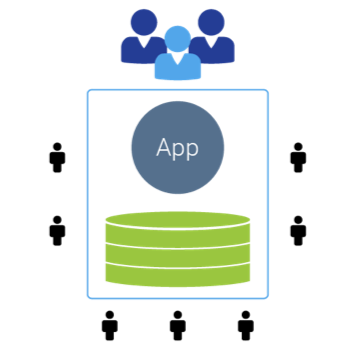
Figure 3: A multitenant model requires less resources and easier (and rolling) upgrades (i.e. no version numbers). Only one software instance and hardware stack for multiple tenants. All customers are always on the latest version of software. Locus Technologies figured this out in 1999, and it has become a key differentiator for us in the years since.  Locus can scale up infinitely without adding proportional cost. Others cannot.

Multi-tenant architecture

Figure 4: “Can’t we create a separate stack for just this one customer? I promise it’s just this one…” Even a single installation for one “special” customer breaks the multitenant model. Don’t do it.

I would also add that single-tenant (hybrid) cloud applications are worse than on-premises installments because they are fake clouds. In single tenancy, each customer has his or her independent database and instance of the software. These instances may reside on the same or different servers. In this model, a customer is, in fact, outsourcing maintenance of their application (software and hardware) to a vendor (or their consultant) that is not likely equipped to perform these tasks. No single vendor in the EHS software industry is large enough to undertake maintenance of the single-tenant infrastructure on behalf of their customers regardless of how inexpensive hardware or software virtualization may be. Even if they offer their hosting on Microsoft Azure Cloud or Amazon Web Services (AWS), they still cannot guarantee multitenancy as these solutions address only hardware challenges.

The Economist magazine described it as: “Those forerunners also promised a software revolution by hosting the software applications of companies. But they failed because they simply recreated each client’s complex and unwieldy data centre in their own basements, and never overcame the old problems of installation and integration with other software. With each new customer, the old ASPs had, in effect, to build another datacenter; there were few economies of scale.”

To improve their position in a shifting marketplace, on-premises EHS vendors have found a way to market their solutions as “cloud-based” when they are not backed by the fundamental principle of what that means. Considering the large investment that is associated with the purchase or licensing of EHS software, it is critical for customers to be able to discern a true cloud product from a fake one. But how can you spot a fake?

Just ask the EHS software vendor these four questions:

  1. Do you support both single-tenant and multi-tenant deployments of your software?
  2. Does your software have version numbers? 
  3. Do you charge for upgrades?
  4. Can we install your software on our infrastructure?

If the answer to any of these questions is yes, the vendor is not committed to multitenant architecture, and you should not move to their “cloud.”

Multitenancy is the only proven SaaS delivery architecture that eliminates many of the problems created by the traditional software licensing and upgrade model where software is installed as a single-tenant application on a customer’s premises or at a customer’s or vendor’s data center. In contrast, in multitenancy, all customers access the same software on one or a set of linked servers.

Multitenancy requires a new architectural approach. Companies have to develop applications from the ground up for multitenancy. Once companies commit their limited financial resources to one architecture, it becomes nearly impossible for them to switch to the multitenancy model, no matter how many resources they have available. Moreover, for this reason, I am skeptical that many current vendors will be able to make a switch to multitenancy.

A vendor who is invested in on-premise, hosted, and hybrid models cannot commit to providing all the benefits of a true SaaS model due to conflicting revenue models. Their resources are going to be spread thin supporting multiple versions rather than driving innovation. Additionally, if the vendor makes the majority of their revenue selling on-premise software, it will be very difficult for them to fully commit to a true SaaS solution since the majority of their resources will be allocated to supporting the on-premise software.

And if they suddenly introduce a “multitenant” model (after selling an on-premises version for 10+ years) who in the world would want to migrate to that experimental cloud without putting the contract out to bid to explore a switch to a well-established and market-tested true multitenant provider? Even Google and Microsoft are playing a catch-up game with Amazon’s AWS when it comes to cloud hosting businesses. The first mover advantage when it comes to multitenancy is a huge advantage for any vendor.

In summary, an EHS software vendor can be either truly multitenant or not. If a vendor has installed their software on somebody’s else hardware and runs multiple instances of that software (even if the code base is the same) they are not and will never be true multitenant.

Multi-tenant architecture

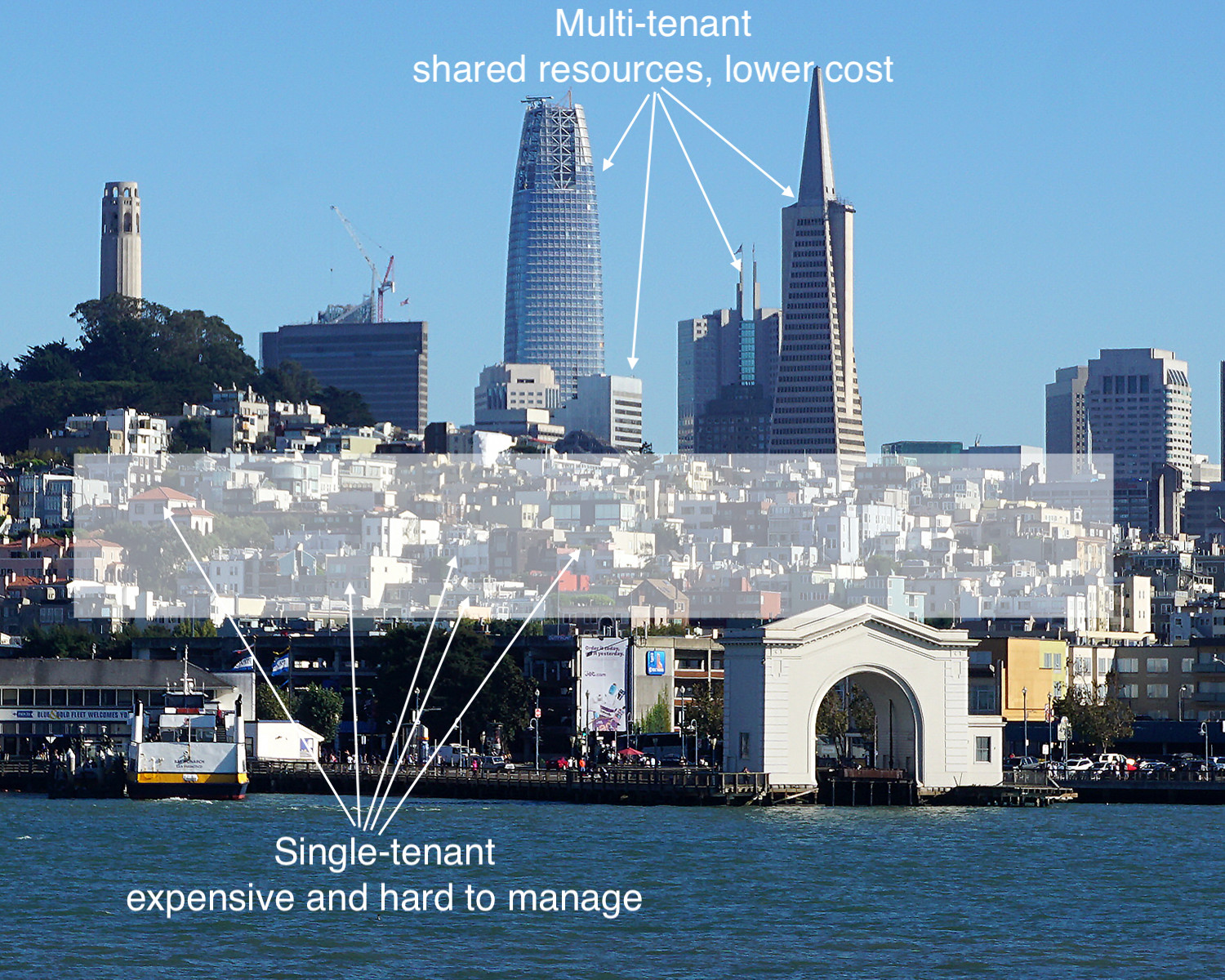
Figure 5: Where do you want your software to reside? In multitenant or single-tenant infrastructure? If multitenancy is attempted on old infrastructure or legacy application upgrade, watch out. After a vendor built the first few floors of that skyscraper, there is no easy way to replace the foundation. You will be lucky if they end up like the tower of Pisa or Millennium Tower in San Francisco. To keep the tower standing, they will have to do constant underpinning of the foundation and restrict access to the structure. And you, the customer, will pay for it. That is what many customers of single-tenant EHS vendors are facing today.

Therefore, when considering a SaaS solution, make sure that the vendor is a true SaaS vendor who is solely committed to the multitenant SaaS delivery model and has invested in a true multitenant platform. This is the only way to reap all the benefits that a SaaS model has to offer.

Webinar: IoT technology for enhanced environmental compliance

IoT is considered one of the fastest growing trends in technology and has a potentially huge impact to automate how we manage water quality, air emissions and other key environmental performance indicators for data monitoring.

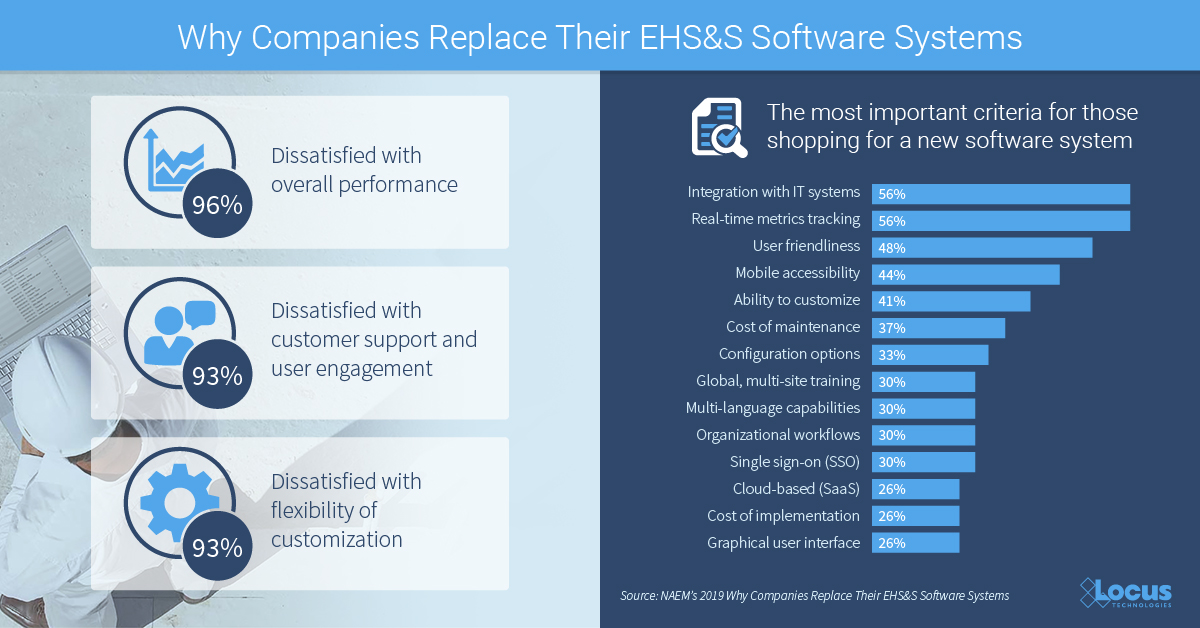
Thinking of buying configurable EHS software? Make sure to focus on the right questions

As most people researching EHS software know, the words “configurable”, “multi-tenant”, and “platform” are being discussed everywhere. There are plenty of other great discussions on Platform as a Service (PaaS) and multi-tenancy.  Let’s look at some tips for getting the most out of configurable software.

Locus Platform Configurability

Ask yourself “What sets us apart?”

A key question to ask (as soon as you start thinking about configurable software) is “what sets my company apart?”  What special challenges or circumstances make your EHS needs more nuanced or complex?

  • Are you in an industry or segment of the industry that may have unique tracking and reporting needs? Maybe you are an organic milk producer or only manufacture snacks from sustainable sources following global fair-trade policies.  These more specialized practices may require additional or unique reporting to maintain accreditation.
  • Do you handle non-standard materials in highly regulated environments (such as radioactive materials, for example) that impose additional handling, tracking, disposal, and reporting requirements?
  • Are you a global enterprise with highly variable reporting needs in multiple jurisdictions? Or are you operating in a location with demanding local regulations?
  • Are you operating in an uncertain regulatory environment?

These are just a few of the things that could set EHS customers apart.  The more unique or specialized tracking and reporting needs you have, the more you will value the ability to have software easily configured for requirements that are typically not supported in “off-the-shelf” solutions.

Most modern software handles the “basics” very well, but when you have unique or emerging needs—including future needs that you don’t even know about yet—having a configurable option really pays off.

When needs change, configurable software can be updated easily and quickly by the vendor or even your own in-house staff, saving time and avoiding the agony of “waiting for the next release”. And, best of all, those changes can be done by trained configuration staff, without the need for software developers and the cost and time usually associated with software development.

Configurable Building Blocks


Follow best practices and engage with industry peers

Learning and internalizing industry best practices, a hallmark of the EHS professional association NAEM and its outreach events, can help any software buyer make better choices and evaluate software features, platforms, and key differentiators.  Check out the excellent library of resources, including publications, newsletters, and webinars from industry peers.  By taking advantage of shared industry knowledge, you can dramatically streamline and expedite your search for the right solutions.

One word of caution: many industry publications can be influenced by sponsors.  This is not only true in the EHS domain, but in all industry expert reviews.  That’s why actually talking and comparing notes with industry colleagues is an invaluable resource to get beyond the reviews and hear about real-life experiences with the EHS domain itself and the software options that others have actually used.

If you’re looking for advice on how configurable software may be used to address your EHS needs, talking to actual software users will help.  Locus, along with many other vendors and hundreds of EHS professionals, routinely attends NAEM’s EHS and Sustainability Software and Data Management Conference in order to meet with potential customers and dive into any questions you may have.

Locus Platform Configurability


Know the boundaries of configurability

“Configurable” means something different to each software vendor.  Some will say “everything is configurable”—for a price.  Others will tell you that you can change report names and add a few fields to outputs, and they call this being “configurable”.

Ask the vendor to explain in detail exactly what can easily be configured—and what is “off limits” and requires actual development effort (i.e., additional cost).  You might ask:

  • Are application workflows easy to change, along with associated notifications and audit tracking?
  • Can I change my forms to add five new sections with new lookup values? Will the update be automatically reflected on my mobile forms?
  • Can I create an entire new application for tracking volume of green recycling vs. plastics (or anything else you need to track)? Will the new application show up on the mobile app, or is that a separate configuration?
  • Can the user interface look different based on the user’s role in the application? For example, could I streamline the interface for my technicians so they only see what is relevant for them?
  • Can I change the filter selections on my dashboard reports? How about the charts?  Can I add new charts?

By knowing the software’s limitations, you can make better choices on the best fit for your current (and future!) needs.  Your software vendor may also identify new configurable features that you hadn’t considered before, but that would greatly improve the usability of the software.  Even if you don’t need these options now, knowing you have access to them in the future is critical when selecting software.

Locus Platform Configurability

Beware the illusion of “the perfect fit”

As we’ve established, “configurable” software can mean anything—from a total blank slate and empty platform, to changing a title of a single data entry field, and everything in between.  A “blank slate” may excite more technical people who love to tinker in software programs.  For others, the thought of building their software from the ground up might elicit general fear and discomfort.

Most customers want something off-the-shelf that perfectly meets their needs. Honestly, who can disagree? That is the gold standard and what everyone wants.  In reality, this solution is hard to find—especially for customers with unique need—and often the software tools that address those unique needs are so focused on a particular niche that they neglect some of the other, more basic EHS needs you might have.

The good news is that configurable software provides almost unlimited options for customers, and it can make a huge difference in how the software fits into your EHS workflow.  With some solutions on the market today, you could choose to build one application from a blank slate and make minor tweaks to another pre-built application in the same software.

One of the common pitfalls that EHS professionals frequently encounter in selecting a software solution for a specialized need is the tendency to narrow their options down to limited set tailored to their specific industry.  For example, if your organization has requirements for refrigerant handling, you might feel constrained to selecting a solution with specific “out-of-the-box” capabilities for that need.  Considering the configurability of the software may allow you to consider new and more robust options, and some simple configurations to an existing chemical inventory application could address your refrigerant reporting needs even more accurately, within a single EHS platform.

Locus Platform Configurability


Change is inevitable—make sure your software can handle it

Many customers will buy existing applications that meet their general needs, but eventually realize they need another form, a mobile solution, or changes for new regulations.  Anyone in the EHS industry knows this is the norm rather than the exception.

According to Forbes, federal departments, agencies, and commissions issued 3,853 rules in 2016, while Congress passed and the president signed 214 bills into law—a ratio of 18 rules for every law.  That’s just at the federal level.  It’s not hard to imagine the amount of change when you factor in state and local rules and requirements.

Over the anticipated implementation life for your EHS software, you can be reasonably assured that the EHS requirements for your organization are going to be changed in some way.  Some of these changes you can anticipate, but not all.  Given such routine change, you can safely assume that the more configuration options you have, the more prepared you’ll be for those changes.  You’ll be in a better position if you know you can configure your software quickly, rather than waiting for a scheduled vendor update that may be out of your control.

Locus Platform Configurability


Develop a vision of success—for today and tomorrow

Configurable software can be an effective, sustainable long-term management and reporting solution that integrates smoothly into your existing EHS workflows, but it does require you to do your homework.

You can set yourself up for success with some initial reflection and examination of your organization’s unique needs, a few conversations with industry peers, a healthy skepticism of seemingly perfect “out-of-the-box” solutions, and a willingness to ask tough questions of potential software vendors.  Think ahead to the future challenges and regulatory changes that might impact your organization, and make sure your potential software vendor has provided evidence that you’ll be able to handle these changes through configuration.  Take the time to truly imagine your perfect application and EHS workflow, and ask the vendor to show how it can be possible through configurability.  And finally, don’t be afraid to think outside the box!

Locus configurable solutions


Marian Carr

About guest blogger— Marian Carr, Locus Technologies

Ms. Carr is responsible for managing overall customer solution deployments and customer relationships with Locus’ government accounts. Her career at Locus includes heading the product development team of the award-winning cloud-based environmental ePortal solution as well as maintaining and growing key customer accounts with Locus’ Fortune 100 enterprise deployments. In addition, Ms. Carr was instrumental in driving the growth and adoption of the Locus EIM platform with key federal and water organizations.


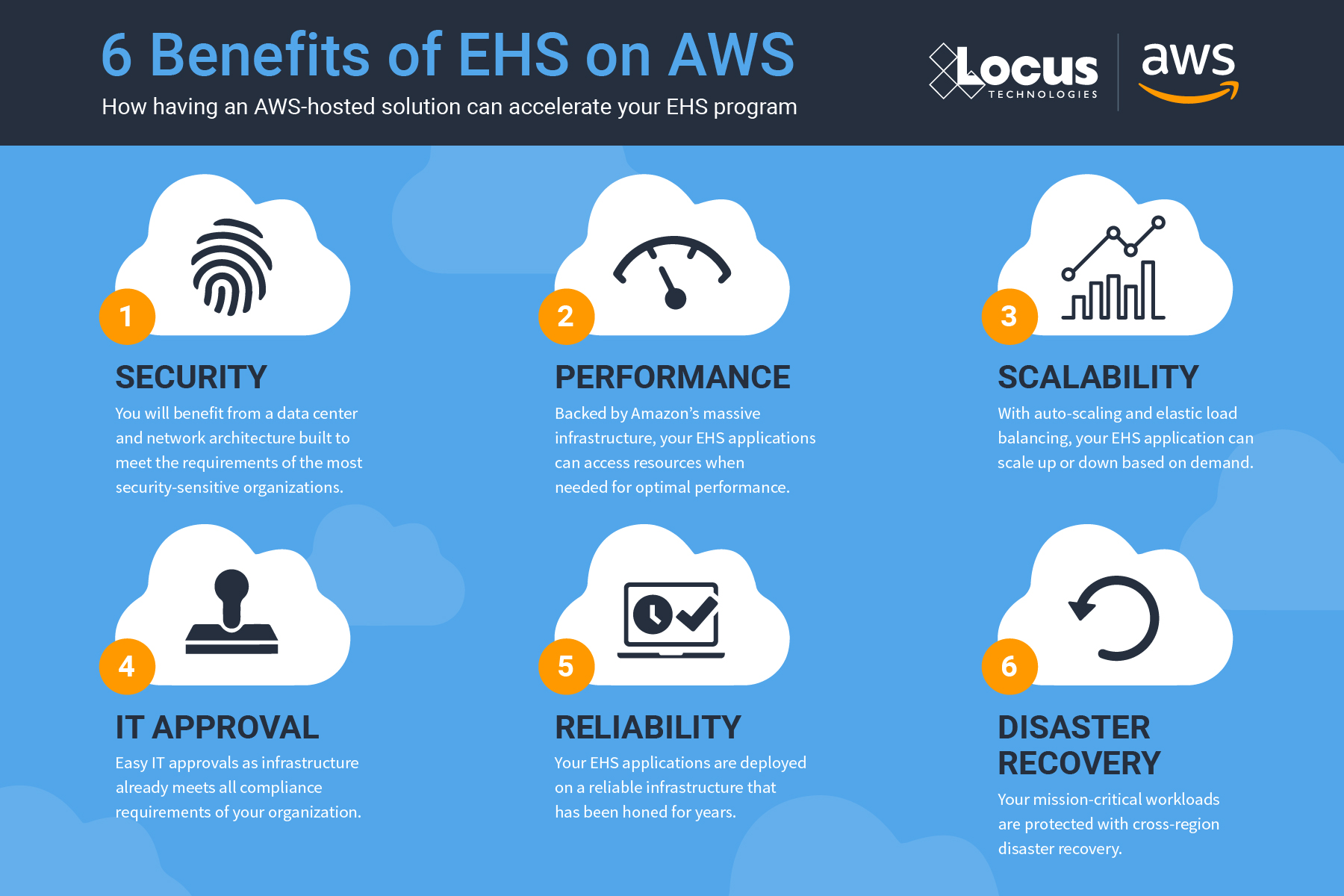
Why multitenancy matters for EHS software as a service (SaaS)

Why multitenancy matters for EHS software as a service (SaaS)

Despite the fact that multitenancy is a distinction that has been around for a very long time, even in 2025, there is a considerable degree of confusion in the EHS software space when it comes to the importance of multitenancy. That confusion may be intentionally perpetuated by EHS software companies that are unable to support multitenancy. We will try to clarify its importance here.

EHS software vendors that are not engineered for multitenancy make wild claims to prospective customers. For example:

  • They might claim multitenancy is a “techie” thing that doesn’t need to be part of the conversation, or
  • They might say anything to make the sale, such as “sure, we can do multi-tenant, single tenant, whatever you need!”

Unfortunately, those vendors simply do not understand what they are talking about.  Multitenancy is a major shift in computing and requires an all-new approach to software architecture and delivery models.  It is transformational, and customers who intend to buy the next generation of EHS software should take the time to understand the real meaning and importance of multitenancy.

Multitenancy is the core foundation of SaaS in the EHS market and beyond

Multitenancy is the core foundation of modern SaaS, and it shouldn’t be taken lightly, generalized, or massaged into something that suits a vendor’s self-serving interpretation of a SaaS model.  Having experienced the true benefits of multitenant SaaS first-hand, I can’t fathom how SaaS would have delivered those benefits if it hadn’t been multitenant. It’s not a trivial attribute that vendors can make optional — it’s fundamental to the offering.  For example, imagine companies like Salesforce, Google, or Amazon offering a “single-tenant” solution side-by-side with their multitenant clouds?  One could argue that a company offering a single-tenant solution cannot be a serious contender in offering multi-tenant SaaS.

I would also add that single-tenant (hybrid) cloud applications are worse than on-premise installments.  Why?  Because they are fake clouds.  In these instances, a customer is, in fact, outsourcing maintenance of their application to a vendor that is not equipped for that maintenance.  No single vendor in the EHS software industry is large enough to undertake maintenance of the single-tenant infrastructure on behalf of their customers, regardless how inexpensive hardware may be at the time.

There are many ways to take the functions of on-premise installed software model of the 1980s and package them as services.  Some of these service delivery modes, such as ASP, single-tenant hosting, and hybrid clouds, merely relocate and reassign long-standing problems. They might even make them worse.  In a single-tenant model, user customizations may infiltrate throughout the stack in a way that makes it difficult to upgrade the performance of the stack.  The true SaaS models confront and mitigate (or even eliminate) the most vexing elements of software installation and maintenance:

  • configurability on the fly,
  • software maintenance, and
  • upgrades.

It is “a tyranny of software upgrades” that kills the single-tenant model.

An analogy for multitenancy vs single tenancy: AC/DC (but not the rock band)

Let me offer a simple analogy to drive home the point as to why multitenancy matters: Tesla vs. Edison and the War of Currents.

The War of Currents was a series of events surrounding the introduction of competing electric power transmission systems in the late 1880s and early 1890s. It pitted companies against one another and involved a debate over cost and convenience of electricity generation and distribution systems, electrical safety, and a media/propaganda campaign. The main players were the direct current (DC) based on the Thomas Edison Electric Light Company and the supporters of alternating current (AC) based on Nikola Tesla’s inventions backed by Westinghouse.

With electricity supplies in their infancy, a lot depended on choosing the right technology to power homes and businesses across the country.  The Edison-led group argued for DC current that required a power generating station every few city blocks, like the single-tenant model. In contrast, the AC group advocated for a centralized generation with transmission lines that could move electricity great distances with minimal loss (multitenant model).

The lower cost of AC power distribution and fewer generating stations eventually prevailed.  Multitenancy is the equivalent of AC when it comes to cost, convenience, and network effect.  You can read more about how this analogy relates to SaaS in the book by Nicholas Carr, “Big Switch,” a Wall Street Journal bestseller. It’s “the best read so far about the significance of the shift to cloud computing,” said Financial Times.

The impact on EHS, ESG, and water programs

Given these fundamental differences between different modes of delivering software as a service, it is clear that the future lies with the multitenant model. While Locus has been pioneering the use of multitenancy in the EHS software space for years, most vendors have been laggards.

Whether all customer data is put onto one database or onto multiple databases is of no consequence to the customer.  For those arguing against it, it is like an assertion that companies “do not want to put all their money into the same bank account as their competitors.” In reality, those companies are putting their money into different accounts at the same bank.

When customers of a financial institution share what does not need to be partitioned, such as the transactional logic, database maintenance tools, security, and physical infrastructure and insurance offered by a major financial institution, then they enjoy advantages of security, capacity, consistency, and reliability that would not be affordably deliverable in isolated parallel systems.

In enterprise cloud applications and cloud application platforms, multitenancy yields a compelling combination of efficiency and capability without sacrificing flexibility or governance.

When a software provider seeks to blur the distinctions between one technology and another, there’s usually just one reason: they are unable to offer the superior technology to their customers, and they hope to persuade their customers that real differences are not relevant to their needs.  Multitenant platforms for enterprise on-demand applications represent genuine opportunities for customer advantage.  The reality of multitenant differentiation is acknowledged by authoritative industry analysts such as Gartner and other analyst firms.

Hosting models that do not leverage multitenancy don’t belong in the same discussion as the value proposition implied by the term, “SaaS”.  Multitenancy is a difference that makes a difference.


Why SaaS multitenancy is key to successful and sustainable EHS management

A recently published survey by a research analyst firm indicates that 90 percent of EHS software applications installed today are single-tenant on customer premises or single-tenant, vendor hosted.  Only 10 percent are multitenant, vendor-hosted. In other words, most of the vendors in the EH&S space do not run a single version of their software maintained at one location. Instead, they run multiple copies at a single or multiple locations, with the high likelihood that these multiple copies are not alike, but instead represent multiple versions or contain specific customizations for individual customers. This model is crushing their growth and scalability potential.

Locus delivers EHS+S SaaS solutions as highly scalable, Software as a Service (SaaS) application and platform services on a multitenant technology architecture. Multitenancy is an architectural approach that allows Locus to operate a single application instance for multiple organizations, treating all customers as separate tenants who run in virtual isolation from each other. Customers can use and customize an application as though they each have a separate instance, yet their data and customizations remain secure and insulated from the activities of all other tenants. Locus multitenant services run on a single stack of hardware and software, which is comprised of commercially available hardware and a  combination of proprietary and commercially available software. As a result, Locus can spread the cost of delivering EHS SaaS services across user base, which lowers the cost for each customer. Also, because Locus does not have to manage thousands of distinct applications with their business logic and database schemas, we believe that we can scale our business faster than traditional software vendors. Moreover, we can focus our resources on building new functionality to deliver to customer base as a whole rather than on maintaining an infrastructure to support each of their distinct applications.

Multitenancy also allows for faster bug and security fixes, automatic software updates and the ability to deploy major releases and frequent, incremental improvements to Locus’ services, benefiting the entire user community. Our services are optimized to run on specific databases and operating systems using the tools and platforms best suited to serve customers rather than on-premise software that must be written to the different hardware, operating systems and database platforms existing within a customer’s unique systems environment. Locus developers build and support solutions and features on a single code base on our chosen technology platform. Locus efforts are focused on improving and enhancing the features, functionality, performance, availability and security of existing service offerings as well as developing new features, functionality, and services.

Locus customers and third-party developers can create apps rapidly because of the ease of use of Locus Platform and the benefits of a multitenant platform. Locus provides the capability for business users to configure applications easily to suit their specific needs.

Also, Locus multitenant cloud platform makes it possible to use a remarkably small number of servers as efficiently as possible. When organizations move business applications to Locus, they can significantly reduce their energy use and carbon footprints compared to traditional on-premises or single-tenant or ASP solutions

Locus built and maintains a multitenant application architecture that has been designed to enable service to scale securely, reliably and cost effectively. Locus’ multitenant application architecture maintains the integrity and separation of customer data while still permitting all customers to use the same application functionality simultaneously.

Both Locus and its data centers providers hold independent  AICPA SOC1 (SSAE16)  and SOC2 certification.

Tag Archive for: SaaS

Nothing Found

Sorry, no posts matched your criteria