By Neno Duplan, Founder and CEO, Locus Technologies
Reading Time: 13 minutes 8 seconds
TL;DR: Drinking water utilities and wastewater agencies are managing PFAS under a set of pressures that no asset management system, laboratory report filing cabinet, or compliance checklist tool was designed to handle. EPA has retained enforceable 4 parts per trillion limits for PFOA and PFOS with a compliance deadline now extended to 2031, while AWWA estimates the capital investment needed to meet PFAS treatment standards at $37.1 to $48.3 billion across the sector.¹ Locus EIM has been built for exactly this kind of program, managing 4,603,084 validated PFAS records, and this article explains what that means in practice for a water system or wastewater agency trying to build a defensible, connected compliance program.

Water utility professionals deal in a currency that many organizations don’t: public trust. Regulators review your Consumer Confidence Reports and expect the numbers to be right. Ratepayers want to know what is in their tap water and they want a straight answer. State primacy agencies reviewing your monitoring records expect a complete, auditable chain of evidence. And a public that has watched years of PFAS litigation coverage and settlement proceedings is asking pointed questions about what their water system is doing, and when it started doing it.
None of that pressure looks like the PFAS challenge facing a chemical manufacturer, where the primary concern is industrial liability and regulatory defense. Water utilities and wastewater agencies have those concerns, too, but they also carry something no industrial company faces: a federal obligation to tell the public what they found, in a format ordinary people can read, issued on a schedule set by the Safe Drinking Water Act. The software running your PFAS monitoring program needs to be built for that reality, not retrofitted to approximate it.
The Financial Pressure Underneath the Compliance Pressure
The context in which water utility environmental professionals are working right now shapes everything about what a PFAS compliance system needs to do. Over the next 25 years, AWWA projects total drinking water infrastructure needs at $2.1 to $2.4 trillion in 2025 dollars, far exceeding earlier estimates tied solely to buried infrastructure. Current capital spending averages about $33.6 billion per year, while the annual investment needed to meet projected requirements is approximately $90.2 billion, leaving an annual funding gap of roughly $56.6 billion.² PFAS treatment is one of the primary new cost drivers in that equation. AWWA estimates that capital investments needed to install PFAS treatment infrastructure to meet current drinking water standards will total between $37.1 billion and $48.3 billion over the next five years, with combined operations, maintenance, and monitoring costs adding $2.7 to $3.5 billion per year on top of that.¹
If ratepayers alone are asked to fill the funding gap, average annual household drinking water bills would more than double from $429 in 2025 to $969 by 2050, in 2025 dollars.²
One of Locus’s smaller water utility customers, serving approximately one million customers, is facing a significant PFAS compliance and water-quality management challenge. The utility has been proactively monitoring PFAS across its drinking-water sources, generating a large volume of sampling and laboratory data while evaluating treatment options for impacted wells and facilities. With new federal PFAS drinking-water standards creating enforceable compliance obligations, the issue has become a major enterprise priority involving capital planning, regulatory reporting, treatment implementation, public communication, and long-term data management. The scale is substantial: approximately $400 million has been set aside for PFAS-related treatment and compliance, which equates to roughly $400 per customer if spread across one million customers. For Locus, this illustrates why PFAS is not a side issue for water utilities, but a core operational, compliance, and customer-confidence challenge where robust environmental data management is directly relevant.
In this type of environment, every capital investment decision carries real weight. The quality of a utility’s monitoring data connects directly to its ability to make sound treatment investment decisions, access state revolving fund financing, and demonstrate to regulators and the public that the problem is being managed responsibly. A utility whose PFAS data is scattered across spreadsheets, laboratory PDFs in file shares, disconnected SCADA exports, single-tenant cloud software, and consultant-managed datasets cannot answer the question regulators and ratepayers will keep asking: what do you know, when did you know it, and what are you doing about it?
What the Regulatory Calendar Actually Requires
The current PFAS regulatory picture for drinking water utilities involves more moving parts than most compliance teams are tracking simultaneously, and the picture keeps changing.
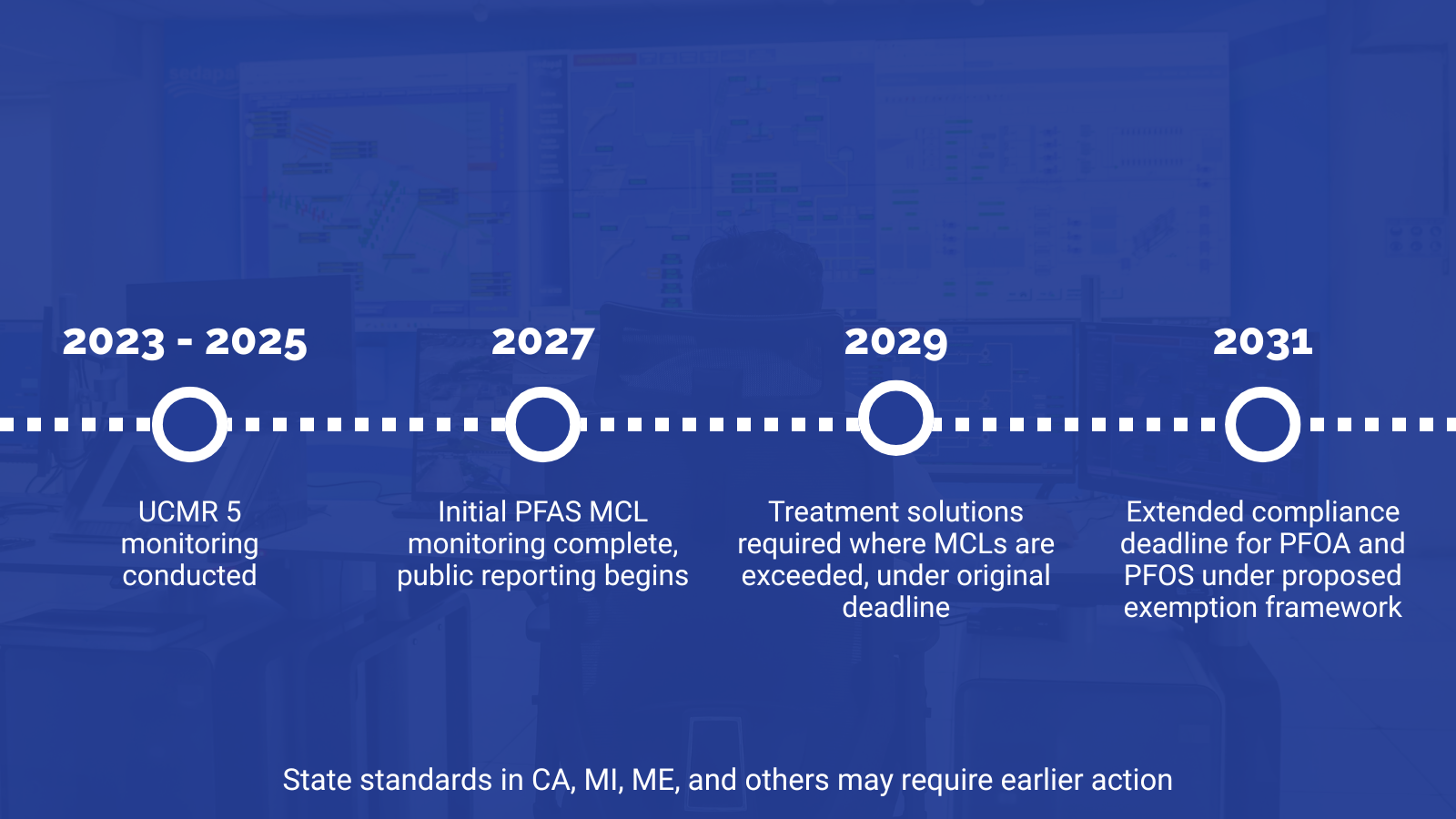
The US EPA established legally enforceable Maximum Contaminant Levels for six PFAS in drinking water, with compliance determined by running annual averages at the sampling point. Public water systems must complete initial monitoring by 2027, followed by ongoing compliance monitoring, and must provide the public with information on PFAS levels in their drinking water beginning in 2027.³ The PFOA and PFOS MCLs remain at 4.0 parts per trillion. Systems requesting and receiving a federal exemption under the proposed extension rule would have two additional years to achieve compliance, though all monitoring and reporting requirements remain on the original schedule under the April 2024 rule.⁴
The wastewater regulatory horizon is extending on a separate track. EPA published a Draft Sewage Sludge Risk Assessment for PFOA and PFOS that does not yet establish enforceable limits for PFAS in biosolids but provides data that state regulators and organizations handling biosolids are already acting on.⁵ States including California, Michigan, and Maine have moved ahead of federal standards with their own PFAS limits for wastewater discharges and biosolids management. A draft multi-sector general permit would require operators in 23 industrial sectors to monitor for 40 PFAS compounds quarterly in areas where the EPA holds NPDES permitting authority.⁵ Wastewater agencies running industrial pretreatment programs are dealing with the downstream consequences of that expansion whether their data systems were designed for it or not.
This layered, multi-program regulatory picture does not fit in a spreadsheet.
The Problem with the Tools Most Utilities Are Using
The technology landscape for water utilities has historically organized itself around two categories of software: (1) utility operations platforms covering SCADA, asset management, billing, and work order management, and (2) laboratory information management systems handling the lab side of analytical data. Neither category was designed for environmental compliance data management at the scale and complexity that PFAS now demands.
Asset management systems track infrastructure, maintenance schedules, and capital planning. They were not built to manage the chain from a field sample collection through laboratory analysis, quality control validation, running average calculation, and regulatory reporting. SCADA systems capture real-time operational data but cannot handle laboratory electronic data deliverables or produce the defensible, auditable compliance record that regulators require. Laboratory information management systems handle the laboratory workflow but typically stop when the data leaves the lab. What happens to that data when it arrives at the utility, how it gets validated against the compliance monitoring plan, how it feeds running average calculations, and how it ultimately becomes a Consumer Confidence Report entry or a regulatory submission are not LIMS functions.
The result at most utilities is a data gap between the laboratory and the compliance record. Results arrive and get filed. Someone calculates the running average in a spreadsheet. The CCR gets assembled manually each year from multiple sources that were never designed to talk to each other. If a regulator asks for the chain of custody for a result reported three years ago, finding it requires a search through systems that were never built for that purpose.
PFAS has turned that administrative gap into a compliance and public relations risk with a defined regulatory deadline attached to it.
What “Built for Environmental Science” Means for a Water Utility
Locus EIM has been the foundation of our platform since 1999. We built EIM around analytical data: field samples, laboratory results, electronic data deliverables, quality control parameters, chain-of-custody documentation, and the regulatory calculations that flow from all of it. Water utilities and wastewater agencies are exactly the kind of organizations the platform was designed for, and the difference from an asset management system or a repurposed compliance checklist tool shows in specific, practical ways.
Locus EIM’s PFAS chemical library is complete and current. All 430 compounds in the EPA’s analytical inventory are in the system with the associated CAS numbers, analytical methods, and detection limit parameters. When EPA Method 533 or Method 537.1 results arrive from a certified laboratory, Locus EIM already knows what to do with them. When the regulatory list of monitored compounds expands, the system accommodates that expansion without configuration work measured in months.
The data chain from sample to report runs as a single connected workflow. A sampling event generates a sample collection record. Samples go to the laboratory and come back as an electronic data deliverable. The EDD loads into the system, where automated validation checks flag results that fall outside expected parameters, below method detection limits, or outside the quality control criteria in the sampling and analysis plan. Validated results flow into compliance calculations. Calculations feed regulatory reports. Every step is connected, auditable, and traceable. When a regulator asks about a result that appeared in a 2024 Consumer Confidence Report, the supporting laboratory report, chain of custody, QC data, and calculation methodology are accessible in seconds.
The Locus EIM calculation engine reflects the realities of PFAS monitoring at regulatory scale: annual averages across multiple sampling points, defensible treatment of non-detects in compliance averaging, exceedance tracking with the correct notification thresholds, source-water monitoring against health advisory levels, and treatment-performance tracking against design targets. No other EHS or water-compliance software can match Locus’s depth of PFAS experience. Locus has maintained and managed what we believe is the largest validated PFAS database in the United States, with 4,603,084 PFAS records drawn from real monitoring programs operating under real regulatory scrutiny as of today. That knowledge is built back into the platform and shared across our customer base, so each customer benefits from decades of accumulated validation, regulatory interpretation, and field-tested calculation logic. A utility attempting to recreate this capability in spreadsheets, single-tenant disconnected databases, or legacy point systems is not just building calculations from scratch; it is assuming the full burden of validation, defensibility, audit exposure, and regulatory risk on its own.
The GIS layer connects every result to its geographic context. PFAS exists in a watershed, in an aquifer, at a treatment plant intake, in a distribution system – not in a data table. Understanding where detections are occurring, what potential sources might explain them, how concentrations are trending over time, and what the exposure implications are for different customer populations all require geographic intelligence, not just tabular reporting. Every monitoring location in Locus EIM carries a coordinate that ties the analytical result to the physical world.
The Wastewater Dimension: A Different Set of Obligations
Wastewater agencies face a PFAS challenge that is meaningfully different from the drinking water side, and worth addressing directly because the two programs are often managed by separate teams using separate tools, even within the same organization.
A wastewater agency’s PFAS obligations run across multiple programs at once. Industrial pretreatment programs are the first line of source identification: which industrial dischargers in the collection system are contributing PFAS to influent flows, and at what concentrations? Permit compliance monitoring tracks whether the agency’s own effluent meets applicable discharge limits. Biosolids management is an emerging and rapidly evolving obligation, as PFAS increasingly restricts beneficial reuse options, creates liability exposure in disposal decisions, and requires documentation connecting the biosolids PFAS profile to contributing industrial sources. Receiving water monitoring tracks whether the discharge is affecting downstream water quality.
Each of those programs generates its own monitoring data. In most agencies, that data lives in separate places and gets reported through separate processes. The pretreatment coordinator tracks industrial user sampling. The operations team manages plant effluent monitoring. The biosolids program manages land application records. When a state regulator asks for a comprehensive picture of the agency’s PFAS data across all those programs, assembling the answer is a project, not a report.
Locus connects all of those programs on a shared data layer. Industrial pretreatment monitoring results, effluent compliance data, biosolids sampling records, and receiving water monitoring all live in the same system, with the same underlying data model and the same analytical and reporting tools. When a regulator or an attorney asks for the full picture, pulling it together is a query, not a weeks-long exercise.
A Practical Path Forward for Drinking Water Utilities and Wastewater Agencies
If your organization is managing PFAS obligations with spreadsheets, laboratory reports in file shares, a repurposed asset management system, or a collection of disconnected tools, the question worth asking is how much operational, regulatory, and financial risk is accumulating while you rely on systems that were never designed for environmental monitoring at this scale.
Here is what a move to Locus Technologies looks like in practical terms.
You begin with your existing data. Locus EIM can ingest historical PFAS monitoring results from virtually any source: laboratory electronic data deliverables, spreadsheets, SCADA exports, compliance databases, legacy environmental systems, and consultant-managed datasets. Decades of sampling history can be organized into a defensible, searchable, spatially referenced environmental record.
You do not spend months building a PFAS database. The compounds are already in Locus, as are the EPA methods and laboratory validation rules. Federal and state drinking water standards, wastewater permit requirements, and health advisory thresholds can be maintained as regulations continue to evolve.
You get a calculation and compliance engine built for real-world monitoring programs. Whether you are managing MCLs, source water monitoring, treatment performance tracking, permit compliance, trend analysis, or public reporting requirements, the calculations are already there. Running averages, detection limit handling, data validation, exceedance tracking, and reporting workflows are delivered as part of the platform.
You get complete traceability from sample collection through laboratory analysis and final reporting. Every sample, chain-of-custody record, laboratory result, quality control parameter, validation flag, and reporting action is connected and auditable. When regulators, auditors, consultants, or the public ask questions about a reported result, the supporting evidence is immediately available.
You get a GIS-enabled platform that places every sample, well, intake, treatment process, monitoring station, outfall, and discharge point in its geographic context. PFAS is a spatial problem. Understanding trends, migration pathways, potential sources, impacted customers, receiving water, and treatment effectiveness requires geographic intelligence, not just rows and columns.
For drinking water utilities, this means connecting PFAS monitoring to source water protection, treatment optimization, distribution system management, Consumer Confidence Reporting, and long-term capital planning.
For wastewater agencies, it means connecting PFAS monitoring to industrial pretreatment programs, source identification, collection system management, biosolids programs, receiving water impacts, permit compliance, and emerging regulatory requirements.
More broadly, it means a platform that connects PFAS data to the full scope of the water utility mission. PFAS results influence operational decisions, treatment investments, regulatory reporting, public communications, legal exposure, and long-term infrastructure planning. Locus provides a single environmental information platform for managing all of those responsibilities from a common foundation of trusted, validated data.
As PFAS regulation expands across drinking water systems, wastewater discharges, biosolids management, and source control programs, the organizations that come through it well will be the ones that built their monitoring programs on a defensible data foundation before regulators and ratepayers demanded to see one.
Frequently Asked Questions
What is the difference between an asset management system and environmental information management software for PFAS compliance?
Asset management systems were built to track infrastructure, maintenance cycles, capital replacement schedules, and work orders. Environmental information management software was built to handle different kinds of data: field samples, laboratory results, chain-of-custody documentation, quality control parameters, and the regulatory calculations that determine compliance status. PFAS monitoring requires the latter. Locus EIM has been built around analytical environmental data since 1999, which is why the full chain from sample planning through Consumer Confidence Reporting is handled natively, without workarounds.
How does Locus EIM handle Consumer Confidence Report requirements for PFAS?
The CCR obligation requires utilities to report PFAS levels detected in their drinking water to customers beginning in 2027. Locus EIM connects the analytical results from your monitoring program directly to reporting workflows, so the data feeding your CCR is the same validated, quality-controlled data supporting your regulatory submissions. There is no manual re-entry, no reconciliation between a compliance database and a reporting spreadsheet, and no risk that the figure in the CCR differs from the figure in the monitoring record. Every CCR entry carries a complete audit trail back to the original laboratory result.
What does PFAS monitoring mean for a wastewater agency’s biosolids program?
Biosolids management is one of the most rapidly evolving PFAS obligations facing wastewater agencies. EPA’s draft sewage sludge risk assessment for PFOA and PFOS does not yet establish enforceable federal limits, but several states have already set their own standards, and the direction of future federal regulation is visible in the draft document. PFAS concentrations in biosolids increasingly restrict beneficial reuse options including land application, create liability exposure in disposal decisions, and require documentation connecting the biosolids PFAS profile to contributing industrial sources identified through pretreatment monitoring. Locus EIM connects biosolids sampling data to the broader monitoring program, including industrial pretreatment results that help trace contributing sources and effluent compliance monitoring that tracks PFAS through the full treatment system.
How should utilities be managing their data given the compliance deadline extension to 2031?
The extension of the PFOA and PFOS compliance deadline provides additional time to install treatment infrastructure, but the monitoring and reporting obligations that begin in 2027 remain unchanged. Utilities must still complete initial monitoring by 2027 and report results to the public on the original schedule. The extension also has no effect on state-level PFAS standards, which in California, Michigan, Maine, and other states are more stringent than federal MCLs and carry their own timelines. The practical value of the extended deadline is the opportunity to make sound treatment investment decisions based on a complete monitoring record, rather than making capital commitments before the full picture is clear. A utility that uses this period to build a defensible, well-organized PFAS data program is in a fundamentally better position to choose the right treatment approach than one working from a patchwork of spreadsheets and lab report PDFs.
Can Locus EIM handle PFAS data from both drinking water and wastewater programs in the same system?
Yes, and for organizations managing both programs, having them in a single system is a huge advantage. Locus EIM is built around a shared data model that accommodates monitoring data from source water, treatment, distribution, collection systems, wastewater treatment, and receiving water programs on one platform. A water resource recovery facility that also operates a drinking water system can manage all of its PFAS monitoring in one place, with consistent data structures, shared location and GIS information, and unified reporting. That is not possible when the drinking water compliance database and the wastewater permit compliance system are separate tools that were never built to exchange data with each other.
Neno Duplan is the founder and CEO of Locus Technologies, which he established on April 11, 1997, in San Francisco, California. Locus manages more than 532 million environmental records across 1.6 million sites globally, including 4,603,084 validated PFAS records across more than 38,000 sites, covering all 430 compounds in the EPA analytical inventory. To learn more about Locus EIM and PFAS data management for water utilities and wastewater agencies, visit locustec.com or schedule a demonstration.
Footnotes
¹ American Water Works Association. “Forever Chemicals 2025 Update.” Gabelli Funds analysis citing AWWA-sponsored study. Available at: https://gabelli.com/research/forever-chemicals-2025-update/. AWWA estimates capital investment for PFAS treatment infrastructure at $37.1 to $48.3 billion over five years, with annualized operations, maintenance, and monitoring costs of $2.7 to $3.5 billion per year.
² American Water Works Association. “Beyond the Replacement Era: Balancing Compounding Infrastructure Needs with Household Affordability.” March 2026. Available at: https://www.awwa.org/beyond-the-replacement-era/. Total drinking water infrastructure needs projected at $2.1 to $2.4 trillion over 25 years (2026 to 2050) in 2025 dollars. Annual investment needed: approximately $90.2 billion. Current annual capital spending: approximately $33.6 billion. Projected household bill increase: $429 in 2025 to $969 by 2050 if funding gap is addressed entirely through rate increases.
³ U.S. Environmental Protection Agency. “Per- and Polyfluoroalkyl Substances (PFAS).” EPA Safe Drinking Water Act page. Available at: https://www.epa.gov/sdwa/and-polyfluoroalkyl-substances-pfas. EPA finalized the National Primary Drinking Water Regulation for six PFAS on April 10, 2024, establishing enforceable MCLs with initial monitoring required by 2027 and public reporting beginning in 2027.
⁴ U.S. Environmental Protection Agency. “Proposed PFOA and PFOS Compliance Extension Rule.” May 2026. Available at: https://www.epa.gov/sdwa/proposed-pfoa-and-pfos-compliance-extension-rule. Proposed rule would provide eligible systems an option to request up to two additional years, extending compliance to 2031, while all monitoring and reporting requirements remain on the original schedule.
⁵ Manko, Gold, Katcher and Fox. “Federal PFAS Regulation and Litigation: Developments, Implementation, and the Second Year of the Trump Administration.” January 2026. Available at: https://www.mankogold.com/publications-PFAS-TSCA-CERCLA-RCRA-EPCRA-Corporate-Compliance.html. Covers EPA Draft Sewage Sludge Risk Assessment for PFOA and PFOS and the draft multi-sector general permit requiring 23 industrial sectors to monitor for 40 PFAS compounds quarterly.
Locus is the only self-funded water, air, soil, biological, energy, and waste EHS software company that is still owned and managed by its founder. The brightest minds in environmental science, embodied carbon, CO2 emissions, refrigerants, and PFAS hang their hats at Locus, and they’ve helped us to become a market leader in EHS software. Every client-facing employee at Locus has an advanced degree in science or professional EHS experience, and they incubate new ideas every day – such as how machine learning, AI, blockchain, and the Internet of Things will up the ante for EHS software, ESG, and sustainability.