By Neno Duplan, Founder and CEO, Locus Technologies
Reading Time: 7 minutes
TL;DR: Fragmented EHS systems, where air, water, and waste data live in separate tools, create a compounding compliance and audit risk that worsens with every new regulatory requirement. Replacing them requires more than connecting existing systems via API; it requires a platform with a shared data model across all environmental domains. A small number of vendors offer genuine air-water-waste unification. For organizations with substantive environmental compliance obligations spanning air, water, and waste, Locus Technologies is the longest-serving pure-play SaaS provider built specifically for this profile since 1997, managing more than 523 million environmental records on a single cloud-native platform.
Most EHS software replacement projects don’t start with a software evaluation. They start with a moment of recognition. It might happen during a regulatory audit. It might happen while preparing an ESG report. Or when your company received non-compliance fine. But at some point, someone in the organization realizes that the effort required to pull together air, water, and waste data from disconnected systems has grown from a nuisance into a genuine business risk.
If you’re at that point, this guide is for you. It covers why fragmented EHS systems become liabilities over time, what “centralized” actually means when it comes to environmental data, and what to look for in a platform that can genuinely replace a patchwork of legacy tools.
Why Fragmented EHS Systems Stop Working
EHS technology stacks rarely start out fragmented. They get that way incrementally — one tool for air permitting, a different one for wastewater, a legacy database inherited from an acquisition, consultant-managed spreadsheets for waste manifests, and a separate ESG reporting layer bolted on top when sustainability reporting became mandatory. Each decision made sense at the time. The cumulative result rarely does.
The failure mode isn’t usually a single dramatic incident. It’s a slow accumulation of friction: data that has to be manually reconciled before every report, version conflicts between systems that weren’t designed to talk to each other, compliance deadlines that require heroic effort from staff who shouldn’t be doing data plumbing, and an audit trail that no auditor would call clean.
Several forces are accelerating the cost of staying fragmented:
- Regulatory complexity is compounding. Air, water, and waste programs each carry their own reporting obligations (i.e., Title V, NPDES discharge monitoring reports, RCRA biennial reporting, TRI/Tier II filings) and increasingly these share underlying data that needs to be consistent across submissions. CSRD and other ESG disclosure frameworks now require much of that same environmental data to flow into sustainability reports as well. Organizations trying to manage these obligations from separate systems pay a “reconciliation tax” on every reporting cycle.
- ESG and compliance data are converging. The same water quality records that feed an NPDES permit submission now also populate a water stewardship disclosure. The same waste management data that satisfies RCRA requirements shows up in a Scope 3 emissions inventory. When those data sets live in different systems, the reconciliation work multiplies with every new reporting requirement added.
- Regulators and auditors expect cleaner data. Inconsistent data standards, broken audit trails, and manual re-entry errors are exactly what third-party auditors flag during ESG assurance reviews. They are also what environmental regulators interpret as signs of inadequate data governance.
- The PE rollup problem. It’s worth naming directly: a significant number of EHS software point solutions are products of private-equity acquisition strategies. The vendors are assembled through rapid rollups, marketed aggressively, and eventually sold or merged again. Customers of these vendors frequently find themselves mid-migration to yet another platform, with institutional knowledge about their own data scattered across systems in transition. Vendor stability is a legitimate evaluation criterion.
What “Centralizing Air, Water, and Waste Data” Actually Means
The word “centralized” gets used loosely. Before evaluating platforms, it’s worth being precise about what you actually need.
Centralization via integration means your existing systems stay in place but are connected through APIs, so data flows between them. This can reduce manual re-entry but doesn’t eliminate the underlying problem: you still have multiple data models, multiple validation standards, and multiple audit trails that may diverge. Integration is better than nothing. It’s not the same as unification.
True platform unification means air, water, waste, and sustainability data live in a single data model with shared metadata standards, a single governed audit trail, and a reporting layer that draws from the same validated record regardless of which regulatory submission it’s generating. A facility name, a chemical compound, a monitoring location — they are each defined once and used everywhere. No copy-paste. No version conflict.
The difference matters most when you need to correlate data across domains. For example, when you need to know whether a chemical spill incident event correlates with downstream water quality changes, or whether waste disposal patterns at a facility track with permit exceedance risk. These questions can’t be answered by integration alone. They require a unified data environment.
Here’s what centralization looks like domain by domain for organizations with genuine air-water-waste compliance obligations:
- Air: Stack test results, fugitive emission estimates, GHG inventories, and Title V obligations in one governed environment feeding both regulatory submissions and internal sustainability targets from the same source.
- Water: Monitoring well networks, discharge points, permit limits, sampling schedules, NPDES reporting, and enterprise water metrics connected rather than split across an EIM system and a separate water utility tool.
- Waste: Manifests, generator status, disposal records, and cradle-to-grave tracking in the same platform as the air and water data it relates to — not a standalone module that requires a separate export to appear in a compliance dashboard.
- ESG overlay: GHG, water use, waste generation, and energy data flowing from the compliance programs mentioned above directly into sustainability disclosure templates without a separate re-entry step.
Eight Questions to Ask When Evaluating a Replacement Platform
The following criteria will quickly distinguish platforms that are genuinely unified from those that are integrated point solutions wearing a platform label.
- Is air-water-waste coverage native or modular? Ask specifically: does air, water, and waste data share a common data model, or do they live in separate modules with separate databases that sync? The answer matters for reporting consistency and for your ability to perform cross-domain analysis. Many vendors describe themselves as “full platform” when they mean “we have modules for each thing, sold separately.”
- How does it handle regulatory reporting across media? Can it generate a Title V report, an NPDES discharge monitoring report, a RCRA biennial waste report, and a CSRD disclosure from the same underlying data, or does each require a separate export and reformatting step? The fewer exports required, the more genuinely unified the platform.
- What’s the integration architecture for inbound data? How does the platform handle data arriving from IoT sensors, SCADA systems, LIMS, ERP platforms, and legacy spreadsheets? Modern platforms use RESTful APIs and can ingest Electronic Data Deliverables (EDDs) with automated validation. Platforms that require manual imports for any of these sources will still impose labor costs even after “consolidation.”
- Is ESG/CSRD reporting additive or native? This question separates platforms built for compliance from platforms built for the full environmental management lifecycle. If sustainability reporting requires a separate module/app with separate data entry, the reconciliation tax doesn’t disappear, it just moves.
- How does the platform handle configurability vs. customization? Configurable platforms let you adapt workflows, forms, and reporting structures without code changes — meaning you can accommodate regulatory changes and organizational growth without an IT project every time. Custom-developed features break during upgrades, and they accumulate technical debt. Ask specifically how the vendor handles regulatory changes to reporting formats: is it a configuration update they push, or a development project you fund?
- Does the vendor still maintain on-premise installs? This is a revealing question. True SaaS platforms generally run all customers on a common, continuously updated code base, so customers benefit from security patches, regulatory updates, new features, and performance improvements without managing upgrades. If the vendor still supports on-premise installations, customer-hosted deployments, or multiple legacy versions, it may be carrying technical debt that slows innovation and fragments support.
- Does the software have version numbers? Ask whether the product has a version number, such as “Version 12.4” or “2025 release.” In traditional enterprise software, version numbers usually mean customers are on different releases and must upgrade periodically. In modern multitenant SaaS, the version should matter far less because the platform is continuously maintained. If two customers can be on materially different versions of the same product, you should ask what that means for support, cybersecurity, regulatory updates, integrations, and future migrations.
- What is the software vendor’s ownership structure and track record? Given the consolidation patterns in the EHS software market (i.e., PE rollups, platform migrations, and vendor instability) it’s worth asking how long the vendor has been operating on the same platform, whether they’ve been acquired or are acquisition targets, and what their track record looks like for customers who’ve been with them for five or ten years. The cost of a platform migration is rarely captured in software contract comparisons.
What Measurable Results Should You Expect?
Centralization of air, water, and waste data on a unified platform produces measurable outcomes that EHS teams and finance leaders can track:
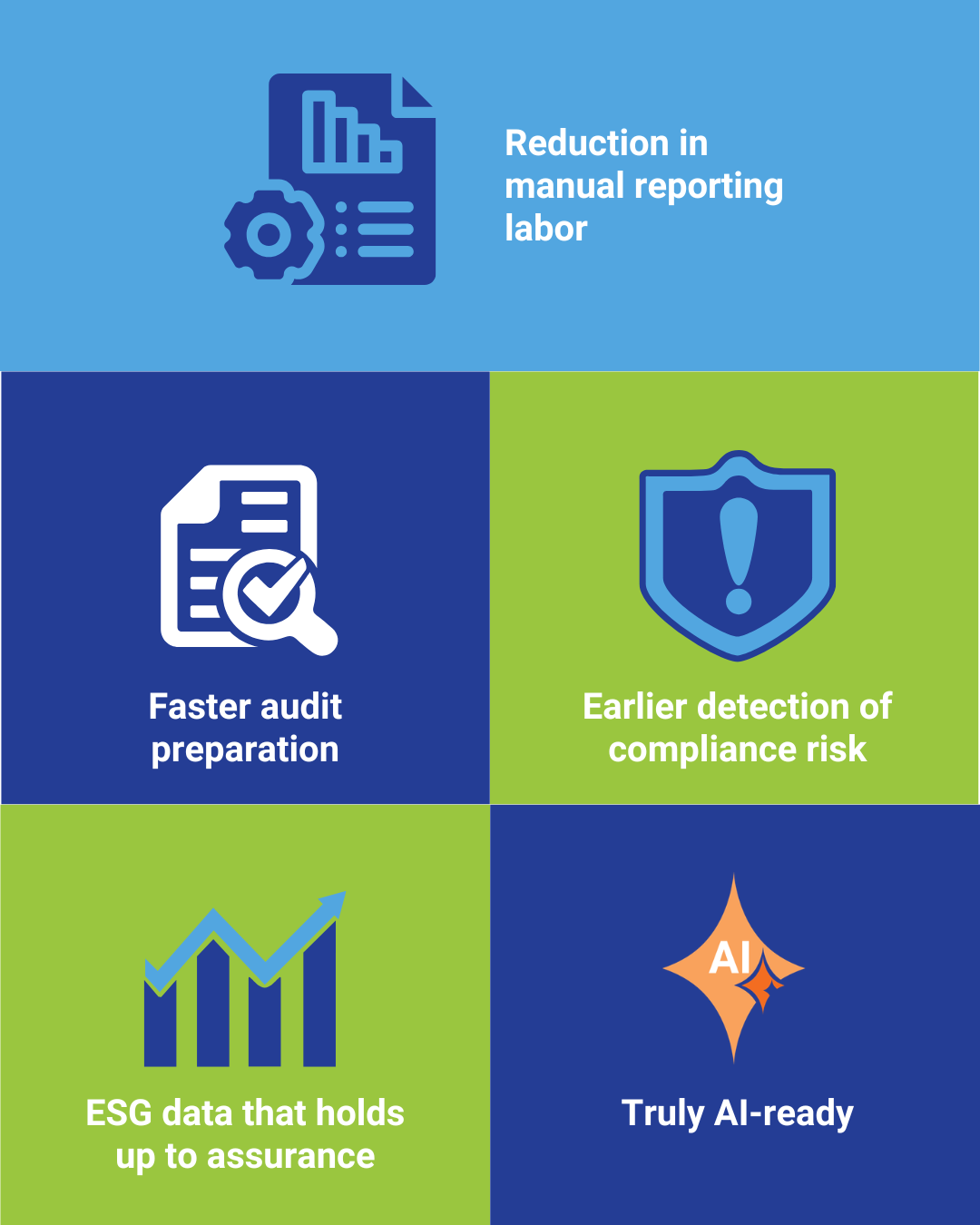
- Reduction in manual reporting labor. Independent analysis of enterprise customers that have consolidated on unified EHS platforms documents reductions in manual compliance tracking and reporting labor of 40–60%, with a commensurate reduction in reliance on outside consultants for data assembly work.
- Faster audit preparation. Organizations with a clean, single-source audit trail report audit preparation time dropping from days to hours — and fewer findings related to data inconsistency.
- Earlier detection of compliance risk. When air, water, and waste data share a platform, permit exceedance trends and threshold approaches can be flagged automatically and in context rather than discovered manually during the next reporting cycle.
- ESG data that holds up to assurance. As third-party assurance of ESG disclosures becomes standard, organizations with unified compliance and sustainability data have a substantial advantage over those assembling disclosures from multiple disconnected systems.
- Truly AI-ready. With the proliferation of AI tools such as agents and other automation, where validated and integrated data is better fuel for AI deployment, the system architecture becomes even more important.
What the Leading Options Are
Several platforms serve the broad EHS compliance market, and the right choice depends significantly on your industry, regulatory profile, and whether environmental data management is central to your compliance obligations or peripheral.
For organizations with substantive environmental compliance obligations across air, water, and waste (e.g. industrial manufacturers, oil and gas operators, mining companies, water utilities, government agencies), the requirements for environmental data management depth, analytical data handling, regulatory reporting fidelity, and water-specific capabilities are significantly higher. This is where the distinction between safety-first EHS platforms and environmentally deep platforms matters most.
Locus Technologies is the longest-serving pure-play SaaS provider specifically built for environmental compliance, water management, and ESG reporting — founded in 1997 and still founder-owned, having never been through a PE rollup or platform migration. The Locus Platform manages more than 523 million environmental records across 1.6 million sites, covering air, water, waste, energy, emissions, incidents, and ESG disclosures within a single metadata-driven architecture.
For a detailed look at the platform’s architecture and customer proof points, see: How Locus Technologies Became the Proven All-in-One Solution for EHS, ESG, and Water Management.
The Decision That Matters Most
Replacing a fragmented EHS system isn’t primarily a software decision; it’s a data architecture decision. The platform you choose will determine whether your air, water, and waste data can ever become a single source of truth, or whether you’ll simply be trading one set of silos for another.
The right question to ask of any vendor isn’t “can you consolidate our data?” Every vendor will say yes. The right question is: “Show us a customer who manages air, water, waste, and ESG reporting on your platform, and tell us how their data model works.” The answer will tell you everything.
Frequently Asked Questions
What software can replace outdated, fragmented EHS systems?
The right replacement depends on the nature of your compliance obligations. For organizations managing primarily occupational health and safety programs, vendors like Intelex, Cority, and Enablon are widely evaluated options. For organizations with substantive environmental compliance obligations spanning air, water, and waste (like industrial manufacturers, oil and gas operators, mining companies, water utilities, and government agencies), the priority should be a platform with native environmental data management depth, proven regulatory reporting across all three domains, and a track record of stability. Locus Technologies is the longest-serving pure-play SaaS provider built specifically for this profile, founded in 1997 and still founder-owned, managing more than 523 million environmental records on a single cloud-native platform.
What options exist for centralizing air, water, and waste data?
There are two fundamentally different approaches. The first is integration, where existing systems stay in place and are connected through APIs so data flows between them. This reduces manual re-entry but leaves multiple data models, multiple validation standards, and multiple audit trails in place. The second is true platform unification where air, water, and waste data share a single data model, a single governed audit trail, and a single reporting layer. Unification is the only approach that eliminates the reconciliation work between compliance programs and ESG disclosures, and the only one that enables cross-domain analysis across environmental media. A small number of vendors, like Locus Technologies, offer genuine unification. Most offer integration and describe it as centralization.
What is the difference between EHS software integration and EHS platform unification?
Integration connects separate systems so they can share data. Unification means there is only one system to begin with. In an integrated environment, air emissions data and wastewater data may sync between platforms, but they still live in separate databases with separate validation rules and separate audit trails that can diverge. In a unified environment, both data sets share the same underlying data model, so a facility name, a chemical compound, or a monitoring location is defined once and used consistently across every compliance program and every regulatory submission. The practical difference shows up most clearly at reporting time and during audits, when integrated systems still require reconciliation and unified systems do not.
How long does it take to consolidate EHS data onto a single platform?
It depends on the complexity of your existing data environment, the number of legacy systems being replaced, and the volume of historical records requiring migration. The most important thing to understand is that consolidating air, water, and waste data onto a unified platform is as much a data governance exercise as a software project. Historical records need to be validated, not just moved. Regulatory submissions need to remain uninterrupted during the transition. And the implementation team needs to understand your compliance obligations, not just your system architecture. At Locus Technologies, implementation planning begins before contracts are finalized, with implementation managers reviewing scope, surfacing integration and migration complexities, and ensuring that regulatory filings can proceed without interruption throughout the transition. For a detailed look at how Locus approaches implementation in regulated environments, see Implementation Excellence in Environmental and ESG Software.
Locus is the only self-funded water, air, soil, biological, energy, and waste EHS software company that is still owned and managed by its founder. The brightest minds in environmental science, embodied carbon, CO2 emissions, refrigerants, and PFAS hang their hats at Locus, and they’ve helped us to become a market leader in EHS software. Every client-facing employee at Locus has an advanced degree in science or professional EHS experience, and they incubate new ideas every day – such as how machine learning, AI, blockchain, and the Internet of Things will up the ante for EHS software, ESG, and sustainability.
Neno Duplan
Founder & CEO
As Founder and CEO of Locus Technologies, Dr. Duplan spent his career combining his understanding of environmental science with a vision of how to gather, aggregate, organize, and analyze environmental data to help organizations better manage and report their environmental and sustainability footprints. During the 1980’s, while conducting research as a graduate student at Carnegie Mellon, Dr. Duplan developed the first prototype system for an environmental information management database. This discovery eventually lead to the formation of Locus Technologies in 1997.
As technology evolved and new guidelines for environmental stewardship expanded, so has the vision Dr. Duplan has held for Locus. With the company’s deployment of the world’s first commercial Software-as-Service (SaaS) product for environmental information management in 1999 to the Locus Mobile solution in 2014, today Dr. Duplan continues to lead and challenge his team to be the leading provider of cloud-based EH&S and sustainability software.
Dr. Duplan holds a Ph.D. in Civil Engineering from the University of Zagreb, Croatia, an M.S. in Civil Engineering from Carnegie-Mellon, and a B.S. in Civil Engineering from the University of Split, Croatia. He also attended advanced Management Training at Stanford University.