
Reading Time: TBD
Environmental compliance is not one program. It is dozens of them running simultaneously, each with its own data, its own deadline, and too often, its own disconnected system.
- Water quality monitoring generates continuous readings from wells, discharge points, and surface stations — data that must align with permitted limits, sampling schedules, and watershed-level regulatory submissions.
- Air emissions programs track stack testing results, fugitive emission estimates, and greenhouse gas inventories that feed both internal sustainability targets and mandatory disclosure reports.
- Remediation and sampling programs produce years (or sometimes decades!) of analytical records tied to specific site coordinates, regulatory agreements, and cleanup milestones.
- Waste tracking follows manifests, disposal records, and generator status across facilities and jurisdictions.
- Refrigerant phasedown compliance demands precise inventory records as regulations tighten and phase-out schedules accelerate.
- Chemical inventories must stay current for Tier II reporting, process safety management, and community right-to-know obligations.
- Safety and incident records feed OSHA logs, workers’ compensation programs, and root cause investigations that inform future risk controls.
- Audit and inspection findings create corrective action obligations that need to be tracked from identification through closure.
And then there is an emerging layer that is reshaping how organizations think about environmental stewardship altogether: Environmental Product Declarations (EPDs) and sustainable construction lifecycle data. As green building standards and embodied carbon reporting move from voluntary to expected and in some jurisdictions, required, the organizations managing industrial facilities and construction programs need systems that can capture and report on the environmental footprint of materials and projects alongside traditional compliance data.
Each of these specialties generates its data. Each carries its regulatory vocabulary. Each has historically justified its software tool, spreadsheet workflow, or manual reporting process. Multiply that across a portfolio of facilities, and the result is a scenario where no one has a complete picture — and where the person responsible for the annual sustainability report or the permit renewal spends weeks assembling information that already exists somewhere, in some system, if only it could be reached.
That is the version of environmental data management that most EHS professionals know too well: not just a few siloed systems, but an entire ecosystem of complexity with no connective tissue holding it together. Every regulatory deadline becomes an exercise in reconciliation. Every new compliance obligation lands on infrastructure that was never designed to absorb it. And the question of whether the organization’s data is actually accurate quietly haunts every submission.
That version is expensive. It is slow. And increasingly, it is indefensible.
The organizations gaining ground in environmental compliance are those treating data integration not as an IT project but as a strategic foundation. When every data source, from a field sensor to a sustainable construction lifecycle record, feeds a single governed environment, something shifts… Teams stop managing data and start using it. Reports that once took days to produce are done in hours – or seconds. Anomalies surface before they become violations. And when AI-assisted analysis comes into play, it offers something worth working with.
That is the architecture Locus Technologies has been building toward for decades, and it is what sets Locus Platform apart.
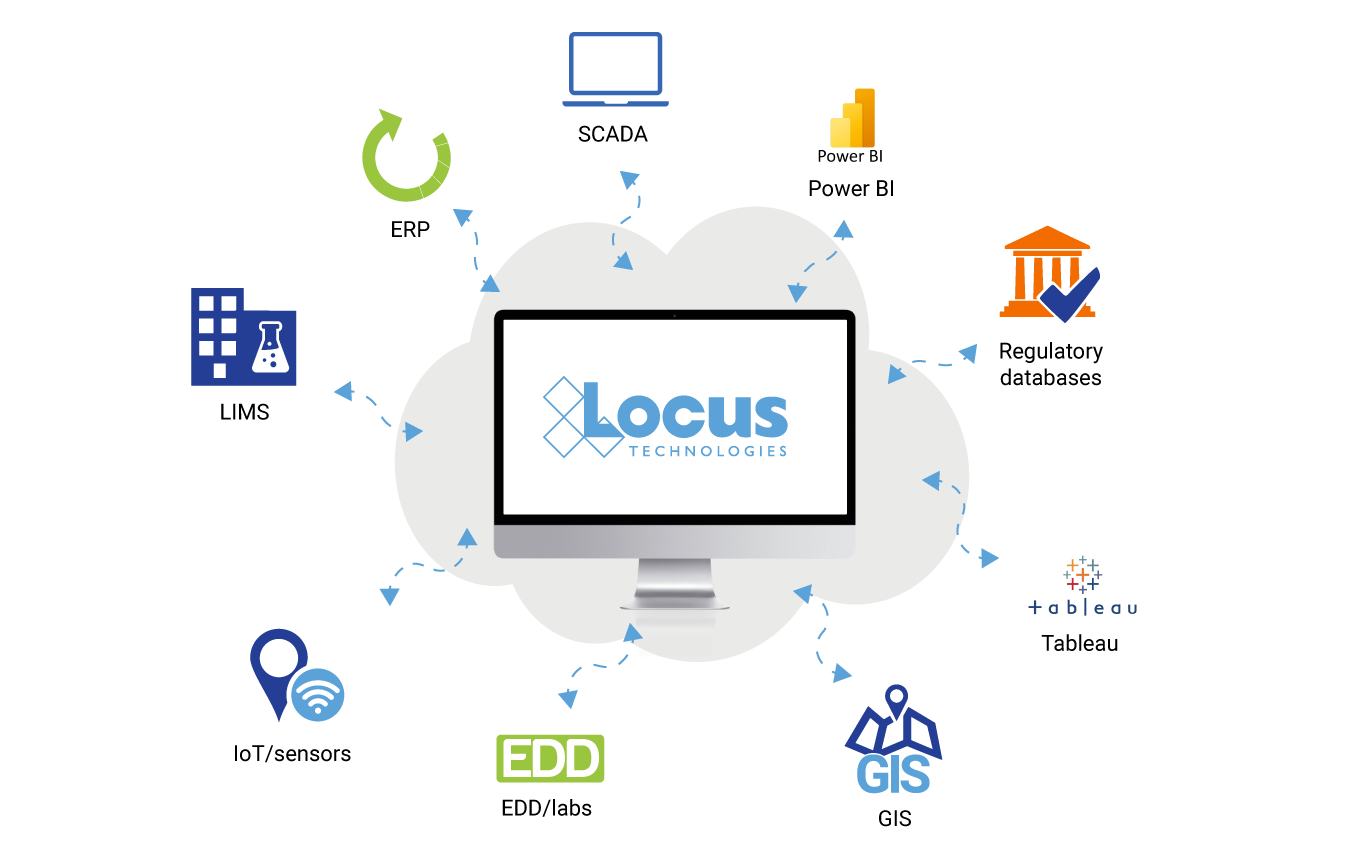
Every Data Source Has a Path In
The Locus Platform is not a closed system. It was designed from the ground up to connect — through APIs, direct integrations, structured data standards, and IoT connectors — with the systems enterprises already run.
Field instrumentation and continuous monitors feed the platform in real time. IoT sensors tracking water quality, air emissions, or industrial process conditions push readings directly into Locus software, where they sit alongside historical analytical records rather than in a separate dashboard that no one checks consistently.
Laboratory data arrives through Electronic Data Deliverables (EDDs) — structured submission files that Locus has standardized to enforce data quality at the point of entry. This matters because bad data caught at ingestion costs far less than bad data discovered during a regulatory audit. The EDD pathway connects contract laboratories directly to the platform, eliminating spreadsheet handoffs and manual QA steps that introduce errors and delays.
Enterprise systems connect through standard APIs. ERP platforms, Laboratory Information Management Systems (LIMS), and SCADA networks — the operational backbone of industrial organizations — can all push and pull data from Locus without custom development or kludgy file-transfer workarounds. Locus has also integrated with enterprise content management platforms, extending document collaboration capabilities for teams managing large volumes of environmental records.
Spatial Intelligence Built In, Not Bolted On
While Locus EIM integrates with ArcGIS Online, the GIS+ mapping in Locus Technologies is not a third-party add-on licensed from elsewhere. It is native to the platform, and that distinction matters operationally. A monitoring result without location context is often a compliance liability. When spatial data lives in a separate GIS environment, maintaining alignment between analytical records and their geographic reference points is an ongoing task.
With Locus, the map and the data are the same thing. Sampling networks, plume boundaries, compliance zones, and monitoring locations are visualized within the same governed environment that holds the underlying measurements. Locus has been developing GIS-based EHS data insights for decades — long enough for spatial reasoning to be genuinely embedded in how the platform works, not added as a feature after the fact.
Insight Delivered Where Decisions Are Made
Unified data only creates value if people can act on it. Locus addresses this through integrations with Microsoft Power BI and Salesforce Tableau two of the most widely deployed business intelligence platforms in enterprise environments. Detailed white papers guide teams through connecting Locus data to each tool, enabling custom dashboards and reports built in the environment that finance, operations, and sustainability leaders already use.
This closes a gap that many EHS platforms leave open. When environmental data is locked inside a compliance tool that executives never access, it stops influencing decisions. When it flows into the BI environment where the business already operates, it becomes part of how the organization thinks.
Oil and gas operators benefit from a similar principle at the field level: Locus supports the integration of field production data with water data management workflows, including a direct connection to the USGS Produced Water Database which pulls externally governed reference data into the same environment as internal operational records.
A Foundation Built for AI
The conversation around AI in environmental compliance is accelerating. Regulators are making reporting more complex. Sustainability disclosure frameworks are multiplying. The volume of data EHS teams must manage, interpret, and defend is growing faster than headcount ever will. AI offers a credible path through that pressure, but only for organizations whose data is ready for it.
That qualification matters more than most AI discussions acknowledge. For example, feed a model incomplete records, inconsistently formatted submissions, or data reconciled across disconnected systems, and the output reflects all of that underlying disorder. In a regulatory context, an anomaly flag that cannot be traced back to a verified source-reading is not useful. It is a liability.
Locus Technologies’ integration architecture addresses this directly. When IoT sensor feeds, Electronic Data Deliverables, ERP records, LIMS outputs, waste manifests, safety incident logs, audit findings, and emissions calculations all flow into a single governed environment — verified at ingestion, spatially referenced, and linked to their regulatory context — the subsequent dataset is something AI can actually work with. On that foundation, Locus has developed AI-driven EHS capabilities that surface anomalies before they become violations, identify trends across facilities and timeframes that would be invisible in siloed data, and flag corrective action items at risk of missing closure deadlines.
There is also a longer playbook worth naming. Organizations investing in data integration today are making a deliberate choice about the kind of EHS program they will be able to run in five years. The ones that arrive at meaningful AI adoption smoothly will be the ones that did the integration work first. The Locus Platform is built for where this is going, not just where it is today.
The Cost of Staying Fragmented
Every manual handoff between systems is a point where errors occur, time is wasted, and audit trails are broken. The organizations still managing EHS data through disconnected tools are not just operating inefficiently — they are accumulating compliance risk with every reporting cycle.
Locus Technologies was built on the conviction that environmental data management should be governed end-to-end, connected at every source, and accessible to every stakeholder who needs it. The integrations are not features added to a compliance tool. They are the architecture that transforms environmental data from a reporting burden into a genuine strategic asset.
Frequently Asked Questions
Why does data integration matter for EHS compliance? When environmental data is scattered across disconnected systems, establishing end-to-end traceability from field measurement to regulatory disclosure requires manual reconciliation at every step. Integration eliminates handoffs, reduces errors, and automatically produces a defensible audit trail.
What systems does Locus Technologies integrate with? Locus connects with IoT sensors and continuous monitors, ERP systems, LIMS, SCADA networks, enterprise content management platforms, and BI tools, including Microsoft Power BI and Tableau — all through standard APIs and direct connectors.
What is an Electronic Data Deliverable (EDD), and how does Locus use it? An EDD is a structured file format used by contract laboratories to submit analytical results. Locus developed standardized EDD formats that enforce data quality at the point of submission, replacing error-prone spreadsheet handoffs with a governed ingestion process, and those formats can be configured as needed.
Does Locus Technologies have native GIS capabilities? Yes. GIS mapping is built into the Locus Platform, not a third-party integration, although the software also integrates with ArcGIS Online. Monitoring locations, sampling networks, and compliance boundaries are visualized within the same environment as the underlying data — no separate GIS system required.
How does Locus support AI-driven environmental analysis? Locus has built AI-powered EHS capabilities directly into the platform. Because the platform unifies data from every source into a single governed environment, AI models have access to complete, consistent inputs, which is a prerequisite for reliable automated analysis.
Can Locus connect to external regulatory databases? Yes. Locus has integrated directly with the USGS Produced Water Database, for example, allowing operators to align internal production and water data with externally governed reference data in one environment.
What BI tools does Locus support? Locus supports integration with Microsoft Power BI and Salesforce Tableau. The company provides dedicated white papers walking through the connection process for each platform.
How does integrated data prepare an organization for AI adoption? AI tools require clean, complete, consistently formatted data to produce reliable outputs. Organizations that unify their EHS data in a governed platform today are building the foundation that enables meaningful AI adoption — rather than attempting AI atop fragmented inputs.
Is the Locus Platform cloud-based? Yes. Locus operates as a cloud platform, and its integration architecture is designed to support real-time connectivity with enterprise, field, and laboratory data systems without on-premise infrastructure dependencies.
Locus is the only self-funded water, air, soil, biological, energy, and waste EHS software company that is still owned and managed by its founder. The brightest minds in environmental science, embodied carbon, CO2 emissions, refrigerants, and PFAS hang their hats at Locus, and they’ve helped us to become a market leader in EHS software. Every client-facing employee at Locus has an advanced degree in science or professional EHS experience, and they incubate new ideas every day – such as how machine learning, AI, blockchain, and the Internet of Things will up the ante for EHS software, ESG, and sustainability.