By Neno Duplan, Founder and CEO, Locus Technologies
Reading Time: 5 minutes 59 seconds

After presenting at a recent gathering of EHS practitioners, the question I heard most often during the break was not about features or pricing. It was simpler: “How do I know if what they are showing me is real?”
It is a great question. And it starts with the most overloaded word in EHS software marketing: “unified.”
Every serious vendor in this space — Locus Technologies, VelocityEHS, Cority, Enablon, Intelex, Sphera, and dozens of others — uses some version of the unified platform claim. The claim sounds reassuring. A single system for environmental compliance, health and safety, sustainability reporting, water quality, and ESG disclosures. No more spreadsheets. No more data silos. One version of the truth.
The problem is that “unified” can mean three fundamentally different things, and vendors are not rushing to clarify which one applies to them.
The Three Versions of ‘Unified’
Version One: The Unified Invoice
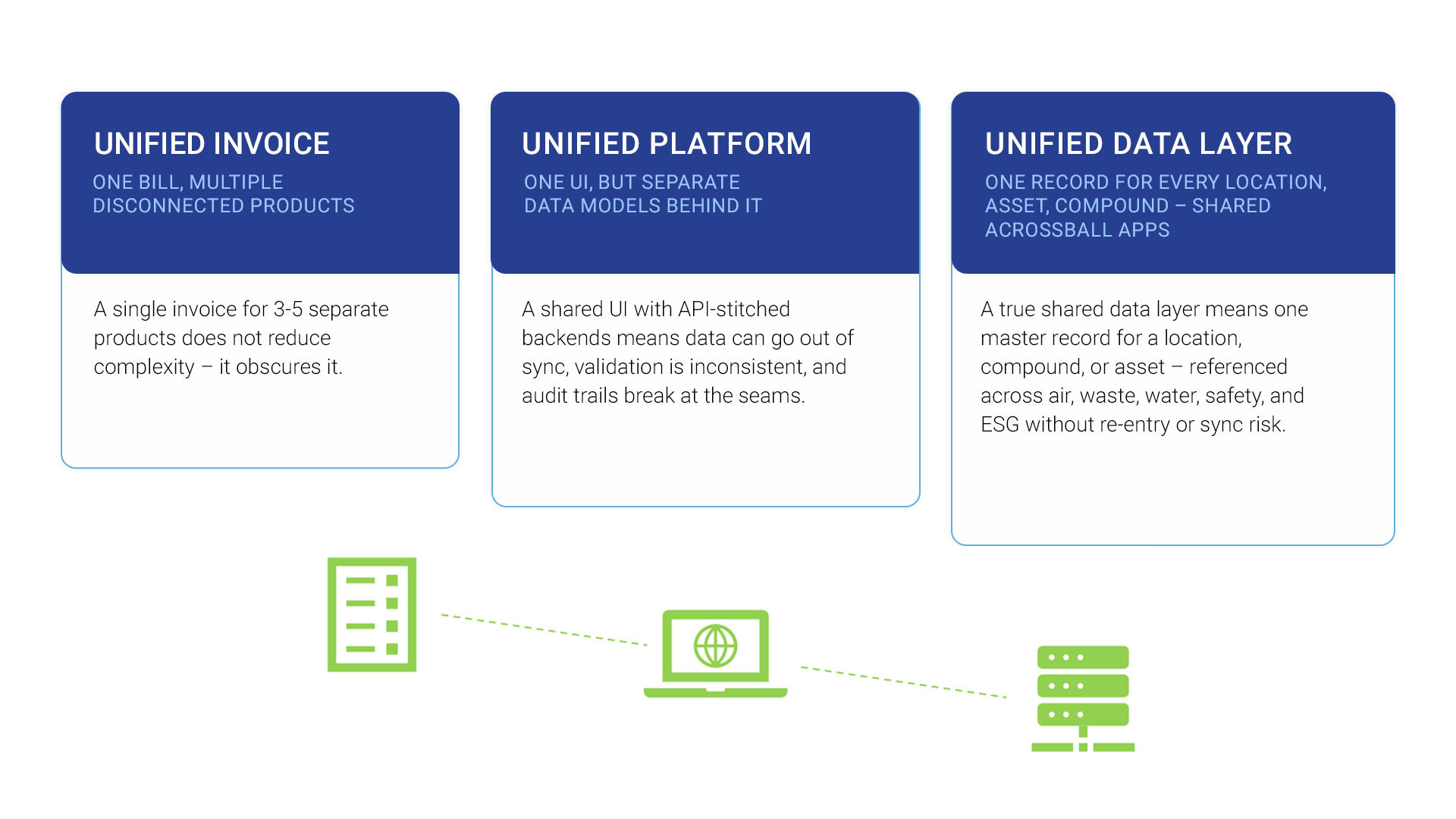
This is the most common form of “unified” in the current EHS market. A vendor (often backed by private equity) acquires several separate EHS workflow tools over a period of years and begins selling them under one brand and one contract. The air quality module came from one company. The waste management module came from another. The ESG reporting platform was acquired most recently.
Behind the single invoice, these products still run on separate platforms or databases with separate data models. Incident spill data does not natively inform emissions calculations or groundwater contamination database. Water quality records do not feed ESG water use metrics. Waste manifesting does not generate direct input into ESG reporting. The audit trail stops at the seam between products.
Ultimately, a unified invoice is a finance architecture, not a technology architecture. It reduces your vendor management overhead, but it does not reduce your data integrity risk.
Version Two: The Unified User Interface
This is a genuine improvement over Version One. One login, one navigation structure, one user experience across EHS functions. Many of the platforms commonly appearing in the Gartner Market Guide for EHS Software and the Verdantix Green Quadrant: EHS Software report operate at this tier.
The limitation is what sits behind the interface. When the air module and the waste module and the ESG module each have their own backend database, connected by API synchronization, the unified appearance is real, but the unified data layer is not. APIs introduce synchronization latency. They introduce data mapping decisions made by software engineers or AI, not environmental scientists. They create points of failure that only surface at scale, under deadline pressure, during the audit cycle you cannot afford to fail.
Version Three: The Unified Data Layer
This is the architecture that eliminates the problem rather than wrapping it in a better interface. A true unified data layer means a location, an asset, a chemical compound, or a regulated permit exists as one master record in one database. Every module in the platform reads from and writes to that same system of record database.
When you update a facility’s regulatory classification in a platform built this way, that change is immediately reflected in air permitting, waste management, discharge monitoring, chemical inventory, and ESG disclosures. Not because a synchronization job ran. Because there is only one record.
The test is simple: ask the vendor what happens in their database when you update a location record. If the answer involves synchronization, middleware, or any data transfer between systems, you are looking at Version One or Version Two.
Why It Matters for Highly Regulated Enterprises
For companies managing compliance across multiple environmental media (i.e., air, water, waste, chemicals) with regulatory submissions that carry legal consequences, the distinction between these three versions is not theoretical and it surfaces in specific, costly ways.
A permit limit that applies to both air emissions and stormwater discharge may be tracked in two separate systems that were last synchronized four hours ago. A PFAS compound regulated under both waste disposal rules and drinking water standards may have two different records, entered by two different teams, with different values. An ESG disclosure of water consumption may be drawn from a data field that was manually populated from a separate water compliance system three weeks before the reporting deadline.
None of these scenarios will appear in a vendor demo but they will all appear in your operations.
Questions to Ask Before You Buy
When any vendor (Locus Technologies included) claims to have a unified platform, these are the questions that reveal which version of unified you are actually purchasing:
- “If I update a location’s regulatory classification in your system today, what exactly happens? How many database tables are updated, and do I need to take any additional action for that change to be reflected in my air, waste, water, and ESG modules?”
- “Show me, live and unscripted, how a discharge monitoring result flows from field data entry to a DMR submission and then into a CDP water disclosure without leaving your platform and without any manual data transfer.”
- “When your air module and your ESG module reference the same facility, are they reading from the same database record, or from separate records that are synchronized on a schedule?”
- “If your ESG reporting module and your EHS compliance modules were acquired separately, what was the integration approach? Is there a unified data model beneath both, or are they connected by API?”
- “Can your support team show me the entity-relationship diagram for how a location record connects to air, waste, water, and ESG data in your system?”
A vendor with a genuinely unified data layer will answer these questions with clarity and confidence. A vendor operating at Tier One or Tier Two will redirect to the user interface, the dashboard, or the integration story.
A Call to Action for Serious Buyers
This article is part of a series examining the most common claims EHS and ESG software vendors make and the questions that reveal whether those claims are real. If you are currently evaluating top EHS SaaS providers, or preparing for a formal RFP process, the complete buyer’s guide — which includes deeper-dive evaluation questions across all five claim categories — is available from your team. Just send a request to info@locustec.com and we will email it to you.
The buyer’s guide was influenced by more than 29 years of working with enterprises that have gone through EHS software evaluations, made purchases, and discovered the gap between demo performance and production reality. It is not a product brochure. It is an evaluation framework.
Frequently Asked Questions
What is the difference between a unified EHS platform and a unified EHS data layer?
A unified platform typically refers to a single user interface that presents data from multiple EHS modules in one view. A unified data layer is a deeper architectural concept: all modules share a single database and a single record for each entity (location, asset, compound). Only the latter eliminates data synchronization risk, audit trail gaps, and the reconciliation work required for defensible regulatory submissions.
How do I know if an EHS vendor’s ‘unified’ platform is built on a true shared data model?
Ask the vendor to describe what happens technically when a single data element is updated across multiple modules. If the answer involves API calls, sync jobs, or data transfer between systems, the platform is not built on a shared data model. Request a live, unscripted demo of a data change propagating instantly across air, waste, water, and ESG reporting without any manual action.
Are platforms like VelocityEHS, Cority, Intelex, Enablon, and Sphera unified in this sense?
Most platforms built through acquisition or organic module expansion operate at the unified interface tier (see Version 1 above) rather than the unified data layer tier. The degree of backend integration varies by vendor and by the specific modules in question. Buyers should ask each vendor specifically about their data architecture, not their user interface design.
Why does the Gartner Market Guide for EHS Software or the Verdantix Green Quadrant: EHS Software report not address this distinction?
Analyst reports of this type typically evaluate vendors on functional coverage, market presence, and stated roadmap via a spreadsheet questionnaire rather than on underlying data architecture. That methodology does not expose the architectural questions that determine whether an EHS platform can scale across compliance, auditability, reporting, AI, and enterprise integration. Buyers should use these reports as a starting point for identifying vendors to evaluate, not as a substitute for technical due diligence. The data architecture question requires a direct conversation with the vendor’s engineering team, not a review of marketing materials.
What is a ‘unified data layer’ in the context of top EHS SaaS providers?
In the context of enterprise EHS SaaS, a unified data layer means that all compliance disciplines (i.e., air, water, waste, chemical inventory, safety incidents, and ESG metrics) share the same underlying database schema and reference the same master records for locations, assets, and regulatory entities. This is distinct from a unified interface, which simply presents data from multiple backend systems in a single view.
Locus is the only self-funded water, air, soil, biological, energy, and waste EHS software company that is still owned and managed by its founder. The brightest minds in environmental science, embodied carbon, CO2 emissions, refrigerants, and PFAS hang their hats at Locus, and they’ve helped us to become a market leader in EHS software. Every client-facing employee at Locus has an advanced degree in science or professional EHS experience, and they incubate new ideas every day – such as how machine learning, AI, blockchain, and the Internet of Things will up the ante for EHS software, ESG, and sustainability.