By Neno Duplan, Founder and CEO, Locus Technologies
Reading Time: 10 minutes 21 seconds
There is a version of the AI conversation in EHS software that is worth having, and a version that is just marketing theater. Distinguishing between them requires understanding one thing that vendors are consistently underemphasizing: AI does not fix bad data. It processes data and produces outputs. The quality of those outputs is determined entirely by the quality, completeness, and governance of the data going in.
When I presented this point to EHS practitioners recently, the response was a kind of relieved recognition. People had been hearing AI pitches from all the big names in EHS platforms, like Locus Technologies, VelocityEHS, Cority, Enablon, Intelex, Sphera, and others, and most people had a vague unease about what was actually being offered. The AI framing was consistent. The details about data quality, validation infrastructure, and audit traceability were not.
What AI in EHS Actually Requires
Genuine AI capability in environmental and safety data management requires four preconditions that are rarely discussed in vendor pitches.
The first is validated data at scale. Environmental compliance data carries regulatory, financial, and legal consequences. A result in a discharge monitoring report is not just a number in a database; it may become a legally reported value. A GHG emissions inventory number in an ESG disclosure may be subject to third-party audit under frameworks such as CSRD, SEC climate rules, or customer supply-chain requirements. The data feeding those outputs must be validated against permits, methods, detection limits, units, holding times, historical baselines, and quality-control rules. It must be governed with clear chain of custody, entry controls, access logging, and review procedures. AI must operate on complete, consistent, and verified data, not on fragments entered across different sites at different times under different assumptions.
The second precondition is a unified data model. AI operating on fragmented data spread across spreadsheets, custom tables, siloed modules, inconsistent field definitions, duplicate location records, and API-synchronized datasets will produce outputs that are internally inconsistent. An AI system cannot reliably know that “Facility A” in the air module and “Site A” in the waste module refer to the same physical location if the underlying system does not understand that relationship. If two separate records in two separate databases represent the same discharge point, waste stream, sampling location, emission source, or regulated asset, AI will inherit that confusion and amplify it.
The third precondition is an audit trail. For any AI output used in a regulatory submission, ESG disclosure, incident investigation, compliance decision, or executive report, the system must be able to show the evidence behind the answer. That means identifying the source records, calculation logic, regulatory thresholds, AI-assisted steps, human approvals, and final certified output. A general explanation of the AI’s methodology is not enough. EHS requires traceability from the final answer back to the specific data records and controls that produced it.
The fourth precondition is governance and permissions. EHS data is not all equal, and not every user should be able to see, modify, approve, or submit every record. AI must respect role-based access, site boundaries, legal holds, approval workflows, confidential incident records, and regulatory certification requirements. An AI assistant that can summarize data but cannot distinguish between draft data, validated data, approved data, and certified data is not ready for serious EHS use. In regulated environments, AI must operate inside the same governance model as the system of record.
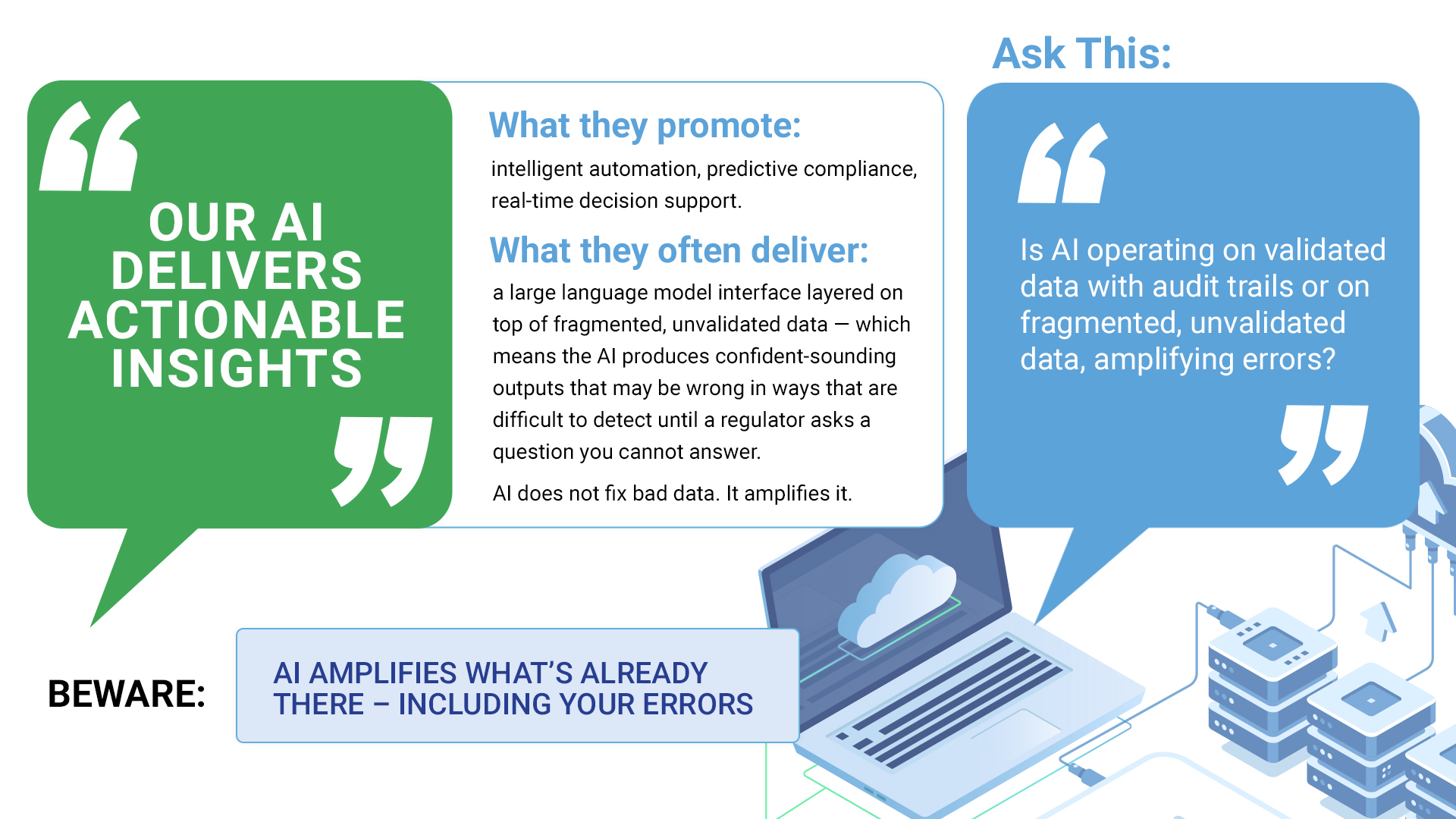
This is where many AI claims in EHS software become thin. A chatbot can answer questions. A model can generate a paragraph. A dashboard can display a prediction. But none of that proves the vendor has the data architecture required for defensible AI. In EHS, the hard part is not generating language. The hard part is ensuring that every answer is grounded in validated, unified, governed, and auditable data.
An AI that summarizes fragmented or unvalidated data does not produce insight. It produces confident-sounding errors. And in environmental compliance, a confident-sounding error is more dangerous than an obvious gap, because it is less likely to be challenged before it causes a problem.
The Scale Argument
One honest measure of an EHS platform’s AI readiness is the volume, age, and quality of the validated data it manages. Locus Technologies manages more than 600 million validated environmental records, including 4.2 million PFAS records, across 1.8 million locations. That represents 29 years of data intake, validation, governance, regulatory reporting, and operational use.
That accumulation matters because AI in EHS is only as strong as the data foundation beneath it. Models trained on, or operating against, validated and governed environmental data have been exposed to the full complexity of real regulatory operations: analytical methods, permit limits, detection limits, units of measure, non-detects, qualifiers, holding-time violations, compound detection challenges, regulatory calculation logic, location hierarchies, and long-term environmental trends.
A platform that recently added an AI interface to an EHS module does not automatically have AI-ready data infrastructure. The interface may look modern, but the underlying system may still lack the validated records, data lineage, governance controls, and regulatory context required to produce reliable answers. In EHS, scale is not about database size alone. It is about how much defensible data has been collected, normalized, validated, governed, and used in real compliance workflows over time.
This is where Locus has a structural advantage. Decades of environmental records give the platform a depth of context that cannot be manufactured quickly. AI can summarize documents, generate narratives, or answer simple questions in almost any system. But to support regulatory reporting, exceedance analysis, PFAS management, ESG disclosures, permit compliance, and environmental risk decisions, AI needs a trusted data foundation. Locus has been building that foundation for nearly three decades.
What the Analyst Reports Miss
Neither the Gartner Market Guide for EHS software nor the Verdantix Green Quadrant for EHS software systematically evaluates the data quality infrastructure underlying vendor AI claims. These reports typically assess whether vendors offer AI features, what those features are described as doing, and in some cases whether customers report value from them. That is useful, but it does not answer the harder question: is the underlying data architecture, validation controls, audit trails, and governance model strong enough to support AI in regulated EHS decisions?
This is a major gap. Buyers are not evaluating AI for generic productivity use. They are evaluating AI that may influence regulatory submissions, ESG disclosures, permit compliance, incident investigations, emissions calculations, discharge monitoring, corrective actions, and executive risk decisions. In those contexts, the presence of an AI feature in a vendor platform does not prove that the feature is appropriate for compliance use.
The critical question is not, “Does the vendor have AI?” The critical question is, “What data is the AI using, and can every answer be traced back to validated, governed, and auditable records?” Most analysts do not test that. They do not ask how many validated environmental records are under management, whether lab results are normalized and quality-checked, whether regulatory calculations are version-controlled, whether AI outputs preserve source attribution, or whether the platform can distinguish between draft, validated, approved, and certified data.
This matters because AI can make weak data look persuasive. A model can generate a confident paragraph, summarize an incomplete record, or produce a polished explanation from fragmented information. In EHS, that is dangerous. The risk is not merely that AI gives an imperfect answer. The risk is that it gives an answer that appears credible but cannot be defended when a regulator, auditor, customer, plaintiff, or executive asks where the number came from.
Analyst reports are helpful for understanding market categories and vendor positioning, but they should not be treated as substitutes for technical due diligence. Buyers should require vendors to demonstrate the full path from source data to AI output: ingestion, validation, normalization, calculation, approval, permissions, audit trail, and final answer. Without that proof, AI remains a marketing claim rather than a compliance-grade capability.
Questions to Ask Before You Buy
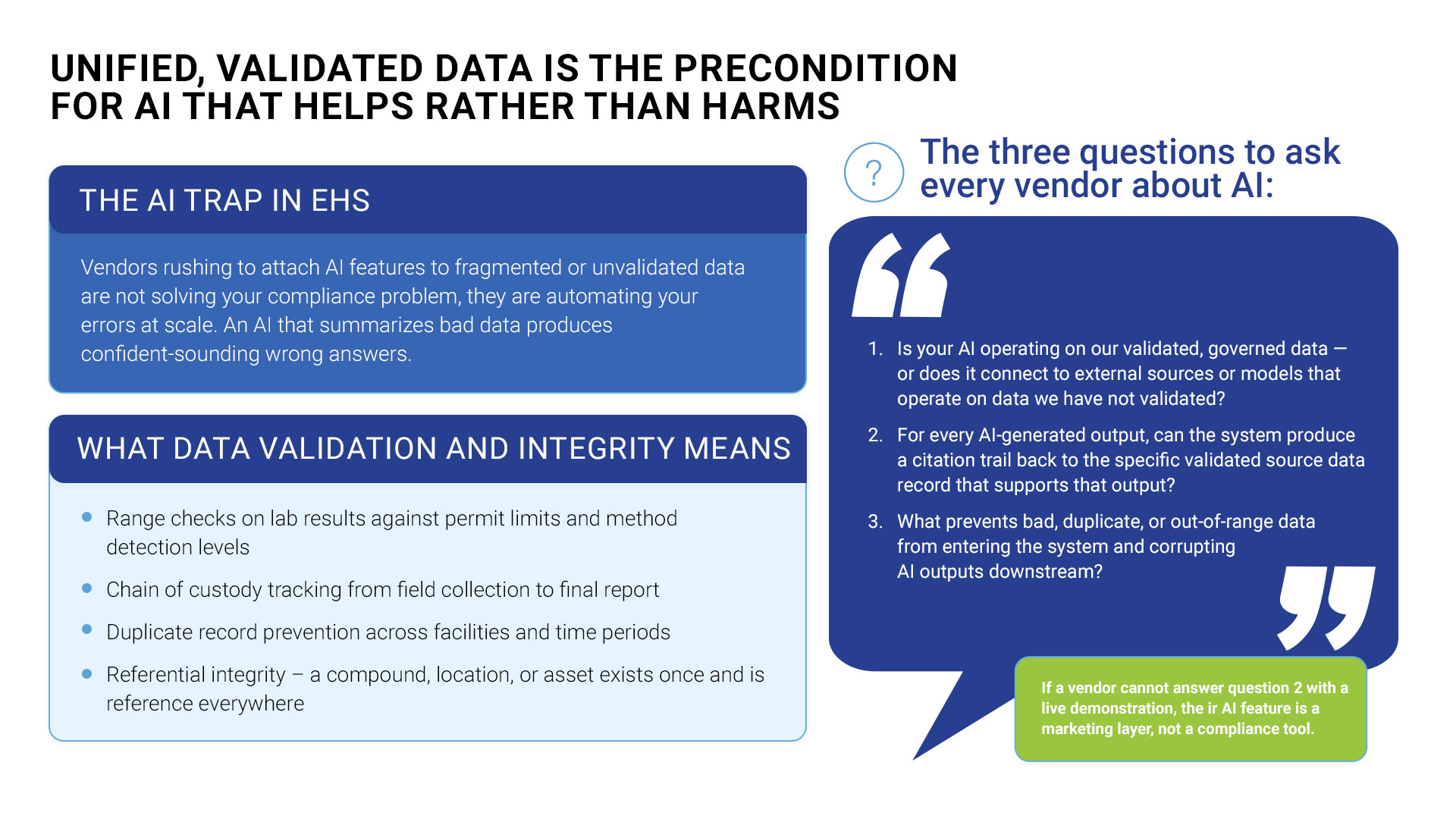
- “For any AI-generated output (eg. a compliance summary, an anomaly alert, an ESG metric calculation) can your system produce a citation trail back to the specific validated source data records that generated that output? Can you demonstrate this?”
- “Is your AI operating on our validated, governed data within our environment, or does it connect to external models or sources that operate on data we have not validated?”
- “What data validation rules does your platform apply before data enters the system? Specifically, how are laboratory results range-checked, how are duplicate records prevented, and how is referential integrity maintained across modules?”
- “How much validated environmental data does your platform currently have under management, and for how long has that data been accumulating under consistent governance standards?”
- “If an AI-generated value in a regulatory submission is later found to be incorrect, what does your system’s audit trail show about how that value was derived? Can you demonstrate this for an existing record?”
A Call to Action for Serious Buyers
The complete buyers guide at locustec.com includes a full section on evaluating AI claims in EHS and ESG software, including the data governance and audit trail questions that should be answered before any AI-generated output is used in a regulatory submission or externally reported ESG disclosure. To get a copy via email, send us a note at info@locustec.com.
Frequently Asked Questions
What makes AI in EHS compliance software different from AI in other enterprise software?
EHS compliance outputs carry regulatory and legal consequences. An AI-generated value in a discharge monitoring report is a legally submitted regulatory value. An AI-generated ESG metric is an externally reported number subject to third-party audit. This creates a requirement for audit traceability (the ability to trace any AI output back to its specific validated source data) that does not exist in most enterprise AI applications.
How do I evaluate the data quality infrastructure behind an EHS vendor’s AI claims?
Ask for a live demonstration of an AI output alongside its source data citation trail. Ask specifically about data validation rules at intake, referential integrity across modules, and how the system prevents duplicate or out-of-range values from entering the governed dataset. The total volume of validated records under management and the length of time that data has been governed under consistent standards are useful indicators of infrastructure maturity.
Are AI features in platforms like Locus Technologies, Sphera, Enablon, and Cority ready for compliance use?
AI feature maturity and the underlying data governance infrastructure vary significantly across vendors and across modules. Buyers should not assume that the presence of AI features in a platform implies that those features are appropriate for use in regulatory submissions or audited ESG disclosures without conducting the specific due diligence questions above.
What is the relationship between PFAS data management and AI in EHS software?
PFAS compliance is one of the most data-intensive areas of current environmental regulation. Tracking thousands of compounds across multiple regulatory frameworks, with evolving detection methods and changing reporting thresholds, requires both the data infrastructure to manage that complexity and the governance controls to ensure the data feeding any AI analysis is validated. A platform like Locus Technologies that is managing 4.2 million PFAS records has stress-tested this infrastructure against real compliance requirements.
What is the difference between predictive compliance and AI-generated compliance errors?
Predictive compliance uses historical validated data to identify patterns, flag anomalies, and anticipate permit exceedances before they occur. This is valuable when the underlying data is validated, complete, and governed. When the underlying data is fragmented, duplicated, or unvalidated, the same analytical processes produce outputs that appear predictive but are actually amplifying the noise and errors in the source data. The difference is invisible in a demo and highly visible under regulatory scrutiny.
What is the difference between predictive compliance and AI-generated compliance error?
Predictive compliance uses validated historical data, regulatory thresholds, operating conditions, and trend analysis to identify where an organization may be approaching a limit or risk condition. For example, it can help flag a likely permit exceedance, an emerging PFAS trend, an unusual discharge pattern, or a site whose emissions profile is moving toward a reporting threshold.
AI-generated compliance error is different. It occurs when an AI system produces a confident answer from incomplete, outdated, unvalidated, or poorly governed data. In EHS, that risk is significant because the answer may appear authoritative while being based on the wrong permit limit, the wrong unit of measure, an outdated regulatory threshold, a duplicate facility record, a non-detect handled incorrectly, or a laboratory result that was never validated. Predictive compliance reduces risk when it is grounded in trusted data. AI increases risk when it generates conclusions faster than the system can prove them.
Should AI be allowed to generate regulatory reports automatically?
AI can assist with regulatory reporting, but it should not replace the governed reporting process. In compliance-grade EHS software, AI should help identify relevant records, summarize trends, detect anomalies, explain exceedances, draft narratives, and accelerate review. The final report still needs validated data, approved calculations, controlled workflows, user accountability, audit trails, and certification by authorized personnel.
The question is not whether AI can generate a report. It can. The better question is whether the organization can defend every number, assumption, calculation, and narrative statement in that report after submission. If the AI output cannot be traced back to validated source data and human approval, it is not ready for regulatory use.
Can AI fix poor EHS data quality?
No. AI can help identify gaps, inconsistencies, duplicates, anomalies, and missing context, but it cannot turn unreliable data into defensible compliance data by itself. If the underlying records are incomplete, unvalidated, fragmented, or not governed, AI will inherit those weaknesses and may make them harder to detect because the output will look polished.
Why is source attribution essential for AI in EHS?
Every AI-generated answer used in EHS should be traceable to the exact records, calculations, permits, thresholds, methods, and approvals that support it. Source attribution allows users, auditors, regulators, and executives to verify the answer rather than simply trust the model. Without attribution, AI becomes a black box layered on top of compliance risk.
What is the biggest risk of AI in EHS software?
The biggest risk is false confidence. A generic AI assistant can generate fluent explanations from incomplete or incorrect data. In EHS, that can lead to wrong compliance decisions, inaccurate ESG disclosures, missed exceedances, improper reporting, or failure to preserve evidence. The danger is not that AI will be obviously wrong. The danger is that it will be plausibly wrong.
How should buyers evaluate vendor AI demonstrations?
Buyers should ask vendors to demonstrate AI using realistic compliance scenarios, not generic prompts. The demonstration should show the full path from source data to AI answer: validated records, calculations, limits, permissions, approvals, and audit history. A useful AI demo should prove traceability, not just conversational fluency.
Locus is the only self-funded water, air, soil, biological, energy, and waste EHS software company that is still owned and managed by its founder. The brightest minds in environmental science, embodied carbon, CO2 emissions, refrigerants, and PFAS hang their hats at Locus, and they’ve helped us to become a market leader in EHS software. Every client-facing employee at Locus has an advanced degree in science or professional EHS experience, and they incubate new ideas every day – such as how machine learning, AI, blockchain, and the Internet of Things will up the ante for EHS software, ESG, and sustainability.