By Neno Duplan, Founder and CEO, Locus Technologies
Reading Time: 11 minutes 6 seconds
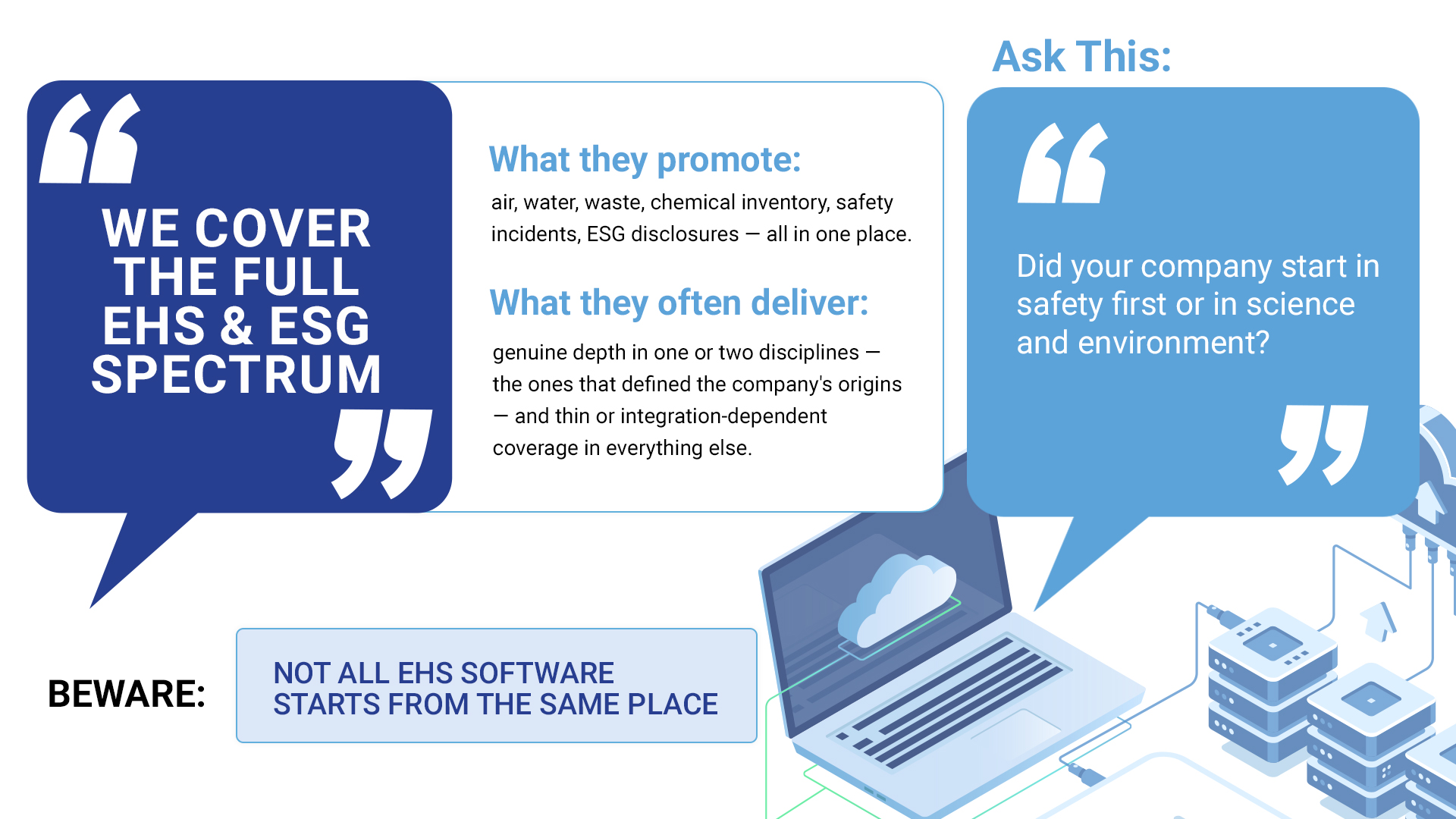
I posed a question during a recent presentation and the room fell silent: “Do you know where your software vendor started?” Not where they are positioned today in the market, but what problem were they originally built to solve?
The reason it matters is straightforward. Every EHS platform carries the architectural DNA of its founding purpose. A platform built to manage workplace safety incidents was designed around workflow, people, and events. A platform built to manage complex environmental data was designed around science, measurement precision, chain of custody, and regulatory calculation. Those are different design priorities. They produce different architectures which tend to persist despite future expansions of feature sets.
Two Lineages in the EHS Market
When you survey the landscape of leading EHS SaaS providers, including companies such as Enablon, Intelex, VelocityEHS, Cority, Sphera, and Locus Technologies, you can see two distinct lineages in how these platforms were originally conceived.
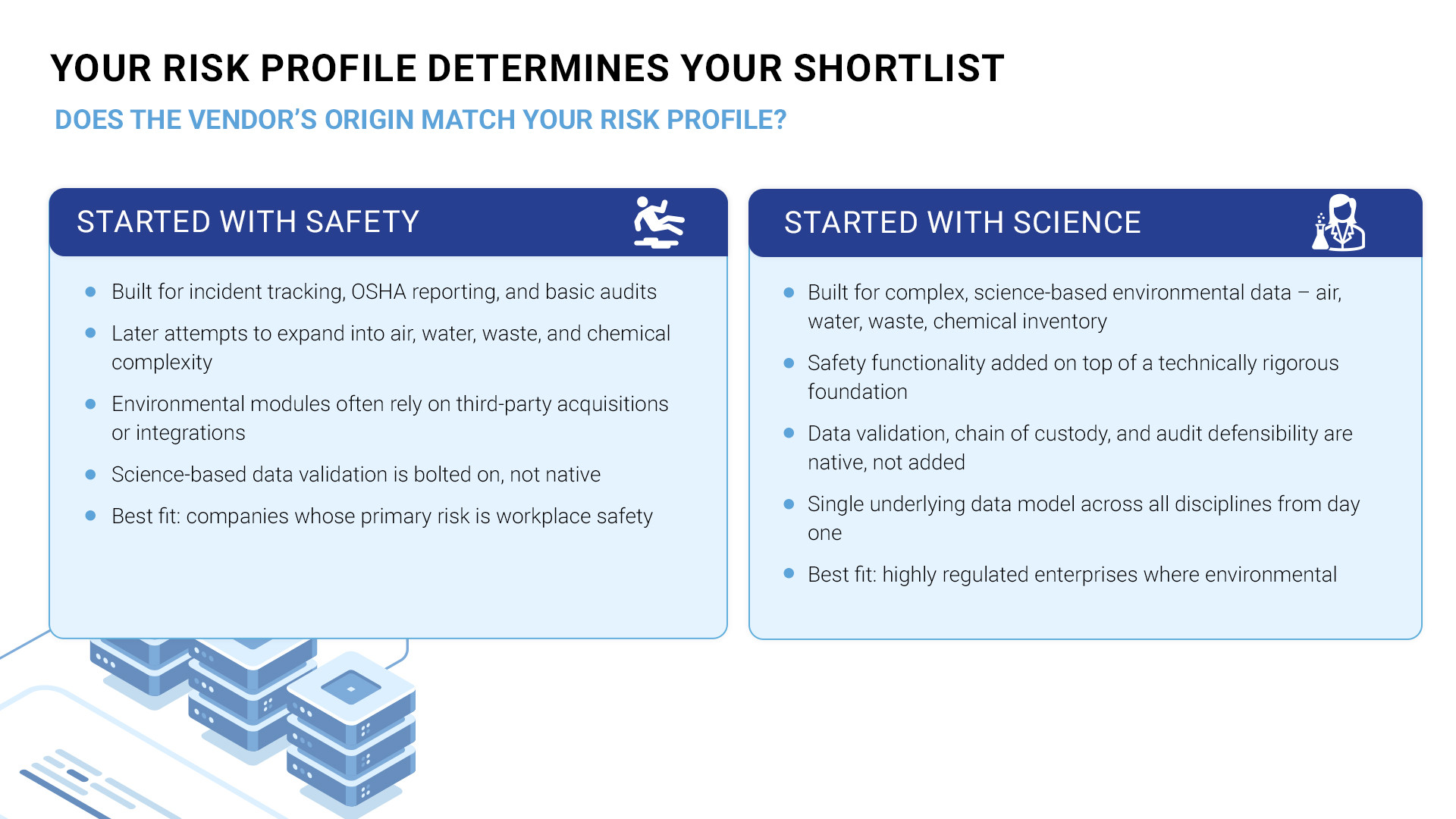
The first lineage starts with safety and compliance workflow management. These platforms were built primarily to manage incident reports, near-miss tracking, OSHA recordkeeping, audits, inspections, corrective actions, training, and operational workflows. Their data models are optimized around events involving people, locations, assets, tasks, and time. As the market expanded, many of these vendors moved into environmental compliance by acquiring environmental point solutions or by adding modules for air, water, waste, permits, and sustainability reporting.
That path has a natural limitation. A workflow-first architecture can manage environmental tasks, but it often struggles with the scientific, numerical, temporal, and spatial complexity of environmental data. Environmental compliance is not only about assigning tasks or closing findings. It depends on defensible measurements, sampling events, laboratory results, detection limits, units of measure, regulatory thresholds, calculation methods, emissions factors, discharge limits, chain of custody, spatial relationships, historical trends, and audit-ready data lineage.
The second lineage starts with environmental data management. These platforms were built to manage laboratory results, field measurements, regulatory calculations, sampling programs, mass balance, emissions inventories, groundwater data, air dispersion inputs, and environmental reporting at scale. Their data models were designed from the beginning for complex environmental observations: what was measured, where it was measured, when it was measured, how it was measured, what method was used, what limit applies, and whether the result is defensible.
Locus belongs to this second lineage. Our foundation is environmental data management, not generic workflow automation. We started with the hard part of EHS: managing scientific and regulatory data with precision, traceability, and auditability. From that foundation, safety workflows, inspections, permits, compliance calendars, dashboards, ESG reporting, and AI-driven analytics become extensions of a governed data platform rather than disconnected modules attached to a workflow system.
That distinction matters because environmental compliance is data-intensive before it is workflow-intensive. A safety system needs to know who did what, where, and when. An environmental system must also know the chemical, concentration, medium, method, unit, detection limit, regulatory threshold, sampling location, aquifer, discharge point, emission source, calculation basis, exceedance status, and historical context. It must preserve the chain of custody and mathematical integrity behind every reported number.
Most safety-born platforms understand people, tasks, incidents, and forms. Environmental-born platforms understand contaminants, samples, calculations, regulatory limits, physical systems, and long-term data histories. They know how to build a groundwater model, evaluate plume migration, manage air emissions calculations, track discharge compliance, calculate half-life of radionuclides, and preserve decades of environmental records. That is the difference between treating environmental compliance as another workflow and treating it as a scientific, regulatory, and data-management discipline.
For buyers, this distinction should be central to vendor evaluation. If your organization’s primary risk is incident tracking and safety workflow, a workflow-first platform may be adequate. But if your risk includes water quality, air emissions, waste characterization, remediation, PFAS, permits, regulatory reporting, ESG disclosures, and long-term environmental liability, the architecture must be strong enough to manage the underlying environmental data. In EHS software, lineage matters because the original design assumptions of the platform determine what it can handle well, what it can only approximate, and where it will eventually break under complexity.
Adding a simpler workflow on top of a complex foundation is straightforward engineering. Adding complex, science-based data infrastructure on top of a simple workflow foundation is effectively building a new platform. Most vendors who have attempted the latter have not completed it.
Where the Gap Shows Up
For organizations whose biggest environmental and safety risks are safety-oriented (OSHA recordable rates, contractor management, behavioral safety observations) a safety-first platform may be adequate. The environmental compliance modules may handle basic permit tracking and reporting without significant issues.
For highly regulated enterprises where the environmental data itself carries legal liability (PFAS contamination monitoring, Title V air permit compliance, discharge monitoring reports, chemical inventory under EPCRA, groundwater remediation data management) the gap becomes material. Here is where it surfaces:
- Laboratory data management. Environmental compliance at this level requires the ability to receive, validate, and process laboratory analytical results with the precision that chain-of-custody standards require. Detection limits, method codes, laboratory qualifiers, and holding time violations are not optional metadata, they determine whether a result is reportable and whether a permit exceedance exists. Platforms not originally built for environmental data management often lack native laboratory data infrastructure.
- Regulatory calculation engines. Discharge monitoring report calculations, Title V emission inventories, PFAS mass balance, and refrigerant tracking under EPA regulations all require calculation logic that is specific to the regulation and must be updated as regulations change. Environmental-origin platforms build and maintain these calculation engines as core capabilities. Safety-origin platforms often rely on manual calculation or third-party integrations.
- PFAS data management. The rapid expansion of PFAS-related regulatory requirements across drinking water, discharge monitoring, hazardous waste, and emergency planning frameworks demands a data infrastructure capable of tracking thousands of compounds, managing evolving detection methods, and producing reports for multiple simultaneous regulatory programs. A platform like Locus with 4.2 million PFAS records under management has built and stress-tested this infrastructure. A platform that recently added a PFAS tracking module has not.
- Water, in both its compliance and sustainability dimensions. Discharge monitoring, drinking water quality, stormwater, vapor intrusion, and the water use metrics now required by CDP, GRI, and CSRD are all water problems that require a platform with real water data depth — not a water module bolted onto a safety workflow tool.
- Audit defensibility and data lineage. Environmental compliance data must be explainable years after it was collected. A regulator, auditor, plaintiff, or internal reviewer may ask where a number came from, who entered it, what lab method was used, whether the detection limit changed, what calculation produced the reported value, and whether the applicable permit limit at that time was different from today’s limit. Platforms that were not designed around environmental data lineage often struggle to preserve this full chain of evidence. In environmental compliance, the reported number is only as defensible as the data trail behind it.
- Laboratory and field data integration. Environmental programs depend heavily on laboratories, field sampling teams, sensors, meters, inspections, chain-of-custody forms, and third-party data feeds. The gap appears when a platform treats this data as attachments or form entries rather than structured, validated, reusable records. A mature environmental platform must ingest lab EDDs, validate analytical results, normalize units, manage qualifiers, track sampling locations, and preserve historical consistency across decades of records. Without that infrastructure, organizations end up reworking data outside the system before it can be trusted inside the system.
- Cross-media environmental intelligence. Air, water, waste, soil, and ESG reporting are often treated as separate modules, but the physical world does not operate in modules. A chemical used in production can become an air emission, wastewater constituent, hazardous waste stream, groundwater contaminant, remediation liability, and ESG disclosure item. The gap emerges when a platform cannot connect these relationships across media. Environmental risk management requires a system that can follow substances, sources, pathways, limits, permits, and liabilities across the enterprise.
- AI readiness. AI will widen the gap between workflow-first and data-first platforms. AI agents can only generate reliable answers, calculations, and recommendations when they operate on governed, structured, traceable data. If environmental records are fragmented across spreadsheets, PDFs, attachments, isolated modules, and custom databases, AI becomes a risky presentation layer over unreliable data. Platforms with deep environmental data architecture will be better positioned to use AI for regulatory analysis, anomaly detection, exceedance review, reporting, forecasting, and decision support.
- This is where the gap becomes more than a feature gap. It becomes an architecture gap. A safety-origin platform may show an environmental module in a demo, but the real test is whether it can manage the scientific, regulatory, historical, and legal complexity of environmental data at enterprise scale. For highly regulated companies, the issue is not whether the vendor can display a permit, generate a dashboard, or assign a corrective action. The issue is whether the platform can defend the underlying data when the organization is audited, challenged, investigated, sued, or asked to explain decisions years later.
This Doesn’t Mean Safety Platforms Are Bad
I want to be clear about what this analysis is and is not. It is not an argument that safety-first platforms are inferior products. It is an argument that they are different products, with different capabilities, suited to different risk profiles.
The Verdantix Green Quadrant: EHS Software report and the Gartner Market Guide for EHS Software both include platforms from both lineages. The evaluation criteria in those reports often weigh EHS workflow tools broadly, including incident management, audits, training, permit tracking. This tends to favor platforms with deep safety workflow capabilities. Environmental data management depth, such as laboratory integration, regulatory calculation engines, and mass balance, receives less consistent attention in broad-market analyst evaluations.
For a buyer whose risk profile is primarily safety-oriented, this is fine. For a buyer whose risk profile includes serious environmental liability, it means the analyst report is measuring something somewhat irrelevant to what matters most to them.
Questions to Ask Before You Buy
- “What was the original product this platform was built from, and what problem did it solve? Was it environmental data management, safety incident management, or something else?”
- “For your environmental compliance modules (air, water, waste, chemical inventory), were these built natively on the same platform, or acquired and integrated? If acquired, what was the original product name and when was the integration completed?”
- “Do your environmental compliance modules share the same data model as your safety modules, or do they operate on separate backends?”
- “Can your platform receive, validate, and process laboratory analytical data — including chain of custody, detection limits, holding time violations, and laboratory qualifiers — natively, without a third-party integration?”
- “How many PFAS compounds does your platform currently track, and how does your system manage changes to the regulated compound list as new PFAS variants are added to TRI, CERCLA, or state-specific programs?”
- “Can your platform manage environmental data by medium, location, constituent, method, unit, detection limit, qualifier, sample depth, sampling event, and regulatory threshold as structured data rather than as attachments or form fields?”
A Call to Action for Serious Buyers
The complete EHS software buyers guide available at locustec.com includes an extended module-by-module evaluation framework for assessing depth across air, water, waste, chemical inventory, safety, and ESG disciplines. If you are comparing top EHS SaaS providers and your risk profile includes serious environmental data liability, the depth questions in this guide will reveal gaps that standard RFP processes miss. To get a copy via email, send us a note at info@locustec.com.
Frequently Asked Questions
What is the difference between EHS software built for safety and EHS software built for environmental compliance?
Safety-origin platforms are optimized for event-based workflows: incident recording, corrective action, audit scheduling, and training management. Environmental-origin platforms are optimized for measurement-based data management: laboratory results, regulatory calculations, chain of custody, and permit compliance reporting. Both may offer capabilities in the other domain, but the native depth of each reflects its architectural origins.
How do I evaluate the environmental data management depth of an EHS platform?
Ask specifically about laboratory data integration, regulatory calculation engines, and PFAS compound management. Request a live demonstration of a discharge monitoring report being generated natively from field and laboratory data within the platform. Ask how the vendor manages updates to regulated compound lists and calculation methodologies when regulations change.
Are platforms like Locus Technologies, Cority, Enablon, and Intelex capable of deep environmental data management?
Each of these platforms has different strengths across EHS disciplines, and capabilities evolve over time. The appropriate approach is to test specifically for the environmental data management requirements your organization has (such as laboratory data processing, regulatory calculations, PFAS tracking, discharge monitoring) rather than assuming broad coverage implies deep coverage in any specific domain.
What is PFAS data management, and why does it matter for EHS software evaluation?
Per- and polyfluoroalkyl substances (PFAS) are a class of synthetic chemicals now subject to expanding regulatory requirements under the Safe Drinking Water Act, CERCLA, EPCRA, and various state programs. Managing PFAS compliance requires tracking hundreds to thousands of individual compounds, applying different calculation methodologies for different regulatory contexts, and managing a compound list that continues to expand. Platforms with large, validated PFAS datasets accumulated over years of real compliance work have infrastructure and quality controls that newer PFAS modules cannot replicate through module development alone.
How do I assess environmental depth when reviewing EHS workflow tools?
Most EHS workflow tool evaluations focus on user experience, workflow configurability, and module coverage. Environmental depth assessment requires a separate technical review: laboratory data handling, regulatory calculation logic, compound tracking capability, and chain-of-custody documentation. Ask for a technical demo from the vendor’s environmental subject matter experts rather than the sales team.
Locus is the only self-funded water, air, soil, biological, energy, and waste EHS software company that is still owned and managed by its founder. The brightest minds in environmental science, embodied carbon, CO2 emissions, refrigerants, and PFAS hang their hats at Locus, and they’ve helped us to become a market leader in EHS software. Every client-facing employee at Locus has an advanced degree in science or professional EHS experience, and they incubate new ideas every day – such as how machine learning, AI, blockchain, and the Internet of Things will up the ante for EHS software, ESG, and sustainability.