By Neno Duplan, Founder and CEO, Locus Technologies
Reading Time: 9 minutes
TL;DR: Nature-related financial disclosures under TNFD and mandatory water reporting under CSRD/ESRS E3 require the same thing: real operational data about how your facilities use, discharge, and depend on water. Most ESG reporting platforms collect that data through surveys and spreadsheet imports, which will not survive external assurance audits. The organizations that will meet these obligations credibly are those with a unified environmental data layer that holds measurement-grade, scientifically validated water and site data already. That infrastructure exists today in environmental compliance software. It does not need to be built from scratch. It needs to be connected to your disclosure workflow.
The Disclosure Obligation Most Companies Are Misunderstanding
Nearly 800 organizations across 56 countries have now formally committed to making TNFD-aligned disclosures. Thousands more are subject to CSRD and its accompanying European Sustainability Reporting Standards, particularly ESRS E3 on water and marine resources and ESRS E4 on biodiversity and ecosystems.
Both sets of obligations sound like reporting challenges, but they are actually data challenges.
The TNFD framework requires companies to use the LEAP approach:
- Locate your interface with nature,
- Evaluate your dependencies and impacts,
- Assess your material risks and opportunities, and
- Prepare to disclose.
Every step in that sequence depends on actual site-level data. You cannot locate your interface with nature from a headquarters spreadsheet. You cannot evaluate your freshwater dependency without knowing how much water each facility withdraws, from which source type, and at what quality. You cannot assess water stress exposure without tying your withdrawal points to watershed-level data.
CSRD/ESRS E3 is even more specific. It requires companies to disclose water consumption by source, the quality of water discharged and its impact on receiving water bodies, information about sites located in water-stressed areas, and trends in these metrics over time. Under CSRD, limited assurance is already required for large companies, moving toward reasonable assurance over the coming years. An auditor will need to examine the data behind these disclosures. Survey estimates and activity-based calculations will not hold up to that examination.
The disclosure obligation is real. The data infrastructure required to meet it credibly is not something most companies have in their ESG reporting platform. It lives, if it exists at all, in their environmental compliance systems.
TNFD and CSRD Are Asking for the Same Data
This is the point that simplifies the picture considerably, and that most sustainability teams have not yet fully absorbed.
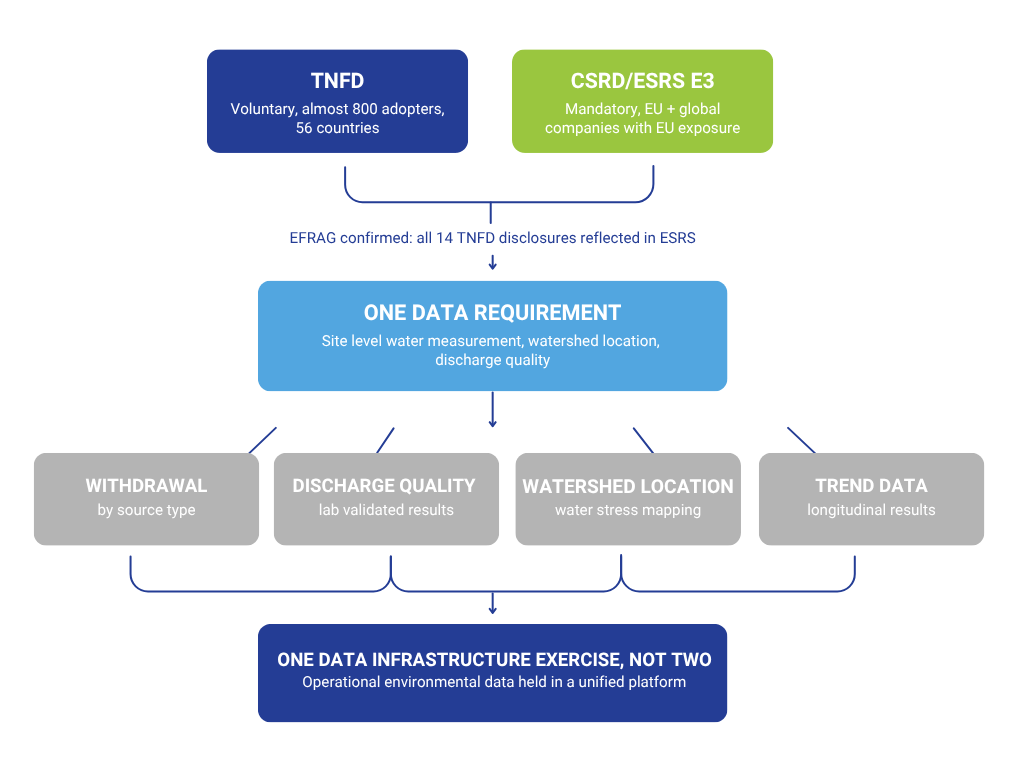
EFRAG, the body that authors the ESRS standards under CSRD, published a formal correspondence mapping with TNFD in June 2024. The finding was clear: all 14 of the TNFD recommended disclosures are reflected in the ESRS. The two frameworks are interoperable by design.
What this means in practice is that a company preparing TNFD-aligned disclosures and a company preparing CSRD/ESRS E3 disclosures are doing the same underlying work. They need the same site-level water data. They need to identify the same watershed intersections. They need to report against the same fundamental metrics: withdrawal by source, consumption, discharge quality, location relative to water-stressed areas.
For North American companies that have committed to TNFD voluntarily, most have EU operations or EU market exposure that puts them inside CSRD scope simultaneously. Dow, International Paper, Bunge, Nutrien, and the major mining and forestry companies on the TNFD adopter list likely face both obligations at once. The smart organizations are treating them as one data exercise, not two.
The question is not which framework to comply with first. The question is: do you have the underlying operational data to support either?
What “Water Data” Actually Means at the Operational Level
Here is where the conversation needs to get specific, because the gap between what ESG platforms call “water data” and what TNFD and CSRD actually require is very wide.
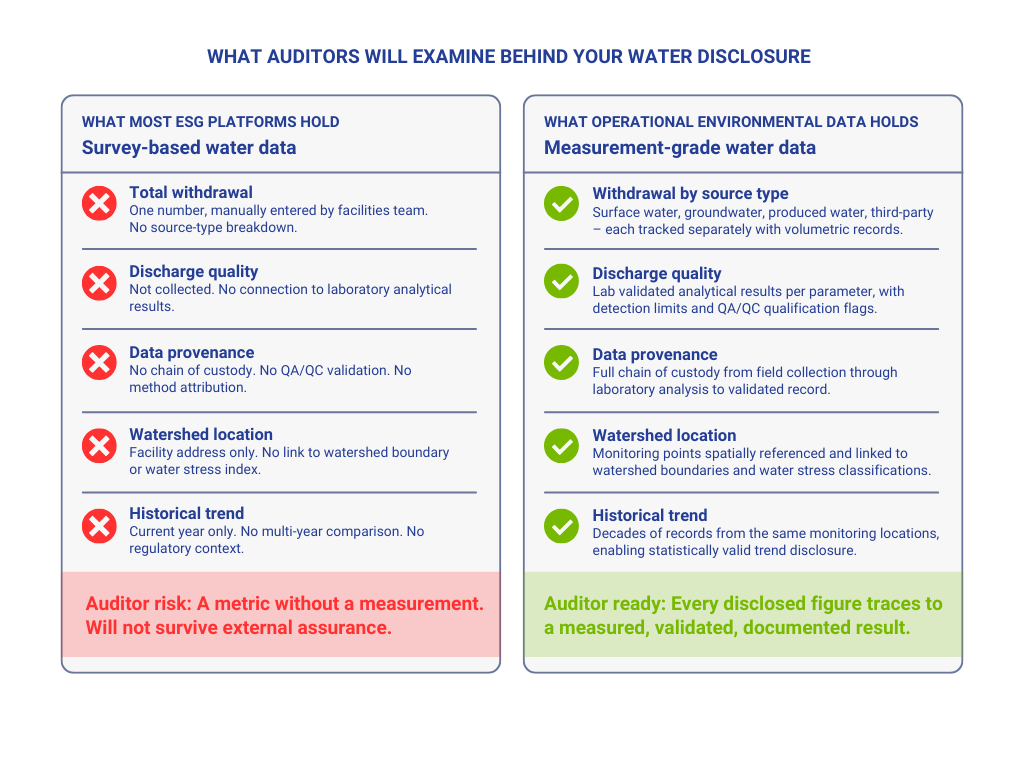
An ESG reporting platform collects a number: total water withdrawal in cubic meters for the year, entered by your facilities team into a web form, aggregated to the corporate level, and mapped to a GRI or ESRS metric. That is useful for voluntary disclosure. It is not adequate for external assurance. And it does not help you answer the harder questions that TNFD’s LEAP approach requires.
Operational water data, at the level that environmental compliance programs have always generated, is something fundamentally different. It includes:
Laboratory analytical results. Surface water, groundwater, and discharge samples are collected at defined locations, analyzed by accredited laboratories for dozens or hundreds of parameters, reported with method detection limits and practical quantitation limits, and validated against quality assurance objectives before being accepted into the data record. A result is not just a number. It is a number with a method, a laboratory, a collection date, a location coordinate, a detection limit, and a chain-of-custody record.
Monitoring well networks. Facilities with groundwater monitoring programs have networks of wells sampled quarterly or semi-annually, generating long-term trend data for contaminants of concern. That data tells you whether groundwater quality is improving, stable, or deteriorating. It is the factual foundation for understanding your facility’s impact on local water bodies.
Discharge monitoring records. Facilities with wastewater discharge permits under the Clean Water Act generate Discharge Monitoring Reports (DMRs) documenting effluent quality against permit limits. These records, maintained over years and decades, are the operational proof of a facility’s impact on receiving water bodies.
Stormwater characterization data. Industrial stormwater programs generate sampling data documenting the quality of precipitation-driven runoff leaving facility boundaries. This data is required for permit compliance and is directly relevant to understanding a facility’s water quality impact on adjacent water bodies.
Produced water and process water data. For oil and gas, mining, and heavy industrial facilities, the volumes and quality characteristics of process waters are tracked in operational systems that go far beyond what any ESG platform is designed to hold.
None of this data lives in your ESG reporting platform, yet all of it is material to TNFD and CSRD water disclosures. The organizations that will make credible, assurance-ready disclosures are those that can connect this operational record to their reporting workflow, not those that are collecting it for the first time through a sustainability questionnaire.
Why the Unified Data Layer Is the Strategic Differentiator
Every large organization with industrial operations has some version of this data. The problem is where it lives. It is fragmented across laboratory data management systems, facility-level databases, spreadsheets maintained by environmental engineers, regulatory agency submission records, and in many cases, decades of paper files. Getting a coherent picture of water withdrawal, discharge quality, and groundwater impact across a portfolio of facilities requires either a massive manual aggregation exercise every reporting cycle, or a platform architecture that holds all of it in one place.
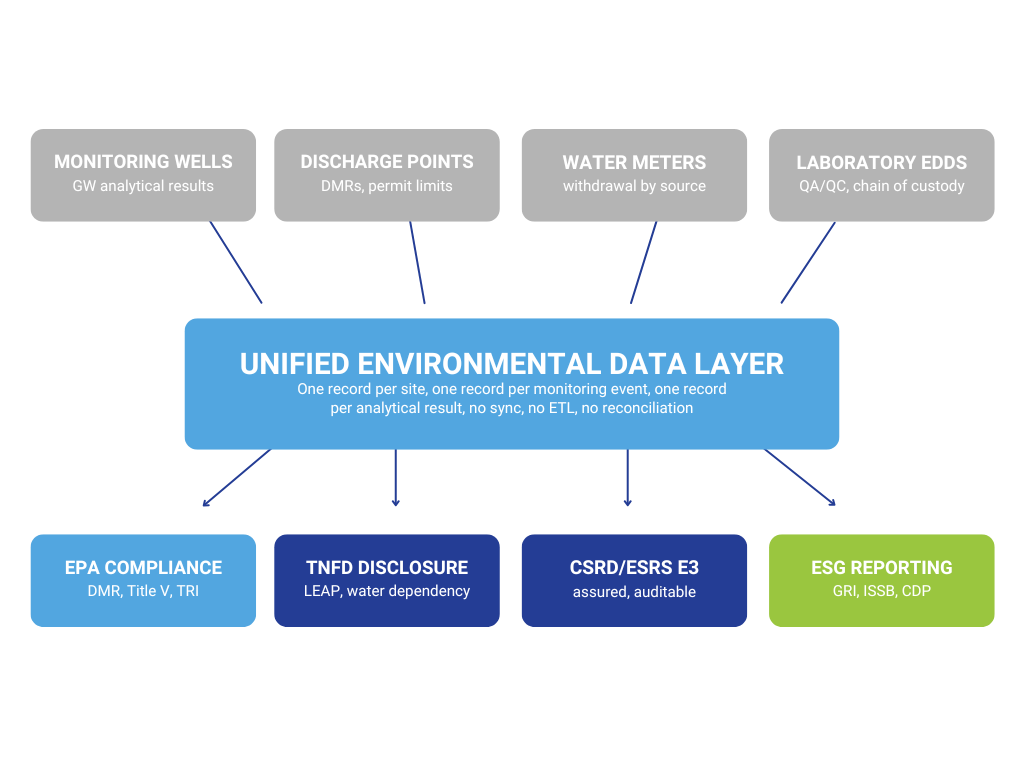
This is the concept of a unified environmental data layer, and it is the infrastructure decision that separates organizations that will meet these disclosure obligations with confidence from those that will struggle every reporting cycle.
A unified data layer means that a monitoring well, a discharge point, a surface water body, a laboratory result, a permit limit, and a regulatory reporting obligation all exist as connected objects within a single data environment. When a sample is collected from monitoring well MW-23 at your facility in Texas, that result is automatically associated with the well’s location, the sampling method, the laboratory QA/QC validation status, the relevant permit condition, and the historical trend for that parameter at that well. When you need to report your facility’s impact on the receiving water body for ESRS E3, that information is already structured and available. You are not reconstructing it from scattered files. You are running a query.
The architectural value of this approach compounds over time. A facility that has been generating environmental monitoring data within a unified platform for ten years has a ten-year auditable record, spatially organized, analytically validated, and connected to the regulatory submissions it supported. That record is the foundation of a credible TNFD or CSRD disclosure. It is also the foundation of a credible response to an auditor who asks: “How do you know your discharge quality meets permit limits and does not adversely impact the receiving water body?” The answer is: we have measured it, validated it, and recorded it, and here is the complete record going back to the first sampling event.
The Scientific Bar That Most Software Cannot Meet
This is a point the market rarely discusses openly, but it matters enormously for any organization preparing for external assurance.
Environmental data management is not generic data management. It operates under a specific scientific and regulatory framework: EPA-defined methods, laboratory accreditation requirements, data quality objectives, QA/QC validation protocols, and chain-of-custody documentation requirements. Managing this data correctly requires software that understands these structures natively, not software that has added an “environmental data” module.
Consider what correct environmental data management actually requires:
Detection limit handling. When a laboratory analyzes a water sample for a contaminant and the result is below the method detection limit, that is not a zero. It is a non-detect, with a specific detection limit value that carries regulatory and statistical significance. Statistical analysis of groundwater trends, including regulatory tests like Mann-Kendall trend tests, requires proper handling of non-detects using Kaplan-Meier estimators or other censored data methods. Software that treats non-detects as zeros or as missing values will produce incorrect trend analyses and incorrect regulatory calculations.
QA/QC validation. Laboratory data packages include field blanks, equipment blanks, field duplicates, laboratory duplicates, matrix spikes, and laboratory control samples. These quality control samples establish whether the analytical results are reliable. An environmental data management system needs to import, evaluate, and flag QA/QC results against acceptance criteria, and propagate QA qualifiers to associated environmental results. Without this, you do not know whether to trust the data you are reporting.
Chain of custody. Regulatory programs require documentation that a sample maintained its integrity from collection through analysis. Chain-of-custody records link a sample to its collector, its handling, its shipping conditions, and its laboratory receipt. This documentation is required for any data used in regulatory submissions and will be required for externally assured ESG disclosures as the market matures.
Electronic Data Deliverable (EDD) processing. Environmental data arrives from laboratories in standardized electronic formats containing hundreds or thousands of results per analytical batch. Processing these EDDs correctly, mapping them to the correct monitoring locations, parameters, and units, and validating them against expected formats requires purpose-built infrastructure that a general-purpose ESG platform does not have.
Spatial data integration. Environmental monitoring data is inherently spatial. Monitoring well locations, discharge points, watershed boundaries, and receiving water body identifications are geographic objects. Connecting analytical results to spatial context, mapping monitoring networks against watershed boundaries for TNFD’s “Locate” step, and identifying which facilities fall within water-stressed areas all require GIS-integrated data management.
The number of software platforms that handle all of these requirements correctly, within a production-grade enterprise system, is very small. Most environmental compliance software handles some of them. Very few handle all of them with the depth required for programs that generate tens of thousands of analytical results per year across dozens of facilities.
When the external assurance auditor asks for the data lineage behind a water quality disclosure, “we pulled it from our ESG platform” is not an answer that will hold up if the auditor then asks where that platform got its data and what validation it applied.
The Integration Problem That Fragmented Platforms Cannot Solve
Here is the practical situation most large industrial companies face. They have an EHS compliance platform for safety and incident management. They have an environmental data management system for site investigation and monitoring data. They have a GHG reporting tool for emissions inventories. They have an ESG reporting platform for disclosure outputs. And they have a water management system that may be separate from all of these.
Each system holds a piece of the picture. None of them holds the whole picture. And the connections between them, to the extent they exist at all, are manual exports, spreadsheet transformations, and periodic data reconciliation exercises that are expensive, error-prone, and not auditable as a chain of custody.
This fragmentation is the core operational problem that TNFD and CSRD are exposing. The frameworks are asking for an integrated picture: how does this facility interact with water, what does that mean for ecosystem health, what are the financial risks if water access changes, and how does this connect to the company’s overall environmental and climate commitments? Generating that picture from five different systems that do not share a common definition of “facility,” “monitoring point,” or “water body” is an exercise in reconciliation that consumes enormous internal resources and still produces a result that cannot be fully traced.
A unified environmental data layer solves this problem at the root. When the same site record, the same chemical compound definition, the same monitoring location, and the same compliance obligation live in a single data environment that underlies EHS compliance, environmental monitoring, waste management, GHG reporting, and ESG disclosure, the integration work disappears. The data does not need to be reconciled because it was never separated. A query for ESRS E3 water withdrawal data by source type returns the same numbers that appear in the facility’s operating permit compliance record, because they are the same data object, not two versions of the same number maintained in two systems.
For software companies, this is an architectural choice that either was made years ago or was not. Organizations that are evaluating software options today should ask the vendors they are considering a simple question: when I look at water discharge data in your ESG reporting module, and I look at water discharge data in your environmental compliance module, am I looking at the same record, or am I looking at two records that need to be kept in sync? The answer to that question reveals the architecture.
What This Means for Your Reporting Strategy
If your organization has committed to TNFD, or is subject to CSRD, or expects to face mandatory nature-related disclosure requirements as they expand globally, the practical implications of this analysis are clear.
Audit your existing environmental data infrastructure before you audit your disclosure outputs. The quality of your disclosure is downstream of the quality of your data. If your facility-level water monitoring data is fragmented, unvalidated, or not spatially organized, your disclosure will reflect that no matter how sophisticated your reporting platform is.
Treat your environmental compliance data as an ESG asset, not just a regulatory obligation. The analytical data your environmental team generates for permit compliance, corrective action monitoring, and stormwater management is exactly the data your sustainability team needs for TNFD and CSRD disclosures. These two functions should be looking at the same records.
Evaluate software on the quality of the underlying data model, not just the reporting output. Any platform can produce a formatted ESRS E3 report. Very few platforms can produce one that is backed by validated, spatially referenced, laboratory-quality measurement data with a complete audit trail. External assurance will force this distinction into the open.
Prioritize longitudinal data continuity. TNFD and CSRD both call for trend data and historical context. A platform that has held your environmental monitoring data for ten years provides something no new implementation can: a decade of auditable measurement history. That history is the foundation of a disclosure that shows not just where you are, but how you got there and where you are headed.
The Window Is Narrower Than It Looks
TNFD adoption is accelerating. The TNFD adopter community passed 792 organizations in late July 2026 and continues to grow. CSRD enforcement for large companies is underway, with limited assurance requirements already in effect and reasonable assurance coming. The ISSB has confirmed it will build nature-related standards on TNFD foundations. Mandatory nature disclosure is not a future possibility. It is an unfolding present.
The organizations that are ahead of this are not the ones with the most sophisticated ESG reporting platforms. They are the ones that made the right infrastructure investments years or decades ago, maintaining rigorous environmental data programs that happen to be exactly what these new frameworks require. Their competitive advantage in disclosure readiness is a byproduct of doing environmental compliance right.
For organizations that have not made those investments, the window to close the gap is narrowing. Building or consolidating a unified environmental data infrastructure takes time. Populating it with validated historical data takes longer. Connecting it to disclosure workflows and preparing it for external assurance takes longer still.
The question every environmental and sustainability leader should be asking right now is not “which framework should we align to first?” It is “do we have the operational data infrastructure to back any disclosure we make with measurement-grade evidence?” If the answer is uncertain, that is where the work starts.
FREQUENTLY ASKED QUESTIONS
Q: Is TNFD the same as CSRD?
No. TNFD (Taskforce on Nature-related Financial Disclosures) is a voluntary global framework that organizations adopt by choice to disclose their nature-related dependencies, impacts, risks, and opportunities. CSRD (Corporate Sustainability Reporting Directive) is mandatory EU legislation that applies to large companies and certain non-EU companies with significant EU operations or revenues. However, the substantive disclosure requirements overlap very substantially. EFRAG confirmed in June 2024 that all 14 TNFD recommended disclosures are reflected in the ESRS standards that sit under CSRD, particularly ESRS E3 (water) and ESRS E4 (biodiversity). For practical purposes, organizations preparing TNFD-aligned disclosures and organizations preparing CSRD/ESRS disclosures are working from the same underlying data requirements.
Q: What specific data does ESRS E3 require that most ESG platforms cannot provide?
ESRS E3 requires disclosure of water withdrawal volumes by source type (surface water, groundwater, seawater, produced water, third-party water), water consumption, discharge volumes and quality, the location of facilities in water-stressed areas tied to specific watershed identifiers, and the impact of discharges on receiving water bodies. Most ESG platforms collect total withdrawal as a manually entered number with no source-type breakdown, no discharge quality data, and no connection to the actual laboratory analytical results that document what was discharged and at what quality. They produce a metric. They do not hold the measurement that the metric is derived from.
Q: Does having a legacy environmental compliance database fulfill these requirements?
Potentially, but only if that database holds data at the right level of scientific rigor: validated laboratory results with method detection limits, chain-of-custody records, QA/QC qualification flags, spatial references for monitoring locations, and linkage to the permit conditions the data was collected to demonstrate compliance with. Many organizations have environmental databases that contain some of this information but are fragmented across systems or lack the validation infrastructure. The test is whether an external assurance auditor could trace a reported water quality figure back to the original laboratory result, with documentation of how that result was validated and how it was connected to a specific discharge point and receiving water body.
Q: How does PFAS fit into TNFD and CSRD water disclosures?
PFAS (per- and polyfluoroalkyl substances) present a specific and growing challenge for water disclosures under both frameworks. ESRS E3 requires disclosure of substances of concern in water discharges, and PFAS are regulated or being regulated at the federal and state level as substances of concern under the Safe Drinking Water Act, CERCLA, and state groundwater programs. Organizations with PFAS in their environmental monitoring data need a platform that can identify PFAS constituents within their analytical records, map them against applicable regulatory thresholds by jurisdiction, and determine which discharges involve PFAS above disclosure or reporting thresholds. This requires a system with awareness of the chemical taxonomy of PFAS (over 14,000 structures), not just a field for entering a contaminant name.
Q: What is the right first step for an organization that has committed to TNFD but does not have a unified environmental data infrastructure?
The most productive first step is an inventory of existing environmental data assets: what monitoring programs are already running, what data exists in what systems, what laboratory data management infrastructure is in place, and what spatial data exists for facility locations and their relationship to watershed boundaries. This inventory usually reveals that more data exists than sustainability teams realize, because it has been generated for permit compliance purposes and sits in environmental engineering systems that sustainability teams have never connected to their disclosure workflows. The gap is frequently not a data collection gap but a data integration and structuring gap. Understanding that distinction determines whether the path forward is a new data collection program, a platform consolidation exercise, or a workflow connection between existing systems.
About the Author
Neno Duplan is the Founder and CEO of Locus Technologies, a company he founded in 1997 to build the first pure-cloud environmental compliance and data management platform. Over nearly three decades, Locus has managed more than half a billion environmental records for clients including Fortune 10 energy companies, major mining and chemical manufacturers, Department of Energy national laboratories, and municipal water utilities. Duplan is a recognized expert in environmental data science, cloud computing for regulated industries, and the convergence of environmental compliance and ESG reporting. He writes and speaks regularly on the practical infrastructure requirements behind credible sustainability disclosure.
Locus is the only self-funded water, air, soil, biological, energy, and waste EHS software company that is still owned and managed by its founder. The brightest minds in environmental science, embodied carbon, CO2 emissions, refrigerants, and PFAS hang their hats at Locus, and they’ve helped us to become a market leader in EHS software. Every client-facing employee at Locus has an advanced degree in science or professional EHS experience, and they incubate new ideas every day – such as how machine learning, AI, blockchain, and the Internet of Things will up the ante for EHS software, ESG, and sustainability.