Reading Time: 3 minutes 52 seconds
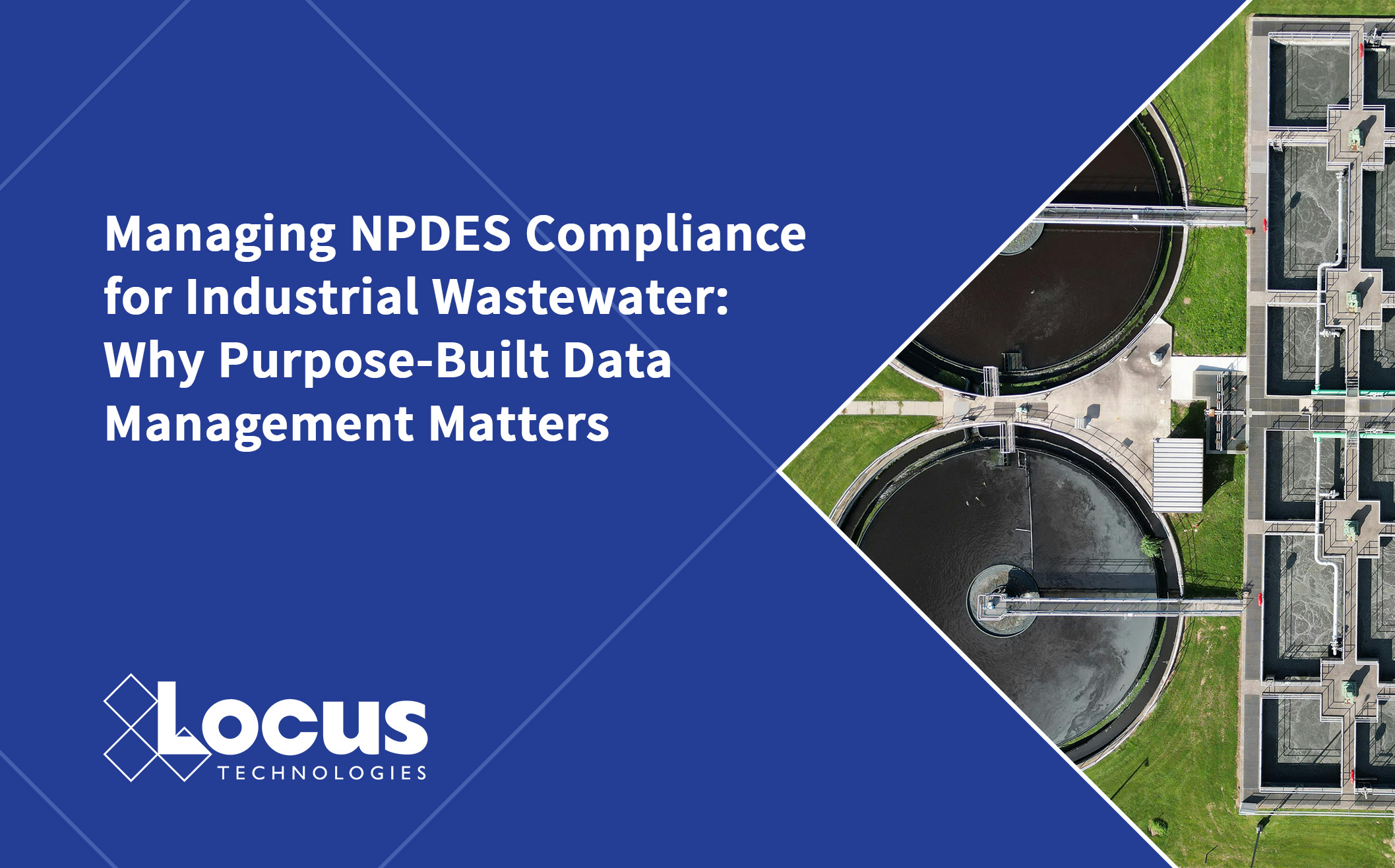
Industrial facilities operating under National Pollutant Discharge Elimination System (NPDES) permits live in a world where “close enough” isn’t good enough. These permits don’t just define discharge limits, they establish an ongoing compliance system that demands consistent sampling, defensible calculations, careful documentation, and prompt reporting. For many organizations, the hardest part isn’t the treatment process itself; it’s managing the data, proof, and workflow needed to prove compliance, day after day. This article outlines three primary considerations for enterprises that are seeking to improve NPDES compliance.
1) The real-world challenges of managing NPDES discharge permit compliance
NPDES compliance is fundamentally a data problem with operational consequences. Industries commonly struggle with:
- High data volume and complexity: Sampling can be frequent (daily/weekly/monthly), across multiple outfalls and analytes, with different methods, detection limits, and units. This creates a constant stream of results that must be validated, trended, and tied back to permit conditions.
- Evolving permit conditions and limits: Permit renewals, modifications, seasonal limits, production-driven variability, and special conditions (e.g., toxicity testing, wet weather provisions, mixing zones) create moving targets. Managing changes while maintaining continuity of compliance evidence is difficult without a system designed for it.
- Manual workflows and spreadsheet risk: Many facilities still rely on spreadsheets, shared drives, email chains, and tribal knowledge. That increases the risk of formula errors, version confusion, late reporting, and gaps in documentation, and those are exactly the issues regulators and auditors focus on.
- Data fragmentation across teams and systems: Lab results may live in LIMS or PDF reports, flow data in SCADA historians, and inspections in paper forms. When an exceedance occurs, pulling together the full story (what happened, why, what was done, and what was reported) can become a huge challenge.
- Defensibility under audits and enforcement: Regulators expect a facility to prove not only “what the numbers were,” but also how the numbers were produced, including chain of custody, QA/QC review, calibration, calculations (averages, loads, MWQ/other stats), and approval trails. Reconstructing this after the fact is costly, risky, and extremely inefficient.
- Response management and institutional knowledge loss: Exceedances and near-misses require consistent incident workflows: root cause, corrective actions, follow-up sampling, and sometimes formal notifications. Turnover or contractor-heavy operations can erode continuity if processes aren’t embedded in a system.
2) Why a robust data management platform is the smartest path
A robust environmental data management solution reduces compliance risk by making the compliance process repeatable, visible, and provable. The best platforms help by:
- Automating validation and calculations: Built-in rules can flag outliers, hold suspect results, apply detection limit logic, and automatically compute averages, loads, and other permit-specific calculations consistently, every time.
- Centralizing the compliance record: A unified system ties together sampling events, lab results, flow/production context, inspections, corrective actions, and reporting outputs so the compliance narrative is complete and easy to retrieve.
- Providing audit-ready traceability: Strong platforms preserve QA/QC status, revision history, approvals, and data lineage. When someone asks, “who changed what, when, and why,” you have an immediate answer.
- Improving timeliness with alerts and workflows: Automated notifications for approaching reporting deadlines, missing data, potential limit excursions, or equipment issues help teams act early and before a minor issue becomes a reportable violation.
- Enabling trend analysis and proactive management: Trending across years, sites, and outfalls helps facilities anticipate issues and optimize treatment. That’s where compliance moves from reactive reporting to proactive performance management.
- Scaling across multi-site programs: For organizations with multiple facilities, a single platform standardizes processes, makes performance comparable, and reduces the burden on corporate EHS and operations leaders.
3) Why Locus Technologies is a better fit than generic EHS software
Generic EHS platforms are often strong for broad programs like training, incident management, inspections, and high-level dashboards. But NPDES wastewater compliance is specialized with high-stakes: it requires deep environmental data handling, permit-driven logic, and regulatory-grade defensibility. That’s where Locus Technologies stands out.
- Environmental data management is core, not an add-on: Locus is built for environmental monitoring and compliance data workflows, not just general EHS checklists. That matters when you’re dealing with analytical chemistry results, detection limits, QA/QC, and complex permit conditions.
- Designed for regulated reporting and defensibility: NPDES compliance demands traceability, consistent calculations, and the ability to rapidly produce an audit-ready record. Locus Platform is structured to manage the full chain from sampling through QA/QC, analysis, and reporting in a way that stands up to scrutiny.
- Better alignment with water and wastewater realities: Wastewater programs require integration of lab results, flow, and operational context; managing multiple outfalls; handling recurring sampling schedules; and supporting the “exception workflow” when something goes wrong. Locus Technologies’ focus on environmental monitoring and compliance makes it a natural fit for these needs.
- Faster value for environmental compliance teams: With generic EHS tools, teams often spend considerable time configuring fields, building calculation workarounds, and forcing specialized workflows into a broad platform. With a purpose-built environmental data management solution, the system fits the compliance program rather than the program bending to the system.
The Bottomline
NPDES compliance is about maintaining a defensible, repeatable process that proves compliance over time. The biggest risks often come from fragmented data, manual calculations, inconsistent workflows, and weak traceability. A robust environmental data management platform reduces those risks by centralizing data, automating permit logic, enforcing QA/QC, and making reporting and audits far less painful.
For industries managing wastewater discharge permits, choosing a solution built specifically for environmental compliance, like Locus Technologies, can be the difference between a reactive, fragile program and a proactive, resilient one.
Locus is the only self-funded water, air, soil, biological, energy, and waste EHS software company that is still owned and managed by its founder. The brightest minds in environmental science, embodied carbon, CO2 emissions, refrigerants, and PFAS hang their hats at Locus, and they’ve helped us to become a market leader in EHS software. Every client-facing employee at Locus has an advanced degree in science or professional EHS experience, and they incubate new ideas every day – such as how machine learning, AI, blockchain, and the Internet of Things will up the ante for EHS software, ESG, and sustainability.

Laura Underwood, PhD
Director of Digital Water Services, Locus Technologies
Dr. Underwood brings over two decades of leadership in the water and environmental sectors, most recently serving as Senior Director of Strategy & Innovation at Veolia. She has also held key roles in water utility management, including serving as the Director of Water Quality & Environmental Compliance for a Municipal Water business unit. A long-time contributor to the American Water Works Association (AWWA) and a passionate advocate for digital transformation, Laura has built a national reputation for advancing smart, sustainable water practices across the utility and industrial landscapes.