By Koushik Gurumoorthy, Director of Implementation Services
Reading Time: 5 minutes
TL;DR
At Locus Technologies, implementation is a core strategic discipline built on continuity, regulatory expertise, technical depth, and proactive adaptation to shifting regulatory pressures. We combine structured project governance and continuity to ensure regulatory confidence, operational stability, and measurable improvement from day one through post–go-live optimization.
Why Implementation Determines Success in Regulated Environments
In Environmental Health & Safety (EHS), ESG reporting, and water compliance programs, implementation is not a technical afterthought. It is a risk management exercise. Organizations are not merely replacing software; they are safeguarding regulatory submissions, audit defensibility, institutional knowledge, and operational continuity.
Many prospective Locus customers come to us at an inflection point:
- A 20+ year old legacy system is no longer viable
- A hosted platform lacks configurability or responsiveness
- Spreadsheet-based processes have become unmanageable
- Multiple systems of record create reporting fragmentation.
In these environments, the real question is not whether the software works. It is whether the implementation team can transition the organization without disruption and without compliance risk.
At Locus, implementation excellence is engineered, not improvised.
Implementation as a Strategic Discipline
In much of the enterprise software market, implementation follows a transactional arc: scope defined, configuration delivered, team reassigned. Institutional knowledge erodes the moment the project closes.
The Locus Technologies approach is structurally different.
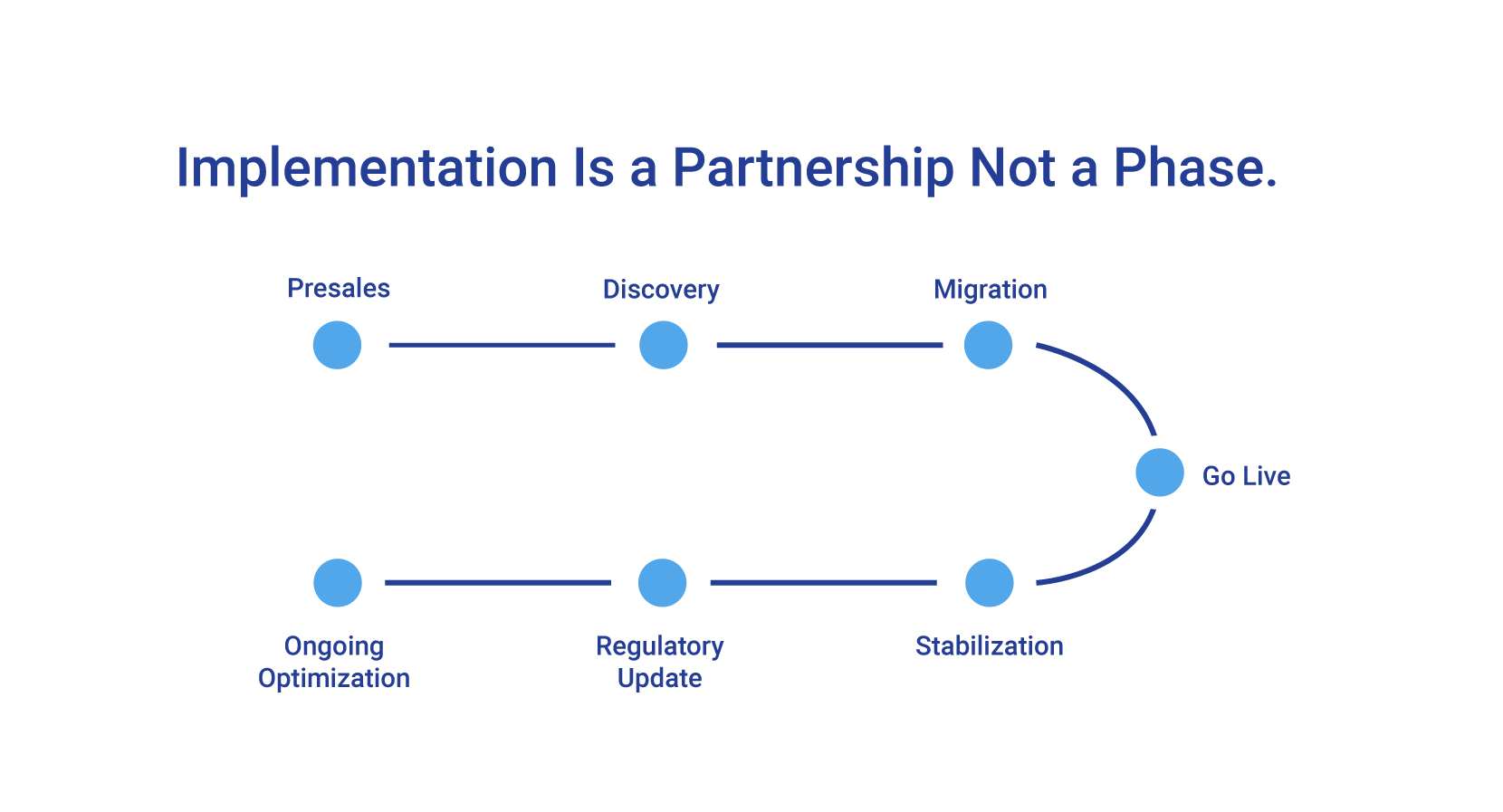
Implementation team leaders are engaged during presales scoping. Before contracts are finalized, implementation managers review and pressure-test the proposed scope to:
- Validate feasibility and assumptions
- Clarify in-scope versus out-of-scope requirements
- Surface integration and migration complexities
- Align compliance, operations, and IT stakeholders.
This early involvement eliminates ambiguity and prevents downstream friction. Instead of reacting to scope surprises later, we anticipate them. Planning begins before kickoff to reduce risk, compress timelines, align expectations, lower overall costs, and strengthen customer confidence.
Business Continuity: Stability from Start to Finish
Regulated reporting does not pause during system transitions. Annual submissions, emissions inventories, water discharge reports, and refrigerant tracking logs must remain accurate and defensible throughout migration.
Our implementation plans are designed around continuity first.
Locus ensures:
- Complete data migration and reconciliation
- Validation of historical records
- Parallel report testing before go-live
- Clear confirmation that regulatory filings can proceed uninterrupted
- Design and customer decisions are documented.
Equally important is human continuity. The same implementation team remains engaged from discovery through stabilization. Customers do not experience staff turnover mid-project, nor do they need to re-educate new consultants about their operational context.
After go-live, we communicate explicitly:
- What to expect in the first 30–60 days
- How enhancement requests are prioritized
- Who to contact for further configuration, product, or renewal matters.
Implementation is not a phase that ends at deployment. It is a managed transition into long-term operational confidence.
Structured Governance with Managed Flexibility
Environmental and ESG software deployments require formal project governance. Locus applies disciplined project management and change-management methodologies specifically tailored for regulated environments.
Each engagement includes:
- Defined stakeholder roles and escalation paths
- Milestone-based implementation roadmaps
- Clearly articulated customer responsibilities
- Transparent communication cadence
- Risk identification and mitigation planning.
However, rigor does not mean rigidity. Scope evolution is common, such as new facilities, evolving regulatory interpretations, or expanded reporting demands.
Rather than defaulting to “sorry, not possible,” we evaluate urgency and compliance impact, prioritize requests, and manage them through structured change queues. This preserves accountability while maintaining adaptability.
We do not avoid our customers’ complexity. We operationalize it.
Applied Expertise Across Three Integrated Disciplines
Implementation excellence requires more than subject-matter knowledge. It requires translating regulatory logic into scalable system architecture. Our teams integrate three complementary areas of expertise.
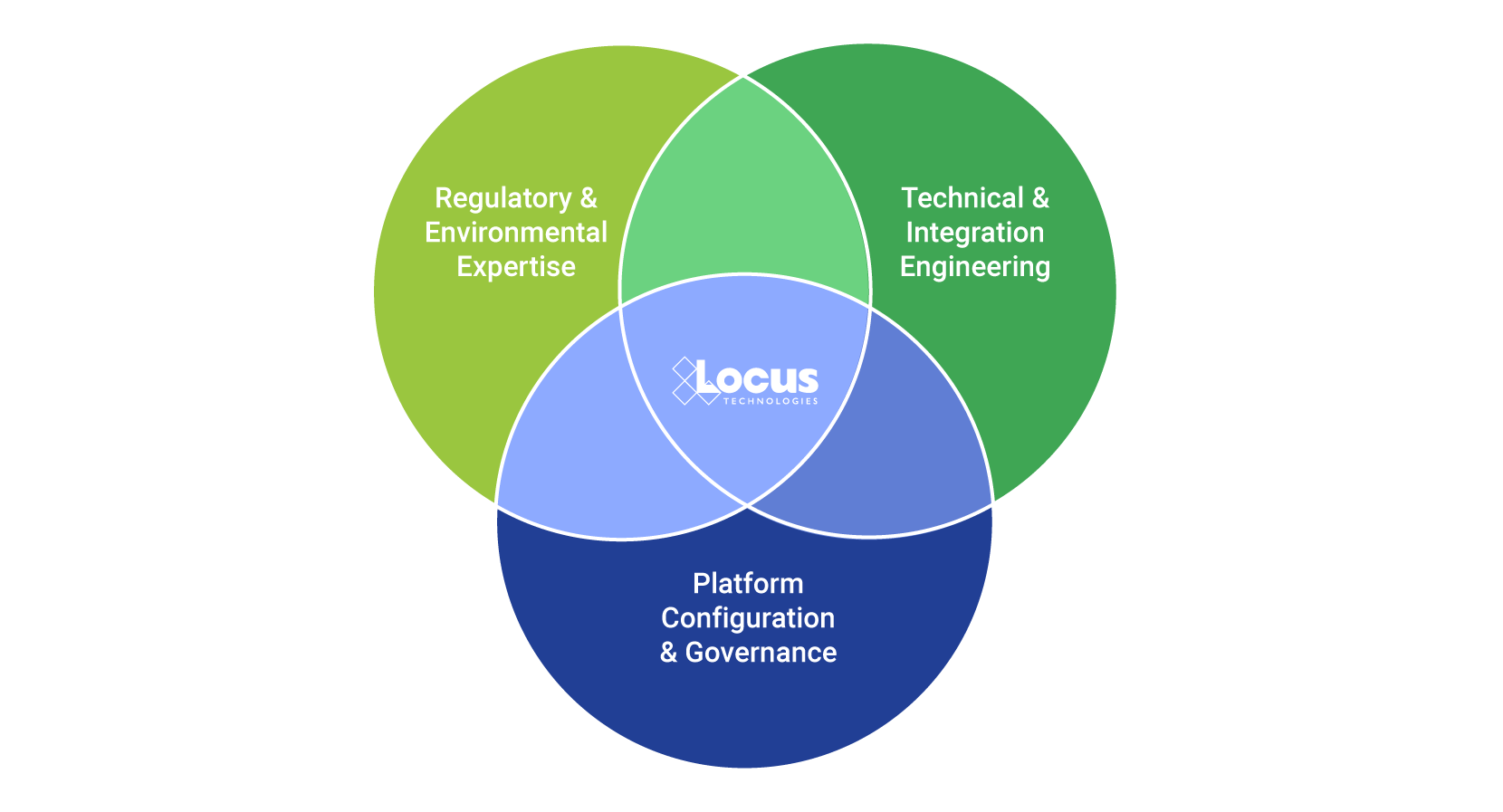
1. Environmental and Regulatory Domain Experts: Our consultants understand environmental reporting cycles, emissions calculations, waste tracking requirements, water compliance frameworks, and ESG disclosure expectations. Many have practitioner or advisory backgrounds. This ensures that workflows are not generic; they reflect how compliance officers operate and how regulators evaluate submissions.
2. Technical and Integration Specialists: Our implementation engineers design and validate integrations across enterprise ecosystems. They evaluate:
- Real-time versus batch synchronization
- Insert-only versus update logic
- Validation controls and error handling
- Traffic optimization and scalability.
Integration is engineered for reliability, performance, and long-term maintainability, not merely connectivity.
3. Platform and Configuration Experts: Because the Locus Platform is metadata-driven, configuration changes can be implemented rapidly. Our configurators (and our Configuration Workbench for customer self-service) enable:
- Workflow modifications
- Report and dashboard adjustments
- Form updates and validation rule changes.
Customers consistently cite responsiveness and configurability as differentiators compared to legacy vendors.
Migration Strategy: Transformation, Not Replication
Our customers typically begin from one of three starting conditions:
- Legacy enterprise systems that are decades old
- Hosted platforms lacking flexibility
- Spreadsheet or paper-based processes.
Each requires a distinct migration strategy.
The Locus Implementation team conducts structured discovery workshops to understand:
- Current data collection and validation processes
- Reporting bottlenecks and audit pain points
- Organizational complexity across facilities or business units
- Desired future-state governance.
We do not replicate outdated structures. We design improved architectures, consolidating fragmented systems-of-record and mapping legacy data into optimized workflows within the Locus ecosystem.
The objective is measurable improvement, not like-for-like replacement.
Cloud Reliability and Operational Responsiveness
Modern SaaS value extends beyond hosting location. It includes uptime, scalability, release agility, and configurability.
Locus Platform operates on Amazon Web Services, delivering 99.9% uptime and enterprise-grade resilience. But reliability is only part of the equation.
Customers also evaluate:
- Release cadence and responsiveness
- Real-time dashboard performance
- Speed of configuration updates
- Vendor agility in responding to regulatory shifts.
Because Locus Platform is metadata-driven, many updates can be implemented quickly, reducing dependency on lengthy release cycles common in older enterprise systems.
In regulated environments, responsiveness is operational risk mitigation.
Integration Expertise: APIs, IoT, and High-Frequency Data
Implementation extends well beyond migration. Increasingly, environmental and ESG programs depend on interconnected systems.
Our technical consultants design integrations that:
- Pull data from ERP and operational systems
- Push validated information into enterprise data lakes
- Interface with laboratory systems
- Connect IoT sensors generating hourly, daily, or minute-level data.
We assess architectural nuances such as data frequency, modification logic, traffic optimization, and scalability. The objective is not simply data exchange, but rather a sustainable, high-performance integration architecture.
Proactive Regulatory Adaptation
Regulatory volatility is constant in environmental and ESG domains. Waiting to react introduces compliance risk.
Our in-house implementation experts actively monitor emerging requirements, participate in regulatory briefings, and coordinate with Locus Platform development teams to prepare in advance. When significant changes are identified, the Locus Implementation Team:
- Drafts adaptation roadmaps
- Defines development and testing timelines
- Communicates rollout schedules to customers
- Assists in reviewing historical data for alignment.
Locus customers do not wait for compliance updates after the fact. They are prepared before deadlines arrive.
Implementation That Doesn’t Quit
A Locus project is not complete when configuration tasks are finished. It is complete when:
- Users operate without uncertainty
- Reports reconcile with historical submissions
- Regulatory filings proceed confidently
- Internal stakeholders trust the system.
We remain engaged until that standard is achieved.
For organizations modernizing their EHS, ESG, or water data management programs, the decisive question is not whether the software includes required features. It is whether the implementation team can translate those capabilities into durable operational results without disruption to day-to-day operations.
At Locus, implementation excellence is embedded into our core value proposition: structured, disciplined, continuous, and built to perform in the most regulated operational environments.
Locus is the only self-funded water, air, soil, biological, energy, and waste EHS software company that is still owned and managed by its founder. The brightest minds in environmental science, embodied carbon, CO2 emissions, refrigerants, and PFAS hang their hats at Locus, and they’ve helped us to become a market leader in EHS software. Every client-facing employee at Locus has an advanced degree in science or professional EHS experience, and they incubate new ideas every day – such as how machine learning, AI, blockchain, and the Internet of Things will up the ante for EHS software, ESG, and sustainability.