By Neno Duplan, Founder and CEO, Locus Technologies
Reading Time: 7 minutes
TL;DR: Environmental data is only trustworthy when it carries its full context. The article explains that a result—such as a PFAS concentration—needs to remain connected to its sample plan, field records, chain of custody, analytical method, detection limits, QA/QC, validation decisions, location, and historical data to be defensible. Locus EIM is positioned as the system that preserves this “chain of evidence,” helping environmental professionals make, explain, and audit compliance decisions. It also argues that AI can support analysis and flag issues, but only when it works from complete, validated, traceable records—not isolated numbers or disconnected spreadsheets.
Environmental data is a chain of evidence. A PFAS result, groundwater measurement, or emissions value becomes decision-ready only when it remains connected to the planning, collection, analytical, quality-control, regulatory, and historical context that gives it meaning. This article explains why Locus EIM is the environmental system of record that connects those elements across the whole solution.
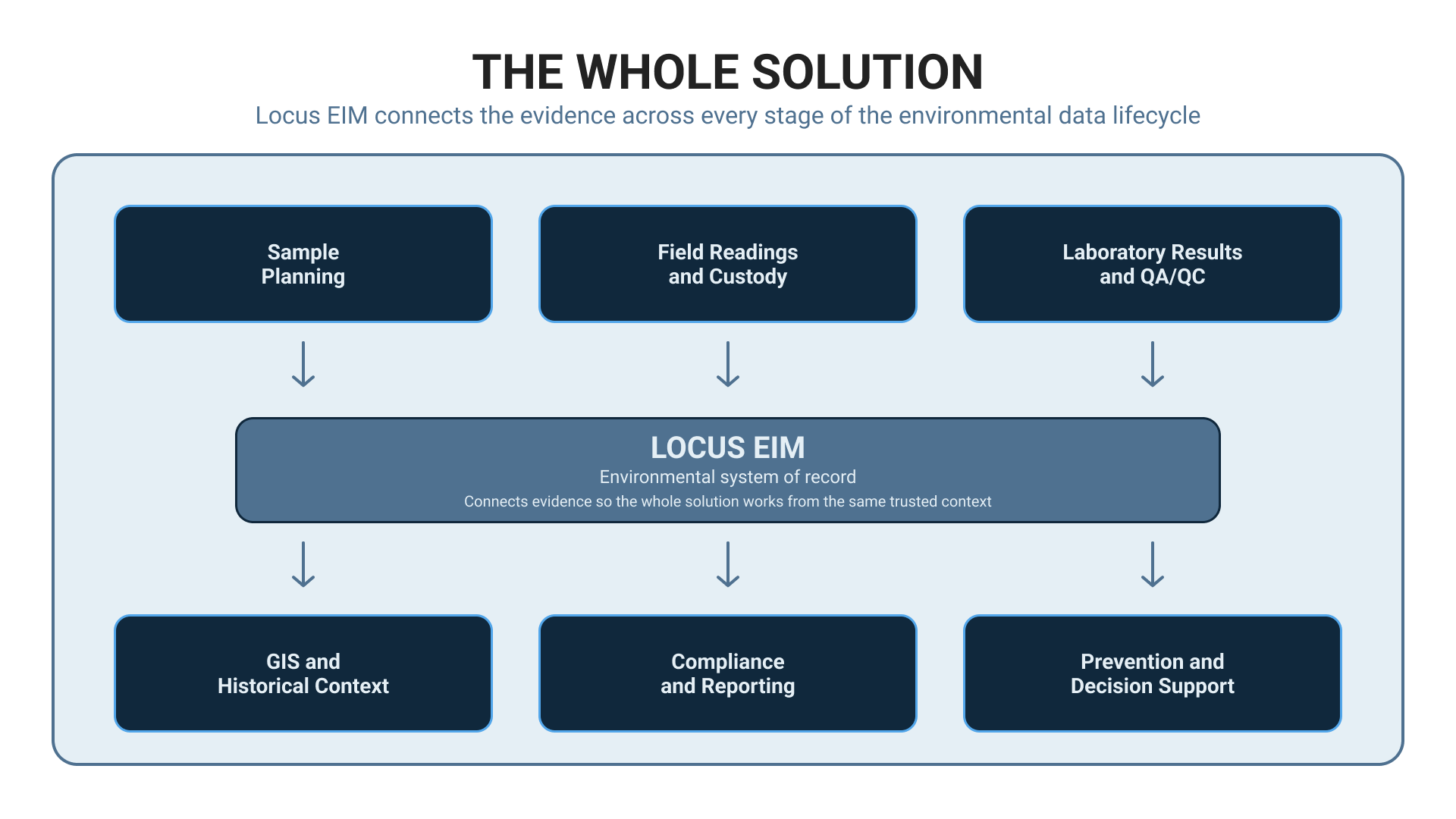
Figure 1. Locus EIM connects the whole solution through a common environmental system of record.
The Difference Between a Result and Its Provenance
A PFAS result is not simply a number in a spreadsheet. It is the outcome of a chain of scientific and operational decisions: what to sample, where to sample it, when to collect it, how to preserve and transfer it, which laboratory method to use, what quality-control evidence accompanies the analysis, how exceptions are evaluated, and what regulatory or operational decision follows. If any link in that chain is missing, the number may still be stored. But it may not be ready to support a permit filing, a remediation decision, an exposure assessment, or a challenge from a regulator, auditor, or court.
Locus EIM was built to manage environmental information as a connected chain of evidence, rather than as a final result file that happens to arrive in an EHS system.
Many software platforms can accept a reported laboratory value, attach a PDF, open a corrective action, or display a dashboard. Those are useful capabilities. They do not, by themselves, establish environmental information management. Environmental professionals need the provenance of a result: its sample and location, field conditions, chain of custody, laboratory delivery, analytical method, units, detection limits, qualifiers, quality-control results, validation history, and the calculation or decision that uses it.
A reported concentration can answer, “what did the laboratory say?” A connected environmental record can answer, “what does this result mean, what supports it, and can we defend the decision that relies on it?”
One Connected Lifecycle from Sample Plan to Prevention
Locus EIM brings together records that environmental programs too often manage in separate systems, email threads, laboratory packages, spreadsheets, and attachments. The process begins before the sample exists. EIM can manage sampling requests and sample-planning workflows, then support field teams with work lists, bottle labels, and chain-of-custody forms. Field readings and observations become part of the same environmental record rather than a disconnected form that must later be reconciled with laboratory data.
When a laboratory delivers an Electronic Data Deliverable, EIM can load and check structured data rather than treating it as an opaque attachment. Analytical results remain tied to the supporting context that determines whether they are usable: methods, detection limits, laboratory qualifiers, quality-control samples, holding times, and other validation evidence. Results can pass through a controlled review process before becoming production records, with the validation history retained alongside the data.
The record then gains enterprise context. It can be viewed alongside historical results, field measurements, locations and GIS, permit or action limits, operational events, reporting logic, and related environmental media. This lets a team investigate more than whether a result exceeded a threshold. It can ask whether the measurement is unusual for that location, whether a laboratory trend needs attention, whether treatment performance is changing, and whether action is warranted before an exceedance becomes a compliance event.
Why This Architecture Matters
The EHS market includes strong tools for safety incidents, audits, training, inspections, and workflow, such as Locus Platform. For organizations whose primary risk lives in those domains, a workflow-first platform may be the right fit. Environmental risk has additional dimensions: chemistry, time series, location, analytical methods, units, detection limits, data qualifiers, regulatory calculations, and decades of historical context.
Locus Technologies starts with the hard problem. Its Locus EIM foundation is built around samples, observations, laboratory data, field data, calculations, and traceable environmental records. Safety and compliance workflows can operate on that foundation, but they do not replace it.
The practical test is simple. When a regulator, executive, scientist, or attorney asks about a particular result, can the platform show the complete chain behind it without a manual reconstruction project? Can it demonstrate the sample plan, field record, custody documentation, laboratory method, QA/QC evidence, validation decision, calculation basis, and relevant history? If not, the organization may have data, but not a durable system of evidence.
The Clinical Standard: A Whole Body of Evidence
A physician does not make a serious diagnosis from a few blood or urine results viewed in isolation. A laboratory value may lead to a question, but the answer comes from the patient’s symptoms, medical history, physical examination, prior results, and, when appropriate, additional studies such as X-rays, CT scans, MRI, pathology, or other specialist testing. Some evidence directly addresses the initial concern. Other evidence helps rule out a different explanation. The diagnosis comes from the assembled clinical record, not a single result.
Reference ranges make the point even more clearly. A result outside the applicable range can be a meaningful signal, but it is not a diagnosis by itself. Ranges vary by the test, method, laboratory, and patient context. A clinician considers the whole body of evidence before deciding whether to monitor, investigate further, or treat.
Environmental work deserves the same discipline. A PFAS result, groundwater reading, or discharge measurement outside a relevant threshold is a signal to investigate in context, not merely a red cell on a dashboard. The reviewer may need to examine the sampling design, chain of custody, field observations, analytical method, detection limit, qualifiers, groundwater conditions, historical trend, treatment-system activity, and the regulatory basis for the threshold before deciding what the result means and what to do next.
A clinical reference range is a guide to interpretation, while an EPA Maximum Contaminant Level (MCL) is an enforceable drinking-water standard under the applicable program. They are not the same thing. But both show why a number needs context. A result relative to an MCL may trigger investigation, response, or compliance action. The evidence around it helps qualified professionals determine whether treatment, remediation, further monitoring, or another course is appropriate. Environmental remediation is the parallel to a clinical intervention: a response chosen from evidence, not reflexively from a number alone.
From Compliance After the Fact to Prevention Before It
Compliance is necessary. It is not the highest value a scientific data foundation can deliver. When validated analytical and field data accumulate in a common environmental record, patterns become visible. Teams can compare incoming PFAS results with historical monitoring data before finalization, identify long-running laboratory performance trends, evaluate treatment-system behavior, surface anomalous field readings for qualified review, and focus resources where the evidence suggests risk is increasing.
This is the move from reporting what happened to seeing what may happen next. It does not eliminate professional judgment. It gives environmental professionals a fuller, more trustworthy basis for applying it.
AI Needs the Record Not Just the Result
AI can help clinicians and environmental professionals recognize patterns, prioritize records for review, and surface questions that merit investigation. AI is not the diagnosis, and it is not the decision-maker. Its usefulness depends on the relevance, quality, traceability, and limitations of the data it receives.
No responsible medical AI should make a credible recommendation from one uncontextualized laboratory value. The same is true in environmental management. An AI tool that sees only a final PFAS concentration cannot assess the quality and meaning of that number as reliably as one that can also access its method, detection limit, qualifiers, sample and location context, related field measurements, quality-control evidence, and history. Locus EIM supplies the governed environmental record that makes this kind of evidence-based assistance possible, while keeping qualified professionals responsible for the interpretation and action.
Evidence Is the Differentiator
Today, it is easy to create a dashboard, summarize a document, or generate a confident statement about a dataset. That makes the underlying evidence more important. A polished report cannot repair an untraceable result. An AI-generated summary cannot establish whether a measurement was collected correctly, reviewed against the right criteria, or appropriate for the decision being made.
Locus Technologies is not asking customers to accept a claim of trust. We are giving them the data lineage to demonstrate it. The power of the Locus Platform is not merely that it stores more environmental information. It connects scientific, field, laboratory, regulatory, spatial, historical, and operational information so environmental professionals can interpret, defend, and act on what the data is saying.
When environmental data carries compliance, financial, legal, and public-health consequences, the result is only as credible as the evidence that travels with it.
Three Questions to Ask Any EHS Vendor
- Can you trace a reported result back to the sample plan, field record, custody, method, and supporting QA/QC data?
- Can the platform preserve the validation decision and historical context with the result, rather than in separate spreadsheets or attachments?
- Can it help qualified professionals detect trends and act before a problem becomes a reportable event?
Related Reading
- The Gap Between Having Data and Having Defensible Data – Validation and audit trail context.
- Full Spectrum Is Not the Same as Full Depth – The broader architecture argument.
- PFAS Software Built for Science Not Safety Incidents – PFAS-specific science and the chain of evidence.
- Analytical and Lab Data Management – Sample planning, EDD intake, validation, and field data.
- Data Validation System Architecture and Operational Framework in EIM – Technical white paper.
- MedlinePlus How to Understand Your Lab Results – Context for the reference-range analogy. Not medical advice.
- US EPA National Primary Drinking Water Regulations – Context for the MCL distinction.
- FDA Transparency for ML Enabled Medical Devices – Context for data inputs, limitations, and human judgment in the AI analogy.
Locus is the only self-funded water, air, soil, biological, energy, and waste EHS software company that is still owned and managed by its founder. The brightest minds in environmental science, embodied carbon, CO2 emissions, refrigerants, and PFAS hang their hats at Locus, and they’ve helped us to become a market leader in EHS software. Every client-facing employee at Locus has an advanced degree in science or professional EHS experience, and they incubate new ideas every day – such as how machine learning, AI, blockchain, and the Internet of Things will up the ante for EHS software, ESG, and sustainability.