By Amelia Anderson
Reading Time: 9 minutes 11 seconds
TL;DR: Managing chemicals, waste, and analytical data across a regulated industrial facility means working with the same substances at every stage of their lifecycle. Locus addresses this through a unified platform and an ecosystem of pre-built applications that share a single data layer, so information created in one context is immediately available in another. This article explains how organizations assemble a tailored compliance solution from Locus applications covering chemical inventory, waste management, analytical data, field sampling, and regulatory reporting, with no data re-entry, no system boundaries, and no gaps in the audit trail.
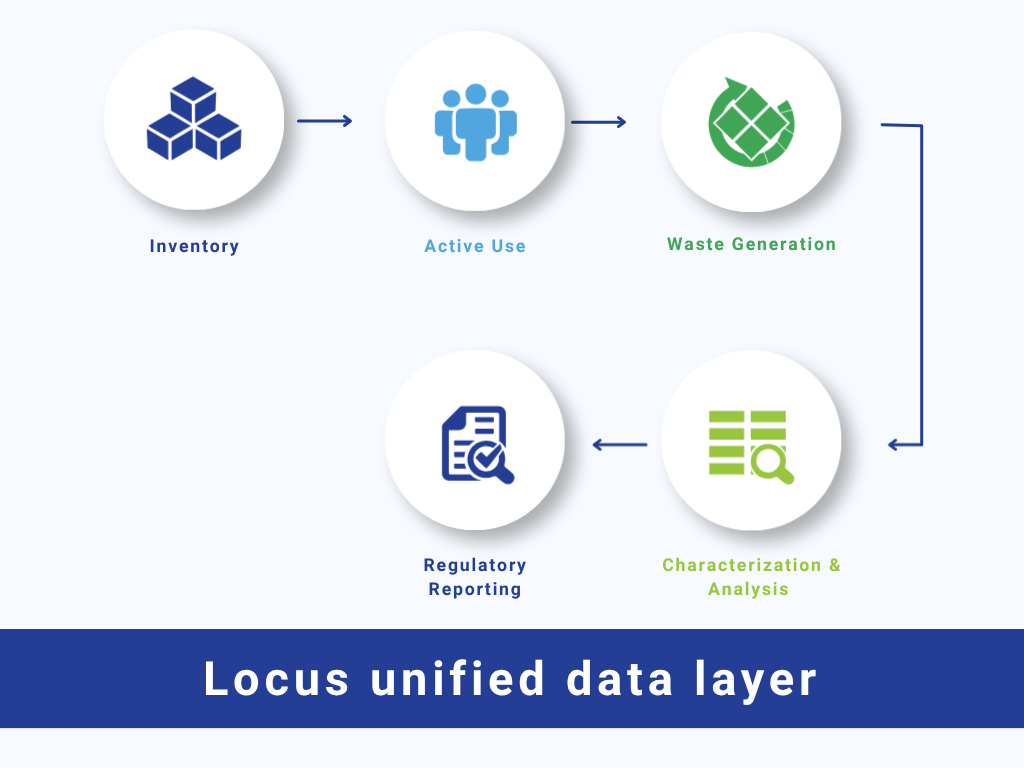
Managing chemicals in a regulated industrial environment is rarely a single-department problem. The same substance that appears in a chemical inventory record will eventually show up in a waste container, generate analytical results during characterization, feed an air emissions calculation, and ultimately contribute to a regulatory disclosure. Each step involves the same material, governed by the same underlying chemistry, tracked by teams who need access to the same data.
Organizations operating at this level of complexity need software that reflects how the work actually flows. Locus Technologies addresses this through a unified platform and an ecosystem of pre-built applications that can be assembled to match the specific compliance objectives of each organization. Because every application shares the same data layer, information created in one context is immediately available in another. There is no export step, no reconciliation between systems, and no gap in the audit trail.
The Chemistry Foundation that Connects Everything
At the center of every chemistry-driven deployment is the Locus chemistry database, curated over 30 years of active use across thousands of industrial, federal, and municipal deployments. It contains more than 20,000 substances with full CAS number libraries, synonyms, elemental compositions, physical and chemical properties, and current regulatory classifications.
This database is not a reference tool that sits alongside the compliance applications. It is the shared foundation beneath them. When a chemical is defined once in the platform, every application that needs it reads from the same record. The EHS manager tracking chemical inventory, the laboratory analyst linking analytical results, the compliance officer preparing a TRI disclosure, and the waste manager characterizing a container are all working with the same chemical identity, the same properties, and the same regulatory classification framework.
This shared foundation is what makes a tailored, multi-application solution coherent rather than fragmented. Users never enter a chemical name, CAS number, or synonym from scratch. The substance is already known to the platform, and its properties travel with it across every application and workflow.
Building a Solution Around the Chemical Lifecycle
Rather than licensing a predetermined set of tools, Locus customers select the applications that address their specific compliance objectives, knowing that those applications share data natively. The following describes how a chemistry-driven compliance program typically comes together on the Locus Platform.
Chemical inventory as the starting point. Locus Chemical Inventory tracks chemicals and materials across all sites, updating inventory levels as substances are received, used, relocated, or disposed of. Storage locations, quantities, concentrations, regulatory classifications, and documentation status are maintained against the same chemical records used by every other application in the program. Built-in templates accelerate EPCRA Tier II, TRI, TSCA, CAA, CWA, EU REACH, EU RoHS, and OSHA HazCom reporting, and KPI dashboards provide visibility into exceedances, supply levels, and trends across all facilities.
Waste management as a continuation of inventory. A chemical moves from active inventory to regulated waste status, but its identity, properties, and classification do not need to be re-established. Locus Waste Management inherits chemical information from the same platform records, supporting waste container tracking, accumulation area management, container inspections, manifest generation, and disposal documentation. RCRA evaluation, TCLP reporting, density-based recalculations, and action-limit notifications all operate on chemistry that is already validated and current. The compliance record from receipt to disposal is continuous.
Analytical data linked to the same records. Laboratory analytical results are the evidentiary backbone of chemical, emissions, water, and waste compliance, and they are most valuable when they are directly linked to the inventory, discharge, emission, and waste records they support. Locus Environmental Information Management (EIM) manages analytical chemistry data, sampling results, laboratory deliverables, exceedances, validation flags, and regulatory reporting within the same platform, referencing the same chemical identities, site locations, monitoring points, and regulated assets used by every other Locus application.
Chemistry is the same anywhere in the world. Chemical names may vary by country, industry, language, laboratory, or regulatory program, but CAS numbers connect those synonyms to the same chemical identity. That means a user searching for a specific PFAS compound, metal, VOC, or other regulated constituent is not dependent on inconsistent naming conventions or manual interpretation. Locus uses chemical identity management to reduce ambiguity and ensure that the right results are found, compared, calculated, and reported.
The same principle applies to units. One laboratory may report a result in ppm, another in mg/L, another in µg/L or parts per trillion. Locus manages unit conversions, so results can be normalized, compared, trended, and reported correctly without spreadsheet manipulation or manual recalculation. That is essential for PFAS, where very small concentrations can carry significant regulatory and legal consequences.
There is no manual assembly of results, no translation between systems, and no loss of scientific context. Analytical data, chemical identity, units, locations, samples, exceedances, and regulatory obligations remain connected in one defensible data model.
Field and mobile capability where the work happens. Field inspections, container checks, groundwater sampling, soil sampling, and QR or barcode-supported container tracking can all be conducted using Locus Mobile, with data uploading directly into EIM and the broader platform in real time. The mobile workflow begins with the Sample Planning Module in EIM, where field samples and associated analyses are scheduled by location. Samplers work from pre-configured provision files on their mobile devices, selecting from validated picklists that enforce established nomenclature and flag out-of-range entries before the data ever reaches the database. When sampling is complete, the dataset uploads to EIM and a chain of custody is printed, all within the same system.
Regulatory compliance and reporting drawn from the same data. Permit tracking, inspection schedules, corrective action management, and regulatory reporting are built on top of the inventory, waste, and analytical records beneath them. Because the data model is shared, there is no discrepancy between what the compliance team reports and what the chemical and waste teams have recorded. The audit trail is complete because the data was never separated in the first place.
Use smart monitoring tools to optimize sampling and reduce costs. For most organizations, the largest cost in an environmental monitoring program is not software. It is field sampling, laboratory analysis, consultant support, and the operational burden of collecting data. The question is not whether more samples can be collected. The question is whether the right samples are being collected. Locus combines analytical data management, GIS, statistical analysis, and AI-assisted evaluation to help organizations identify sampling locations that may be oversampled, under-sampled, redundant, or emerging as higher-risk areas. The goal is not to reduce sampling indiscriminately. The goal is to maximize the value of every sample collected.
Configuration without custom development. Every element of this solution can be configured to match an organization’s specific terminology, workflow steps, approval processes, form fields, and reporting requirements. New regulatory requirements, new waste types, and new chemical classifications can be accommodated through configuration rather than through a vendor’s release cycle. Locus customers can also build and deploy their own applications using the platform’s drag-and-drop visual designer, extending the platform to address emerging challenges without engaging a development team.
What this Looks Like at Scale: Los Alamos National Laboratory
The most rigorous test of any compliance platform is a deployment where data accuracy is legally and operationally non-negotiable. At Los Alamos National Laboratory, one of the most demanding federal environmental environments in the country, Newport News Nuclear BWXT-Los Alamos (N3B) relies on a Waste Data System built on the Locus software to manage regulated chemical and waste characterization workflows.
The deployment includes the full range of capabilities described above: chemical and waste inventory, analytical data management through EIM, mobile field data collection for groundwater stabilization and soil sampling, and regulatory reporting. Locus has continued to extend the system to meet evolving requirements, including integration between WDS and Locus EIM, analytical result retrieval by WDS record, new radiological screening fields, RCRA oil evaluation, EPA-defined TCLP reporting, density-based recalculations, action-limit evaluations, and automated notifications.
These enhancements were delivered through configuration and targeted development on the existing platform, not through a replacement system. The same architecture that tracks chemical inventory at an industrial manufacturer supports the most rigorous chemical characterization requirements in federal environmental compliance.
Similar deployments for the United States Marine Corps Aviation and the Port Authority of New York and New Jersey have applied the same flexible platform approach to chemical inventory, hazardous materials management, waste container tracking, inspections, and compliance reporting, each configured to the regulatory and operational requirements of that environment.
Tailored to the Objective, Not the Package
The value of this approach is that it puts the compliance objective at the center, not the software package. An organization can begin with chemical inventory and add waste management as that program matures. It can bring analytical data management into the same environment when the volume of laboratory data justifies it. It can extend into air emissions, GHG reporting, or ESG disclosures using the same underlying chemistry records, because those applications already exist in the Locus ecosystem and share the same data foundation.
Locus Chemical Inventory manages comprehensive profiles and monitors inventories across all sites, updating chemical levels as they are received, used, relocated, or disposed, with built-in templates for EPCRA Tier II and TRI to accelerate disclosures. Waste management, analytical data, field sampling, mobile data collection, and regulatory reporting all extend from the same foundation.
No application operates in isolation. No data has to be re-entered to cross a system boundary. The compliance program is assembled from capabilities that fit the specific challenge, and it grows as the organization’s needs grow, without replacing what is already in place.
That kind of flexibility is what Locus was built to deliver.
Frequently Asked Questions
Q: What software can manage chemical inventory and hazardous waste in the same system?
Most chemical inventory and hazardous waste applications are sold and deployed separately, which creates data gaps when a substance moves from active use to regulated waste status. Locus Technologies manages both within a single platform, using a shared chemistry database that maintains chemical identity, CAS numbers, regulatory classifications, and physical properties across both applications. When a chemical transitions to waste, its identity and compliance attributes carry forward. Container tracking, manifest generation, RCRA evaluation, and disposal documentation all reference the same records established during inventory, so there is no re-entry of chemical data and no divergence between the inventory record and the waste record.
Q: What is the best software for cradle-to-grave chemical tracking and TRI and EPCRA reporting?
Cradle-to-grave chemical tracking requires a platform that can follow a substance from receipt through active use, waste generation, characterization, disposal, and regulatory disclosure without losing continuity across those stages. Locus Chemical Inventory tracks chemicals across all sites and updates inventory levels as substances are received, used, relocated, or disposed of, with all TRI release data logged by material, release amount, type, location, and any related incident report numbers. Built-in templates for EPCRA Tier II and TRI accelerate disclosures, and the application supports TSCA, CAA, CWA, EU REACH, EU RoHS, and OSHA HazCom reporting. Because chemical inventory, waste management, and analytical data management share the same data layer on the Locus Platform, the regulatory disclosure draws directly from the same records used throughout the compliance program.
Q: Can one platform handle chemical compliance for both standard industrial facilities and highly regulated federal or defense environments?
Yes, and the same underlying architecture serves both. The Locus Platform is a configurable, multitenant SaaS system built on a shared chemistry data model, which means it can be tailored to the specific workflow requirements, approval processes, regulatory frameworks, and reporting formats of any deployment without requiring a custom-built system. At Los Alamos National Laboratory, Newport News Nuclear BWXT-Los Alamos relies on Locus for regulated chemical and waste characterization workflows that include radiological screening fields, RCRA oil evaluation, EPA-defined TCLP reporting, density-based recalculations, and action-limit evaluations. The same platform supports chemical inventory, hazardous materials management, and waste container tracking for the United States Marine Corps Aviation and the Port Authority of New York and New Jersey. Each deployment is configured to its environment; none required a separate product.
Q: Can chemical inventory software connect directly to air emissions and GHG reporting, or does that require a separate system?
Locus Chemical Inventory is built on the same platform as Locus applications for air permitting, GHG tracking, waste management, and industrial wastewater, so no separate system is required. Chemical profiles in Locus include pollutant type classifications covering air, water, and GHG, which means data entered during inventory management is already structured for use in emissions calculations and regulatory reporting. When chemical quantities change, the same platform that tracks the inventory change supports the air permit and GHG disclosure. For organizations subject to TRI, EPCRA Tier II, CAA, and GHG reporting obligations simultaneously, this connected approach reduces the compliance burden and produces a consistent, auditable record across all reporting frameworks without duplicate data entry or manual reconciliation between systems.
Locus Technologies has managed environmental compliance data since 1997, including more than 500 million records across thousands of sites worldwide. The Locus Platform’s chemistry database, curated over 30 years, is the shared foundation for chemical inventory, waste management, analytical data, laboratory workflows, emissions calculations, and regulatory reporting.