Locus is ready for e-Manifest

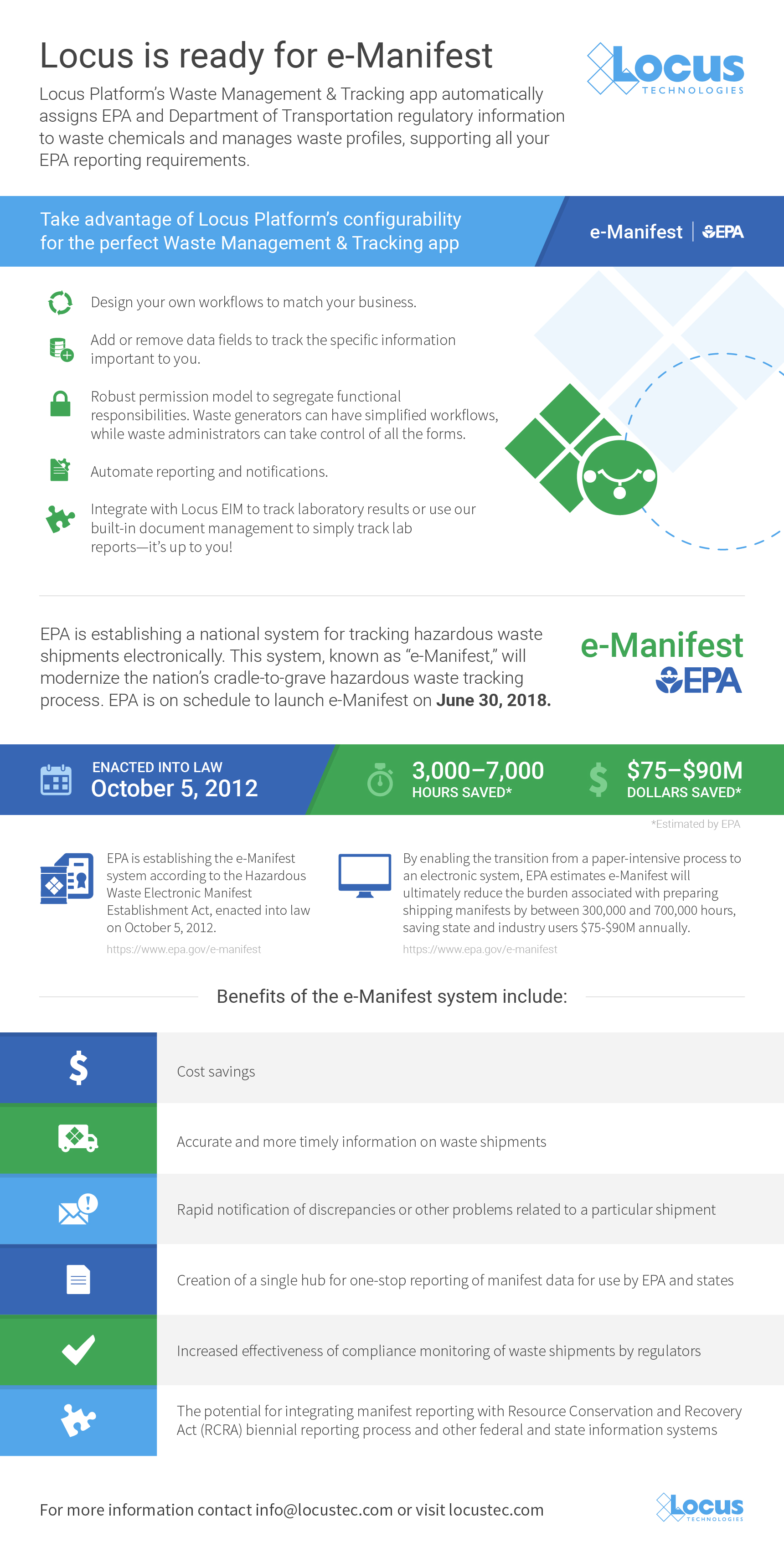
EPA is establishing a national system for tracking hazardous waste shipments electronically. This system, known as “e-Manifest,” will modernize the nation’s cradle-to-grave hazardous waste tracking process. EPA is on schedule to launch e-Manifest on June 30, 2018.


e-Manifest infographic

Download the latest fact sheets for e-Manifest stakeholders.
These fact sheets provide an overview of the e-Manifest program and the impacts it will have on each stakeholder. Each fact sheet outlines basic information about the e-Manifest system, how the specific stakeholder will be impacted, and what actions they need to take to use the e-Manifest system.

Learn more about Locus’ Waste Management application.


Salt River Project selects Locus SaaS for waste information management

Locus Platform provides “out-of-the-box” configurable software to streamline SRP’s Waste Management compliance tracking and reporting

MOUNTAIN VIEW, Calif., 27 February 2018 — Locus Technologies (Locus), the industry leader in EHS, sustainability, and compliance management software, is pleased to announce that Salt River Project (SRP) selected the multi-tenant SaaS Locus Platform to streamline its waste management and tracking, as part of its ongoing environmental stewardship and sustainability initiatives. A key factor for SRP was the “out-of-the-box” configurability of Locus Platform, plus the ability to perform their own data migrations and build APIs to integrate with internal tools, such as their LIMS system.

“The scalable, easy-to-use configuration in Locus Platform will allow us to standardize our waste management and reporting process, and integrating with Locus Mobile will simplify data collection and container management at our waste-generating facilities,” said Noah Manwaring, environmental systems development lead at SRP.

”Locus Platform will help our Waste Management resources to more effectively track, manage, and report information to regulatory agencies, facility managers, and corporate staff, and we can completely customize the solution using the built-in Configuration Workbench tool.”

Locus Platform’s Waste application allows waste-generating facilities to manage waste cradle to grave—including waste streams, processes, detailed profiles, container details and weights, and storage locations—and to produce various report outputs like labels, manifests, and LDR generation.

At the enterprise level, powerful dashboards and reports show users how each facility is generating and managing its waste, and built-in labeling and tracking streamlines workflows to create a full EHS compliance solution.

“By taking our existing Waste application and adding in their API integrations, SRP is combining the advantages of off-the-shelf software with Locus Platform’s powerful configuration tools. This means SRP will get exactly the software solution they need to fit their business processes,” said Wes Hawthorne, President of Locus.

Locus Technologies releases new Waste Management in Locus Platform

The Locus waste management application is fully integrated with the dynamic Locus Platform and will automate waste management for small and large enterprises.

MOUNTAIN VIEW, Calif., 28 February 2017 — Locus Technologies (Locus), the leader in cloud-based environmental compliance and sustainability management software, introduces a powerful waste management application to Locus Platform. Our new waste management app redefines how companies organize and manage their waste profiles and support EPA reporting requirements for hazardous and non-hazardous waste. With the click of a button the platform will be able to generate waste manifests, shipping labels or other documents populated with data from your records. The Locus Platform, a true multi-tenant SaaS, presents a highly flexible, user-friendly interface to meet individual organizations’ environmental management needs.

Nearly everything that doesn’t leave your facility as a product eventually becomes waste that needs to be tracked, managed, disposed of, and reported. Regardless of hazardous, universal or recycling waste stream, Locus Platform is ready. Locus’ waste module brings an organized approach and workflow process to schedule, sample, and analyze results.

One of the standout features that Locus Platform offers is the ability to generate new waste profiles. The flexibility of the platform allows users to create these manually, link to Locus’ EIM system or a third party’s testing results. You will be able to quickly reuse existing profile sheets, only updating the changed information. The platform will help consolidate your profiles in containers or whole areas, and features built in maps to help your transporter know exactly where to go to pick up the ready waste. Users are able to manage the composition of profiles through adding multiple chemical components to the profiles and accounting for their make-up of the whole profile.

Locus Platform is ready out of the box to track waste at any number of locations. You are able to add or remove waste containers, storage locations, etc. from your generating facilities, and allow any user to create their own way of organizing their data by generating filtered dashboards. At the enterprise level powerful dashboards will help you understand how each facility is generating waste, and how it is being handled. With the platform’s flexibility, facility information can be automatically populated based on the user credentials, saving your team time and frustration.

With Locus Platform’s waste management module you will also have real-time insight into your generator status. If your facility is expecting growth we can help you understand when you may reach small quantity generator status, setting up notifications when you approach the threshold limit. Forms will also automatically adapt to a change in status, prompting users to provide different data points when your generator status has changed. The new waste application is fully mobile-enabled to track container location and ensure storage compatibility in satellite accumulation areas. When paired with Locus’ EIM system, the tool can also track all of the waste sampling and characterization processes, and use that information directly to generate waste profiles.

“Waste management processes require coordination between EHS managers, field staff, laboratories, TSD facilities, and other parties. For compliance purposes, it is critical to make sure that information is exchanged correctly and comprehensively between all of these entities in a timely manner. The Locus Platform gives you the notifications, mobile tools, and reporting tools to make waste management processes seamless for any organization. For companies that need to characterize hazardous waste and track detailed analytical data for profiling, this solution integrates directly with the Locus EIM system, giving an expanded toolset for validating and reviewing laboratory data.” said J. Wesley Hawthorne, President of Locus.

The new TSCA law not REACH (in data requirements)

After a bipartisan accord, the US Congress overhauled the 40-year-old Toxic Substances Control Act (TSCA), with legislation to give the EPA greater powers to regulate about 100 hazardous chemicals. This is the first major statutory update to US environmental law that’s been passed in over 25 years. On a 403-12 vote, the U.S. House of Representatives on 24 May 2016 approved bipartisan legislation to amend the key provisions of the TSCA.

Under existing law, the Environmental Protection Agency (EPA) has succeeded in regulating only five toxic chemicals since 1976, prompting public health advocates to decry TSCA as broken. Part of the problem is that the law grants EPA only 90 days to decide whether a new chemical poses “unreasonable risk” before it can enter the market, and agency officials say they rarely get the toxicity data they need to make that call in time.

The compromise legislation will remove those procedural hurdles, require EPA to focus on “high priority” chemicals such as arsenic and asbestos, and give the agency new tools to collect data from companies. It also grandfathers in some existing state chemical safety laws, such as those enacted under California’s Proposition 65, but limits states’ authority to create their own restrictions on chemicals in the future. State pre-emption was a key point of contention between Democrats and Republicans during negotiations.

So how does the new TSCA law compare to the EU REACH program? REACH (Registration, Evaluation, Authorization and Restriction of Chemical substances) is a regulation of the European Union, adopted to improve the protection of human health and the environment from the risks that can be posed by chemicals. REACH also promotes alternative methods for the hazard assessment of substances to reduce the number of tests on animals. Under the REACH Regulation, companies are responsible for providing information on the hazards, risks and safe use of chemical substances that they manufacture or import.

One notable difference between  REACH and TOSCA is how they support downstream users in implementing their chemicals management programs. Regarding knowing chemicals in products, REACH provides clear direction that downstream users must communicate uses up to suppliers and know and publicly disclose (if requested) if their product contains substances of very high concern (SVHC). The TSCA  does essentially nothing to support downstream users in knowing chemicals in products and disclosing them to the public, and its requirements for upstream communication to suppliers on uses are uncertain.

Significantly, REACH requires companies to provide minimum data sets on the inherent hazards of chemicals. This data enables downstream users to evaluate and compare chemicals on their hazard characteristics. TSCA, while expanding the ability of the US EPA to require testing of chemicals, explicitly prohibits the agency from requiring minimum data sets.

While it is important to avoid the unnecessary testing of chemicals, it is also vital to have a data set on chemicals that enable their comparison on a common set of endpoints. The EPA needs the authority to establish a minimum data set on chemicals, although this may differ depending on the specific chemical.

On assessing the hazards of chemicals, the new  US law falls short of REACH and impedes harmonizing European and US requirements for chemical testing. Given that most US chemical companies sell into the European market, and therefore are already meeting those requirements, it is inefficient and wasteful to establish a totally separate testing regime in the US.

To support the use of inherently safer chemicals, REACH provides a clear and more streamlined process for identifying and restricting SVHCs. Over the course of seven years, the Regulation has identified 161 Candidate SVHCs, while over five years, the  US bill only requires the designation of 25 high priority chemicals and with new law extending that number to about 100 chemicals. Harmonization, consistency, and predictability are critical for downstream users, and these elements are all lacking in the new TSCA law.

 

Locus has been awarded by the Environmental Business Journal (EBJ) for a tenth year running!

Environmental Business Journal (EBJ) Recognizes Firms for Growth and Innovation in 2015

MOUNTAIN VIEW, CA–(Marketwired – February 02, 2016) — Locus Technologies announced today that Environmental Business Journal (EBJ), a business research publication which provides high value strategic business intelligence to the environmental industry, granted the company the 2015 award for Information Technology in the environmental and sustainability industry for the tenth year running.

Locus was recognized for continuing its strategic shift to configurable Multitenant pure Software as a Service (SaaS) EHS solutions and welcoming new, high profile customers. In 2015 Locus scored record revenue from Cloud software with annual growth over 20 percent. Locus also achieved a record renewal rate of 99 percent and signed up new customers including Shell Oil Company, Philips 66, Ameresco, California Dairies, Cemex, Frito-Lay, Genentech, Lockheed Martin, PPG Industries, United Airlines and US Pipe & Foundry. Locus also became the largest provider of SaaS environmental software to the commercial nuclear industry; currently over 50 percent of U.S. nuclear generating capacity uses Locus’ flagship product. Locus’ configurable Locus Platform gained momentum in 2015 with new implementations in the manufacturing, agricultural and energy sectors, including a major contract with Sempra Energy for greenhouse gas management and reporting.

“Locus continues to influence the industry with its forward-thinking product set, pure SaaS architecture, and eye for customer needs,” said Grant Ferrier, president of Environmental Business International Inc. (EBI), publisher of Environmental Business Journal.

“We are very proud and honored to receive the prestigious EBJ Information Technology award in environmental business for a tenth time. We feel it is a testament to our unwavering commitment and dedication to accomplish this level of recognition, especially now as we lead the market by providing robust solutions for the emerging space of cloud and mobile-based environmental information management,” said Neno Duplan, President and CEO of Locus Technologies.

The 2015 EBJ awards will be presented at a special ceremony at the Environmental Industry Summit XIV in San Diego, Calif. on March 9-11, 2016. The Environmental Industry Summit is an annual three-day executive retreat hosted by EBI Inc.

Senate Passes Overhaul of TSCA – Chemical Safety Rules

The Senate voted last December to approve a sweeping bipartisan chemical safety bill after years of work and months of tense negotiations.

The primary law overseeing the safety of chemical products—the Toxic Substances Control Act (TSCA)—was passed in 1976 and provides the U.S. Environmental Protection Agency (EPA) authority to review and regulate chemicals in commerce. TSCA was designed to ensure that products are safe for intended use. While the law created a robust system of regulations, over time, confidence in EPA’s regulation of chemicals has eroded.

The Frank R. Lautenberg Chemical Safety for the 21st Century Act, named after the late New Jersey senator, updates the 1976 TSCA to give the Environmental Protection Agency (EPA) broad new powers to study and regulate harmful chemicals like asbestos, while restricting states’ individual abilities to make their own rules. Lautenberg had made chemical reform his top priority before his death in 2013.

The bill would eventually require testing for every chemical currently in commerce, and any new chemicals. The EPA decisions about chemicals would have to be made solely on the basis of the impact on health and the environment, not the compliance costs.

But the legislation also has significant provisions that the chemical industry asked for, such as restrictions on what states can do on their own, which the industry said is essential for certainty and to avoid a patchwork of rules.

The House passed its own chemical reform bill in June 2015. The Senate sponsors said they plan to work with the House toward a compromise measure.

Key Points of the Bill

Some of the highlights, as outlined in a summary of the Senate bill, are:

  • Arequirement that the EPA review the safety of all chemicals in commerce;
  • New chemicals must pass a safety check before they can be sold on the market;
  • An explicit requirement to protect populations whose exposures, age or other conditions make them vulnerable to chemicals;
  • New authority for the EPA to require companies to test new and existing chemicals for safety; and
  • EPA can retain enacted state regulations and laws for chemicals, but temporarily stop new regulations while the agency is assessing a chemical’s risks.

Other provisions include minimizing animal testing, the establishment of a federal sustainable chemistry program, interim storage by mercury generators and a prohibition on the export of certain mercury compounds.

California Lawmakers Approve Ban on Plastic Microbeads to Protect Water

California approves AB888, an important bill to prohibit the use of plastic microbeads in personal care products for sale in California by 2020. When someone uses a product – like a face wash, for example – that has microbeads, several things happen. First – they get a unique kind of cleanse in their face that beauty companies suggest they can’t get any other way. Second – the microbeads (tiny pieces of plastic) are washed down the drain with water. These microbeads do not get recycled. They do not get caught in filters before they hit the sea. They pollute.

With two just-released studies showing overwhelming levels of plastic pollution in San Francisco Bay and in Half Moon Bay’s marine life, it’s not an exaggeration to say that this bill will have a huge impact on the health of California’s waterways — and its people. Alaska, Hawaii, Iowa, Minnesota, New York, Vermont, and Washington also tried and failed this year to enact bans on manufacture and sale, while Oregon’s legislature is considering similar bans.

Studies found that San Francisco bay is contaminated with tiny pieces of plastic in greater concentrations than other U.S. bodies of water — at least 3.9 million pieces every day. Many of those plastic particles are tiny microbeads, less than one millimeter in diameter, which can be found in personal care products like shower gels, facial scrubs and toothpaste.

AB888 will ban the beads by 2020. Product manufacturers can use other exfoliants that aren’t as environmentally destructive, and increasingly, states are demanding that they do so. Six other states have already passed legislation that bans or restricts their use.

In addition to the plastic polluting our waterways — there are 471 million microbeads released into the bay every day from wastewater treatment facilities, Gordon said — they also contaminate the fish that we eat. A recent study in the publication Scientific Reports found “anthropogenic debris” in 25 percent of the fish sampled at markets in California.

Locus Technologies receives EBJ Business Achievement award for Information Technology

Environmental Business Journal (EBJ) recognizes firms for growth and innovation in 2014

MOUNTAIN VIEW, Calif., 10 March 2015 — Locus Technologies announced today that Environmental Business Journal (EBJ), a business research publication which provides high value strategic business intelligence to the environmental industry, granted the company the 2014 award for Information Technology in the environmental and sustainability industry for the ninth time.

Locus was recognized for significant strategic strides in 2014 including entering the water quality management (drinking water supplies and waste water) market; introducing its new Locus Platform (a highly configurable, user-friendly interface to fully meet individual organizations’ environmental management needs); and launching Locus Mobile (a field data collection solution that is fully integrated with Locus’s flagship Environmental Information Management [EIM] platform). In addition, Locus continues to maintain its leadership position in the commercial nuclear industry by solidifying business with more than 50 percent of all U.S. commercial reactor facilities that use Locus EIM for radionuclides monitoring management.

“Locus continues to influence the industry with its forward-thinking product set and eye for customer needs,” said Grant Ferrier, president of Environmental Business International Inc. (EBI), publisher of Environmental Business Journal.

“We are very proud to receive the prestigious EBJ Information Technology award in environmental business for the ninth time. It is a statement of our vision and perseverance to accomplish this level of recognition, especially now as we lead the market by providing robust solutions for the emerging space of cloud and mobile-based environmental information management,” said Neno Duplan, President and CEO of Locus Technologies.

The 2014 EBJ awards, hosted by EBI Inc., will be presented at the annual executive retreat called the Environmental Industry Summit XIII in San Diego, Calif. on March 11-13, 2015.

Rogue Disposal & Recycling, Inc. Selects Locus Technologies’ ePortal Software for Compliance Management

SAN FRANCISCO, Calif., 12 August 2013 — Rogue Disposal & Recycling, Inc. (Rogue), a company that’s been providing Southern Oregon with innovative solid waste disposal and recycling services for over 73 years, has selected Locus Technologies’ cloud-based ePortal software for its compliance management.Rogue will use ePortal to take a more holistic view of its operations, and to proactively manage all compliance activities associated with its Dry Creek Landfill site. The company’s decision to use ePortal for compliance management stems from its continuous commitment to environmental responsibility. Rogue has always strived to become an environmentally conscious leader, and has enacted various innovative “green” policies and programs in order to do its part to both improve and protect the environment.

“Rogue’s overall goal is to be the leading environmental company in Southern Oregon,” said Lee Fortier, Dry Creek Landfill’s General Manager. “Locus’ ePortal system will help us to actively monitor all of our environmental compliance activities as we embrace the environmental regulations as our minimum commitment to our clients.”

“We are very pleased Rogue has chosen Locus to assist it with managing its compliance,” said Neno Duplan, President and CEO of Locus. “We believe Rogue will reap the benefits of tracking and reporting on all compliance activities in a single cloud-based secure system.”

About Rogue Disposal & Recycling, Inc.
Rogue management’s goal is to be the greenest company in Southern Oregon. The company has worked hard to become an environmentally conscious leader by continually looking at ways to both improve and protect the environment. The company features: solar panels at its main transfer station facility to produce clean, renewable energy; two waste collection trucks powered entirely by compressed natural gas (CNG); and the innovative Dry Creek Landfill gas-to-energy facility that converts methane gas from landfill refuse to electrical energy. Rogue is dedicated to new technology and the best management practices that exceed governmental mandates in a continued effort to provide superior service, affordable rates and a commitment to recycling and environmental protection.

Locus Featured in 12 Environmental Management Software Developers to Watch

Enablon, IHS and SAP have emerged as key application providers for forward-thinking businesses looking beyond compliance for ways energy and resource conservation can make them more competitive.