By Staff Writer
Reading Time: 8 minutes
TL;DR
If your risk is rooted in environmental complexity and water compliance — not just incident rates — Locus Technologies’ software is built for you.
Introduction
There is a Latin phrase worth knowing if you work in environmental health and safety: “Ne sutor ultra crepidam”. Roughly translated, it means: “Let the shoemaker not go beyond his shoe” (or “stick to your last”). It’s a warning against experts in one field overstepping into domains they do not truly understand. It is ancient wisdom, and it has never been more relevant than in today’s crowded, noisy EHS software market.
A new category of generic safety and HR-centric platforms has exploded onto the market in recent years. They promise to do everything: incident management, training records, safety observations, audit checklists, and, increasingly, environmental compliance and water data management. Their sales pitch is appealing. But for environmental professionals managing hazardous waste tracking, groundwater remediation, PFAS contamination, Clean Water Act permits, analytical chemistry data, or drinking water compliance, the reality of these platforms can be a dangerous illusion.
They are software products built by people who understand HR workflows and incident rates; not people who have ever drilled a borehole or installed a groundwater monitoring well, interpreted a gas chromatography report, or navigated the labyrinthine complexity of a Discharge Monitoring Report.
Locus Technologies is the inverse.
Born in Science, Not in Safety Checklists
Founded in 1997 by scientists, Locus Technologies has spent nearly three decades doing one thing exceptionally well: managing the most complex, consequential, and defensible environmental data on the planet. The company’s flagship Environmental Information Management (EIM) platform manages more than 500 million analytical records across 1.3 million sites worldwide, spanning soil, groundwater, air, biological tissue, produced water, and emerging contaminants such as PFAS. Every client-facing employee at Locus holds an advanced degree in science or brings deep professional EHS experience. This is not a selling point; it is the foundation of every architectural decision the company has ever made.
That scientific pedigree shows up in the software itself. Locus EIM includes scientist-grade formulas, automated data validation, unit conversion, error flagging, pre-built complex calculations, and GIS mapping. These are capabilities that generic safety platforms simply cannot replicate because their developers have never needed to. When Locus validates an analytical result, it is not running a spell-check. It is applying the same logic that a certified laboratory data validator would apply before signing off on a chain of custody.
Generic safety software starts from the other end entirely. It was built to track who attended safety training, to log near-miss incidents, and to schedule fire extinguisher inspections. Those are legitimate needs, but they are categorically different from managing a multi-year remediation dataset, modeling contaminant plume migration, or demonstrating Clean Air Act Title V permit compliance to a federal regulator. The intellectual and technical distance between those two worlds is vast, and no amount of product roadmap ambition closes it quickly.
The Asymmetry of Expansion
Here is the competitive dynamic that buyers should understand clearly, because the software industry rarely states it plainly:
It is far easier for a specialized environmental platform to handle generic safety needs than it is for a generic safety platform to replicate genuine environmental depth.
Adding incident management, audit workflows, safety observations, and training tracking to a platform already engineered for complex environmental data is a tractable problem. The hard engineering is already done. Locus has done exactly this; its EHS compliance software supports permit tracking across the Clean Air Act, Clean Water Act, RCRA, and OSHA, alongside incident management, risk assessments, occupational health tracking, and inspection workflows. Safety managers at a chemical manufacturer or water utility can run their full EHS program inside Locus without compromise.
The reverse is not true. A platform optimized for safety checklists and HR-adjacent workflows cannot simply add “environmental data management” or “water compliance” to its feature list and deliver the depth that regulated industries require. Environmental data is multidimensional, time-series-heavy, laboratory-validated, geospatially anchored, and subject to chain-of-custody requirements that have legal and regulatory standing. Building this correctly takes decades, not sprints. The generic platforms that attempt it tend to produce shallow implementations — enough to check a procurement box during a demo, but not enough to withstand regulatory scrutiny, litigation discovery, or an EPA inspection.
The companies that find this out the hard way are the ones that selected a platform based on price, UI aesthetics, or appearance in pay-to-play product comparisons, only to discover the gap when an enforcement action arrived.
The Stakes Are Different When It’s Environmental
Consider what is actually at risk when environmental data management goes wrong. The films Erin Brockovich, A Civil Action, and Dark Waters, starring Julia Roberts, John Travolta, and Mark Ruffalo, respectively, are not abstract cautionary tales for environmental professionals. They are landmark legal cases built on the integrity (or lack thereof) of environmental data. Locus Technologies is proud that the science underlying some of the most consequential environmental compliance cases in US history has been managed on its platform.
When the U.S. Department of Energy, Los Alamos National Laboratory, Chevron, DuPont, Chemours, or a major water utility trusts a software platform with its environmental data, they are not shopping for the cheapest incident-rate tracker. They are selecting a system of record that must be defensible before regulators, auditors, and the courts. Locus has served these organizations for decades precisely because its data architecture was designed from the ground up for that standard of accountability.
Generic safety platforms were not. That is not an insult; it is simply a statement of design intent. Their buyers are HR departments and safety managers tracking lagging indicators. Locus buyers are environmental scientists, compliance officers, and water utility operators managing real-time risk in complex regulatory environments.
Water Complexity: Where the Gap Is Widest
Nowhere is the competency gap between specialized and generic platforms more visible than in water compliance. Water utilities, industrial manufacturers, chemical companies, and energy producers all face a thicket of overlapping regulatory obligations: Safe Drinking Water Act compliance, Clean Water Act discharge permits, PFAS tracking, stormwater management, industrial pretreatment, backflow prevention, and emerging contaminant monitoring, all generating high-frequency analytical data that must be validated, reported, and archived to legal standards.
Locus Water, the first fully integrated, AI-ready software suite for water quality, water compliance, and water sustainability programs, was released in 2025 as a direct response to the fragmented, single-purpose legacy tools that utilities have struggled with for decades. The suite includes purpose-built applications for Drinking Water Compliance, Cross Connection Control Programs, Industrial Pretreatment, Water Metrics, Stormwater Inspections, Test Equipment Management, Watershed Maintenance, and Customer Complaints, all of which run on a single multitenant cloud platform with shared workflows, GIS, dashboards, and security.
No general-purpose EHS safety platform offers anything approaching this depth in water compliance. They cannot because building it correctly requires domain expertise accumulated over years of working with water chemists, hydrologists, hydrogeologists, hydraulic engineers, utility operators, and drinking water regulators. Locus has that expertise. It is embedded in every data model, every validation rule, and every compliance workflow in the platform.
What “Scientist-Driven” Actually Means for Buyers
The phrase “scientist-driven software” is more than a marketing tagline. It has concrete implications for every buyer evaluating EHS software for an organization with genuine environmental obligations.
It means that when a new contaminant like PFAS emerges, and regulators begin setting Maximum Contaminant Levels (MCLs) before the industry has even standardized reporting protocols, a scientist-driven platform can adapt its data models quickly and accurately because its developers understand the chemistry, analytical methods, and regulatory intent. Locus Technologies hit 4 million validated PFAS records in its database before most generic platforms had even added a PFAS data field.
It means that when AI and machine learning are layered onto the platform, the underlying data is clean, structured, and scientifically validated, so AI yields credible insights rather than hallucinated summaries of garbage-in data. Locus has been building toward AI-readiness for years, not retrofitting it onto a foundation that was never designed for analytical precision.
It means that configurability is not just a UI feature; it is the ability to adapt complex environmental data models, calculation methodologies, and compliance workflows to new regulations without breaking existing data integrity. Locus offers no-code and low-code configuration through a power user’s workbench, plus a self-service development kit for expert customization. That is configurability designed by people who have had to adapt to changing regulatory frameworks in real time.
One Platform That Earns Both Domains
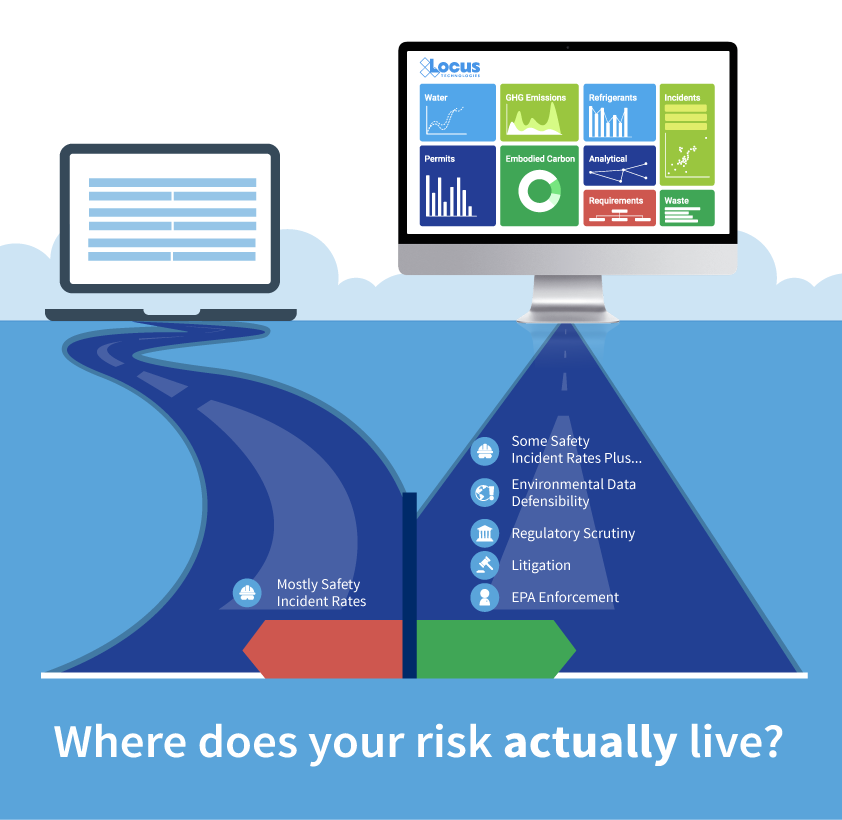
The decision framework for environmental professionals evaluating EHS software should not start with “does your form have XYZ field” or “which platform is easiest to use” or “which platform has the best mobile app for safety observations.” It should start with: “Where does my risk actually live?”
If your organization manages chemicals, industrial water, and discharges, waste, groundwater monitoring wells, Clean Water Act permits, drinking water compliance, multi-site remediation programs, PFAS tracking, or any other dimension of environmental data that has regulatory, legal, or reputational consequences, your primary risk is not in your safety incident rate. Your primary risk is in the quality, defensibility, and completeness of your environmental data.
Locus Platform was built for that risk. And because it was built for the hardest problem first, it handles the easier problems (safety incidents, training records, audit workflows, EHS compliance calendars) with the same architectural rigor that makes it the trusted choice for the Department of Energy, Fortune 500 chemical manufacturers, and municipal water utilities across the United States.
A generic safety platform can tell you how many incidents happened last quarter. Locus can tell you that AND whether your groundwater plume is shrinking, whether your PFAS levels are trending toward an MCL exceedance, whether your DMR is ready for submission, and whether your environmental data would hold up in federal court.
That is a different kind of software. For serious environmental professionals, it is the only kind worth buying.
Does AI Change Anything?
Traditional software vendors do not win because they can write code. Code is a commodity. They win when they encode domain expertise, such as regulatory nuance, scientific rigor, calculation integrity, audit defensibility distilled from decades of operating across complex, highly regulated industries.
That is precisely where most safety-origin software providers fall short. Their architecture was built around incident tracking, forms, and workflow management. Environmental compliance, analytical data management, emissions accounting, and water quality monitoring were layered on later. The foundation was never scientific; it was administrative. As a result, data models are shallow, calculations are brittle, lineage is weak, and scalability becomes a constraint.
Locus was built differently. Our platform originated from science—analytical chemistry, water quality, numerical groundwater flow and dispersion modeling, air emissions, and GHG accounting—where defensibility, traceability, and regulatory precision are non-negotiable. The data structures are designed to handle lab-grade results, complex calculations, and longitudinal environmental records at enterprise scale. Compliance is not a workflow overlay; it is mathematically embedded in the system of record.
AI does not change that fundamental distinction. Yes, AI can surface emerging best practices. Yes, it can accelerate development. But generating code is the easy part. Designing a science-based architecture that preserves data integrity, enforces calculation transparency, and scales across global operations is the hard part.
The real opportunity with AI is not to imitate safety software and build another workflow tool. It is to amplify a scientific foundation—automating interpretation, anomaly detection, regulatory mapping, and predictive risk modeling on top of a defensible environmental data core.
In the next decade, the advantage will not belong to vendors who started with safety forms and expanded outward. It will belong to platforms engineered from first principles of environmental science, where compliance, ESG, and operational performance are computed, not approximated.
The Bottom Line
The EHS software market is full of platforms that do the easy things well. Tracking safety incidents, managing training completion, running audit checklist … these are solved problems, and there are dozens of competent platforms that solve them at competitive price points.
Environmental data management, water compliance, and the kind of scientific rigor that regulators and litigators demand are not solved problems for most of those platforms. But it is, and has always been, the core of what Locus Technologies does.
When organizations choose Locus Technologies, they are not settling for a platform that merely accommodates their environmental needs alongside more generic safety features. They are selecting the industry’s leading purpose-built environmental intelligence platform, one that also handles their EHS safety program with the same depth and discipline.
The cobbler who tries to practice medicine is a risk to his patients. The platform that tries to manage your PFAS data without a scientific foundation is a risk to your organization.
Locus Technologies. Built for serious environmental professionals since 1997.
Did you know Locus Technologies manages 500 million analytical records across 1.3 million sites worldwide? Clients include the U.S. Department of Energy, Los Alamos National Laboratory, Chevron, DuPont, Chemours, the Port Authority of New York and New Jersey, and municipal water utilities across the United States.
Frequently Asked Questions
Why does data integration matter for EHS compliance? When environmental data is scattered across disconnected systems, establishing end-to-end traceability from field measurement to regulatory disclosure requires manual reconciliation at every step. Integration eliminates handoffs, reduces errors, and automatically produces a defensible audit trail.
What systems does Locus Technologies integrate with? Locus connects with IoT sensors and continuous monitors, ERP systems, LIMS, SCADA networks, enterprise content management platforms, and BI tools, including Microsoft Power BI and Tableau — all through standard APIs and direct connectors.
What is an Electronic Data Deliverable (EDD), and how does Locus use it? An EDD is a structured file format used by contract laboratories to submit analytical results. Locus developed standardized EDD formats that enforce data quality at the point of submission, replacing error-prone spreadsheet handoffs with a governed ingestion process, and those formats can be configured as needed.
Does Locus Technologies have native GIS capabilities? Yes. GIS mapping is built into the Locus Platform, not a third-party integration, although the software also integrates with ArcGIS Online. Monitoring locations, sampling networks, and compliance boundaries are visualized within the same environment as the underlying data — no separate GIS system required.
How does Locus support AI-driven environmental analysis? Locus has built AI-powered EHS capabilities directly into the platform. Because the platform unifies data from every source into a single governed environment, AI models have access to complete, consistent inputs, which is a prerequisite for reliable automated analysis.
Can Locus connect to external regulatory databases? Yes. Locus has integrated directly with the USGS Produced Water Database, for example, allowing operators to align internal production and water data with externally governed reference data in one environment.
What BI tools does Locus support? Locus supports integration with Microsoft Power BI and Salesforce Tableau. The company provides dedicated white papers walking through the connection process for each platform.
How does integrated data prepare an organization for AI adoption? AI tools require clean, complete, consistently formatted data to produce reliable outputs. Organizations that unify their EHS data in a governed platform today are building the foundation that enables meaningful AI adoption — rather than attempting AI atop fragmented inputs.
Is the Locus Platform cloud-based? Yes. Locus operates as a cloud platform, and its integration architecture is designed to support real-time connectivity with enterprise, field, and laboratory data systems without on-premise infrastructure dependencies.
Locus is the only self-funded water, air, soil, biological, energy, and waste EHS software company that is still owned and managed by its founder. The brightest minds in environmental science, embodied carbon, CO2 emissions, refrigerants, and PFAS hang their hats at Locus, and they’ve helped us to become a market leader in EHS software. Every client-facing employee at Locus has an advanced degree in science or professional EHS experience, and they incubate new ideas every day – such as how machine learning, AI, blockchain, and the Internet of Things will up the ante for EHS software, ESG, and sustainability.