
01 // Blog
Choosing the Right ESG Software: Why Scientific Rigor and Cloud Architecture Matter
The ESG software market has grown crowded, with more than 20 prominent platforms vying for attention. Many vendors are labeled “leaders” by analysts, yet their capabilities differ widely based on origins and architecture. To make sense of this landscape, it’s essential to understand where each solution comes from and what truly sets them apart.
Four Types of ESG Software Vendors
1. EHS Platforms (Locus, Cority, Enablon, Sphera)
- Born from environmental compliance and/or EHS management.
- Strength: integrating operational, high-frequency data (emissions, waste, incidents) with regulatory rigor.
- Fit: heavy industry sectors where performance and compliance are inseparable.
2. Financial Reporting Solutions (Workiva, Morningstar)
- Originated in corporate controls and financial disclosures.
- Strength: workflow, version control, and audit-ready narrative reporting.
- Limitation: often rely on other systems or manual processes for raw ESG data.
3. Pure-Play Sustainability Startups (Persefoni, Watershed, Measurabl, Novisto)
- New entrants emphasizing usability and rapid deployment.
- Strength: supplier engagement and emerging ESG topics.
- Risk: lack of domain depth, scalability, and long-term staying power.
4. Scrapers (RepRisk, FactSet/Truvalue Labs, GaiaLens)
- Aggregate ESG data from public sources.
- Strength: fast, broad coverage for investors.
- Risk: greenwashing, lack of scientific validation, and unclear data ownership.
The “Crepidem” Problem: The Illusion of Expertise Transfer
A recurring pitfall in ESG software is assuming expertise in one field (finance, CRM, ERP) translates into ESG. Many products end up oversimplified, lacking regulatory depth and real-world applicability. Even giants like Microsoft, IBM, and Salesforce failed to build credible ESG solutions due to this domain gap.
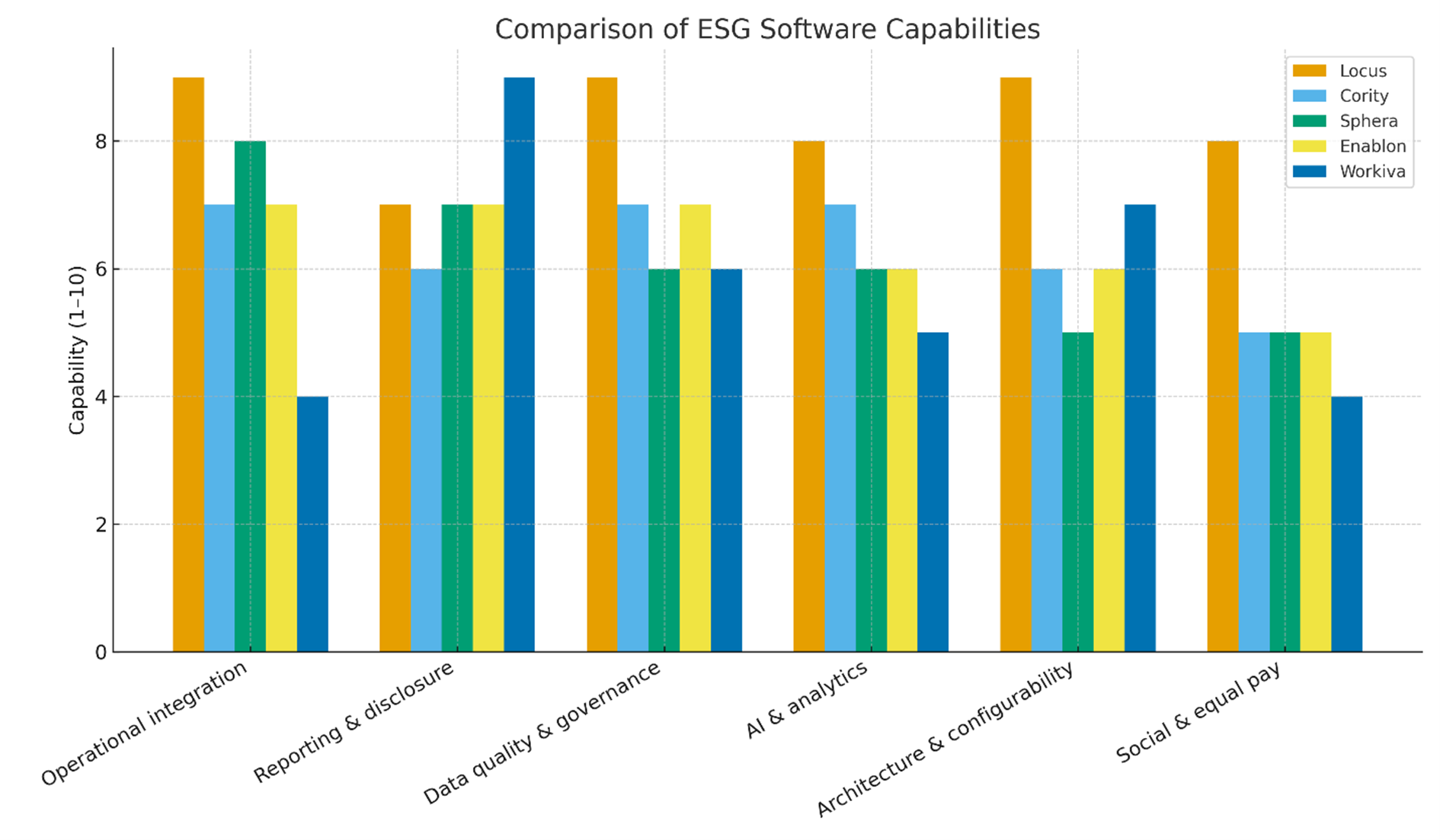
Why Locus Technologies Stands Apart
Among the leading vendors, Locus is the only platform built from the ground up with scientific rigor. Unlike competitors that grew through acquisitions or financial-reporting roots, Locus emphasizes:
- Cloud-native multitenancy: No legacy, on-premises baggage. Continuous updates for all users.
- Data integrity: Decades of validated environmental data, ensuring ESG reporting is reliable at scale.
- Configurability: Metadata-driven architecture for agile adaptation without custom coding.
- Integration breadth: A unified suite spanning water, waste, GHG, refrigerants, and even equal pay equity… capabilities unmatched by peers.
- AI readiness: With a rich history of structured data, Locus AI yields credible insights, not hype.
The company has resisted private equity rollups, focusing instead on organic innovation. Clients like Chevron, Honeywell, and the U.S. Department of Energy rely on Locus for mission-critical EHS and ESG management.
| Vendor | Heritage & Strengths | Cloud Architecture | Data Quality & Integration | AI & Analytics | Distinct Limitations |
|---|---|---|---|---|---|
| Locus | Science-first EHS & ESG platform | True multitenant cloud-native SaaS, no legacy | Unified operational + ESG data; strong audit trails | AI-powered with validated data history | Smaller brand visibility |
| Cority | Strong in safety & ergonomics | Mix of legacy and acquisitions; not fully integrated | Improving governance but fragmented | Building analytics as acquisitions integrate | Limited scalability due to rollup complexity |
| Sphera | Industry-specific EHS & compliance | Late to cloud, legacy apps remain | Decent reporting; weaker in waste & science-driven apps | Catching up in AI; strong safety modeling | Lack of integration; fragmented modules |
| Enablon | Compliance & risk management heritage | Hybrid cloud, not fully multitenant | Strong compliance workflows | Moderate analytics capabilities | Complexity, slower innovation cycle |
| Workiva | Financial reporting & disclosures | SaaS, optimized for reporting workflows | Relies on external systems for ESG data | Strong in narrative & XBRL tagging | Weak operational integration; limited science base |
Key Takeaway for ESG/EHS Buyers
The right ESG platform depends on whether you prioritize operational performance or reporting convenience. If your goal is credible, auditable data that drives both compliance and continuous sustainability improvements, Locus offers unmatched scientific rigor, multitenant scalability, and configurability.
In 2025, ESG success requires more than glossy reports; it demands data integrity, unified architecture, and the agility to adapt. Platforms that lack these foundations risk becoming bottlenecks rather than enablers.