
01 // Blog
AI is Nothing Without Validated Data

AI is Nothing Without Validated Data
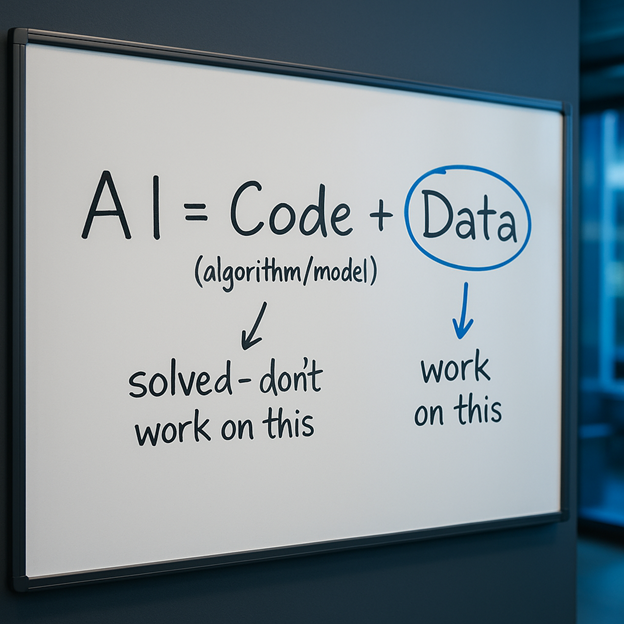
In a world awash with artificial intelligence hype, one truth stands unshaken: AI is nothing without data—and not just any data, but validated, trustworthy, enterprise-grade data, as Andrew Ng said: “AI = Code + Data. The code part includes the models and algorithms, which are solved problems. The Data part is the key that still has a lot of room for improvement.”
AI is nothing without data.
AI relies fundamentally on two key components: code and data. Code refers to the algorithms and models. By 2025, these models are essentially a solved problem. Data, however, is not. There is insufficient validated data, and the existing data often lacks quality. The opportunity now lies in tapping into validated, trustworthy, enterprise-grade data.
When you combine AI technology with decades of validated data from multiple apps, it gets infinitely more helpful. Stressing Locus’s pioneering work in the cloud and AI, it’s important to note that Locus has more validated environmental data than any of its competitors. Poor data quality is the primary bottleneck in current issues with AI results.
When you train AI models on extensive, validated data from multiple enterprise applications over many years, the models become significantly more reliable, accurate, and impactful. That is, it is more reliable than out-of-the-box models that have been trained on overly generalized data from the internet, social media sites, and non-domain-specific sources.
The forefront of AI for EHS, ESG, and water
With roots in Carnegie Mellon, the birthplace of AI, Locus has been at the forefront of deploying AI in the enterprise world, including compliance, big data, and, above all, validating data in unified databases across multiple customers.
The Wall Street Journal recently underscored this point, noting that while AI garners immense attention, actual business value emerges only when AI is grounded in real-world, actionable data. Companies recognize that models trained on noisy, unverified, or siloed information can deliver insights that are not only flawed but also potentially dangerous when informing regulatory compliance or operational decisions. This is where Locus Technologies steps into the spotlight.
Locus: Built for AI Before AI Was Cool
Locus has spent the past two decades preparing for this moment. Long before “AI” became a buzzword in boardrooms, Locus pioneered cloud-based environmental compliance and sustainability solutions. Its cloud-native architecture, developed in the late 1990s, unifies all customer data in a multitenant platform.
This single-database design means that Locus’ AI engines are not struggling to reconcile disparate data sources—they are learning from a continuously growing, harmonized dataset curated over decades and across industries.
Validated Data at Scale
Unlike vendors that bolt AI onto legacy systems, Locus designed its platform to integrate data validation as a core function. Environmental data is inherently messy. It comes from laboratories, field instruments, manual entries, and regulatory systems. Without rigorous quality control, AI models trained on this data are more fantasy than forecast.
After working through stages of learning and experimentation, many EHS managers and sustainability professionals are eager to drive business value, automate compliance, and gain strategic advantage by accelerating AI deployments. However, the following steps present fresh challenges that can expose holes in AI implementation.
Many expect intelligent AI agents to surface issues and opportunities in real-time without waiting for weekly reports. They want proactive alerts when emissions exceedances occur or when water becomes undrinkable — powered by data flowing seamlessly across their entire enterprise and paired with reliable, recommended actions. But do they have such data organized to benefit from AI agents?
Locus argues that across industries, companies feel squeezed, compelled to invest in AI to lower compliance costs while struggling with data silos—operational systems, spreadsheets, documents—that undercut AI’s effectiveness. Unlocking real value means deploying AI agents that act, not just analyze, and building an open data architecture that lets information flow freely. But none of this works without a rock-solid data foundation—integrated, governed, and high-quality.
What Sets Locus Apart?
Today, companies are bombarded with AI offerings from every corner of the vendor ecosystem. Inboxes are overflowing with “AI can do it all” messages. In San Francisco, billboards have scraped away nearly all other advertising in favor of bold promises about AI agents and do-it-all solutions. But these technologies, no matter how powerful, are less than useless if a company cannot interweave them with clean, organized, and validated data.
That is what sets Locus apart. We have it. Our customers have it. Competitors don’t.
Meanwhile, many competitors are effectively locked out of the AI market as serious players. Most are undergoing some form of post-acquisition integration, having been absorbed by private equity firms. Their focus is on financial survival, not innovation. They cannot even begin to develop AI solutions until they figure out what to do with their superseded legacy systems and disconnected data silos. AI initiatives require agility, cohesion, and deep domain data—qualities these competitors lack as they grapple with fragmented architectures and conflicting priorities.
The key to supporting large-scale, effective AI is having a robust, unified data foundation in an organized database, such as Locus. The quality and relevance of data directly impact the accuracy and reliability of AI applications. It’s not just about accessing AI models—anyone with a browser can do that. The key differentiator is the ability to combine those models across multiple apps and utilize customer insights.
Too many companies start with, “What’s our AI strategy?” instead of asking, “Is our data clean and organized? Who owns it, where is it, are we hostage to our data?” Only after that can one ask, “What’s our business strategy, and how can AI make it stronger given the state of our data?”
Data Fragmentation and Real-Time Architecture
Data fragmentation has been a significant obstacle to the effective implementation of AI. Aggregating data in data lakes and single databases has become a prerequisite for AI success. One of our large oil and gas customers has led the way by requiring all vendors to contribute their data to a centralized data lake, dramatically shortening their path to full AI deployment.
Locus’ real-time architecture accelerates data utility. Our customers stream analytical data from labs around the globe to monitor exceedances and manage sampling and lab analysis. They instantly recognize when problems arise, can react before they escalate, and continually adjust compliance reporting, logistics, and monitoring strategies. They also stream waste shipment data and water consumption per barrel of oil produced, enabling predictive insights and more effective regulatory responses.
Investing in Data Quality
Investing in data quality and governance yields a higher return on investment (ROI) than investing in newer, larger AI models. Customers in regulated industries, such as energy and water utilities, lead the pack because they’ve invested in governance, entitlements, and data quality. Locus’ EIM system prioritizes data integrity, ensuring the secure validation of data for all other applications. Most competitors have nothing comparable.
Everyone assumes that if you feed data into an AI model, it’s going to produce magic. However, catastrophic failures occur when data isn’t properly maintained. Data is the true differentiator in the AI era—not the models.
Leveraging Cloud Infrastructure for AI
Our partnership with AWS transforms the economics of AI deployment. Through a pay-as-you-go model, customers access advanced AI capabilities without significant infrastructure investments. This is critical for deploying agentic AI, which demands high computational power and robust controls. With AWS, customers can leverage retrieval-augmented generation (RAG) and other AI tools in a secure, scalable environment.
Machine Learning and Predictive Analytics
Machine learning and analytics offer transformative opportunities. Locus enables clients to move from manual, spreadsheet-based workflows to real-time compliance and predictive insights. We develop predictive statistical models that flag potential exceedances and anomalies, enabling proactive compliance and optimized decision-making.
As noted in our 2021 series of articles on AI—especially Part 4—AI must be explainable and transparent. In regulated industries, black-box models are unacceptable. Locus ensures every insight, prediction, and recommendation is auditable and defensible. What sets Locus apart is:
- Decades of historical, validated data.
- Unified multitenant architecture.
- Vertical-specific intelligence.
- Cloud-native, AI-ready design.
- Explainability and traceability.
The Road Ahead
With a platform that fuses AI and validated environmental data, Locus delivers not just smarter compliance—but faster insights, better risk management, and more sustainable operations.
In this new era, the winners won’t be those who shout “AI” the loudest but those who whisper the truth: validated data is everything.


As Founder and CEO of Locus Technologies, Dr. Duplan spent his career combining his understanding of environmental science with a vision of how to gather, aggregate, organize, and analyze environmental data to help organizations better manage and report their environmental and sustainability footprints. During the 1980’s, while conducting research as a graduate student at Carnegie Mellon, Dr. Duplan developed the first prototype system for an environmental information management database. This discovery eventually lead to the formation of Locus Technologies in 1997.