Reading Time: 4 minutes
TL;DR: Water utilities can turn fragmented compliance data into a valuable data asset by connecting laboratory, SCADA, customer, asset, and GIS systems through a modern SaaS platform. A unified system of record reduces manual work and errors, coordinates compliance workflows, accelerates regulatory reporting, and provides real-time insight for better operational decisions.
As regulatory requirements continue to expand, water and wastewater utilities are recognizing that compliance data has become one of their most valuable operational assets. Historically, compliance information has been scattered across laboratory information management systems (LIMS), SCADA systems, customer information systems, GIS platforms, asset management software, spreadsheets, and paper records. This fragmented approach limits a utility’s ability to gain operational insight and efficiently manage compliance activities.
There is growing demand for water utility compliance platforms that consolidate these disparate data sources into a single, meaningful system of record. By integrating compliance data with operational and enterprise systems, utilities can move beyond simply collecting data for regulatory purposes and begin leveraging it to improve performance across the organization.
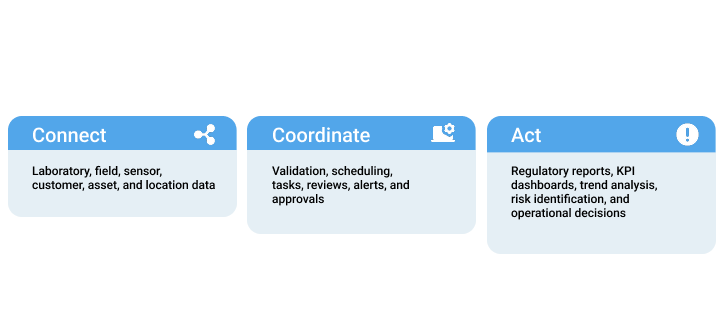
A modern Software-as-a-Service (SaaS) compliance platform should support seamless integration with key enterprise systems, including:
- SCADA systems to ingest operational and process data in near real time.
- Customer billing and information systems to support service line inventories, sampling programs, and customer notifications.
- Asset management systems to connect compliance activities with infrastructure assets, maintenance records, and capital planning.
- Geographic Information Systems (GIS) to provide spatial context for sampling locations, distribution systems, collection networks, and treatment assets.
Bringing these data sources together enables utilities to achieve several important objectives.
First, integrated data provides the foundation for meaningful Key Performance Indicator (KPI) dashboards. Managers can monitor treatment performance, sampling compliance, permit deadlines, laboratory turnaround times, field productivity, and regulatory risk through real-time visualizations rather than manually compiling reports.
Second, data integration helps streamline workflows and operational logistics. Automated data exchange eliminates duplicate data entry, reduces transcription errors, improves task management, and enables staff across departments to work from the same trusted information. Compliance activities — from sample scheduling and field collection to laboratory analysis and regulatory review — can become coordinated, repeatable business processes.
Finally, an integrated compliance platform simplifies the creation of regulatory reports and operational analytics. Instead of assembling information from multiple disconnected systems, utilities can automatically generate state and federal compliance reports while also producing management dashboards, trend analyses, executive summaries, and predictive analytics that support operational decision-making.
As utilities continue their digital transformation, compliance software is evolving from a specialized reporting tool into a comprehensive operational data platform. SaaS providers that prioritize open architectures, standards-based APIs, and robust system integrations will be best positioned to help utilities improve regulatory compliance, increase operational efficiency, and make more informed, data-driven decisions. Locus Technologies is an example.
In the future, the most successful compliance platforms will not simply manage regulatory data. They will serve as the central hub connecting compliance, operations, maintenance, customer service, and infrastructure management into a unified ecosystem that supports both regulatory success and operational excellence.
What is integrated data management for water utility compliance?
Integrated data management connects compliance, laboratory, operational, customer, asset, and location data within a unified platform. It gives water utilities a consistent system of record for managing sampling, monitoring, validation, reporting, and regulatory workflows. This reduces reliance on disconnected spreadsheets and systems while making compliance data more useful for operational analysis and decision-making.
Which systems should water utility compliance software integrate with?
Water utility compliance software should integrate with laboratory information management systems (LIMS), SCADA systems, GIS platforms, customer information and billing systems, asset management software, field data collection tools, and regulatory reporting systems. Standards-based APIs and configurable data exchanges help utilities connect these systems without replacing technology that already supports essential business functions.
How does data integration improve water utility compliance?
Data integration improves water utility compliance by reducing duplicate entry, limiting transcription errors, accelerating data validation, and coordinating work across departments. Automated data flows can also help utilities monitor sampling schedules, laboratory results, permit requirements, reporting deadlines, and potential compliance risks from one trusted source instead of manually reconciling information across multiple systems.
What is the difference between a LIMS and a water utility compliance platform?
A LIMS primarily manages laboratory samples, analytical results, testing workflows, and quality controls. A water utility compliance platform like Locus Water has a broader role, connecting laboratory data with field activities, operational systems, assets, customer records, locations, permits, GIS and reporting requirements. The two systems can work together, with the LIMS managing laboratory processes and the compliance platform coordinating data and workflows across the utility.
Locus is the only self-funded water, air, soil, biological, energy, and waste EHS software company that is still owned and managed by its founder. The brightest minds in environmental science, embodied carbon, CO2 emissions, refrigerants, and PFAS hang their hats at Locus, and they’ve helped us to become a market leader in EHS software. Every client-facing employee at Locus has an advanced degree in science or professional EHS experience, and they incubate new ideas every day – such as how machine learning, AI, blockchain, and the Internet of Things will up the ante for EHS software, ESG, and sustainability.