
01 // Blog
PFAS and Evolving Drinking Water Rules: Building a Data Foundation for What Comes Next
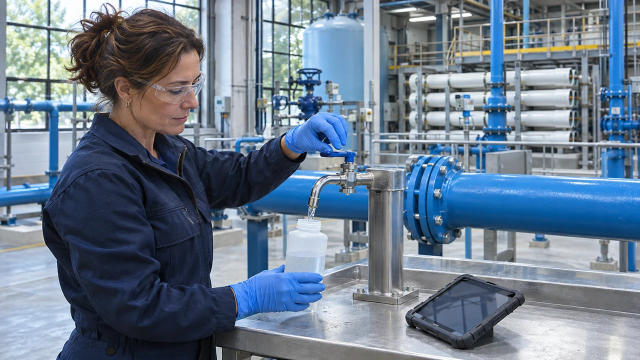
For municipal drinking water utilities, PFAS planning extends beyond the compounds with individual federal limits. Short-chain PFAS and other emerging contaminants raise questions about monitoring, treatment performance, and future investment. Answering those questions requires reliable data that remains useful as regulatory priorities change. Recently, the EPA has proposed changes to portions of its federal PFAS drinking water rule while continuing to evaluate a broader range of contaminants. Utilities need to understand their current obligations and preserve the information that could inform tomorrow’s decisions.
Latest Federal Developments
EPA’s 2024 PFAS National Primary Drinking Water Regulation established individual maximum contaminant levels (MCLs) for PFOA, PFOS, PFHxS, PFNA, and HFPO-DA, commonly associated with GenX chemicals. It also established a Hazard Index MCL for mixtures containing at least two of PFHxS, PFNA, HFPO-DA, and PFBS. PFBS did not receive an individual federal MCL. The rule set initial monitoring completion for 2027 and MCL compliance for 2029.
In May 2026, EPA proposed rescinding the regulatory determinations and associated provisions for PFHxS, PFNA, HFPO-DA, and the Hazard Index mixtures involving those compounds and PFBS. As of this article’s date, EPA continues to identify that action as a proposal. The proposed rescission does not itself remove existing requirements. EPA also states that it intends to evaluate additional PFAS for potential future regulation. A separate proposal would retain the PFOA and PFOS MCLs at 4.0 parts per trillion each and establish a process for eligible systems to obtain additional time, through 2031, to comply. It would preserve monitoring and reporting schedules.
Broader contaminant evaluation also continues. EPA’s draft Sixth Contaminant Candidate List includes additional unregulated PFAS compounds. Shortlisted compounds from the candidate list could then be incorporated into the next Unregulated Contaminant Monitoring Rule (UCMR) cycle for further required monitoring by municipal water treatment operations.
How Locus EIM supports readiness
Locus Environmental Information Management (EIM) helps utilities bring laboratory results, field measurements, and sampling information into a centralized environment. EIM supports multiple electronic data deliverable formats, unit conversion, error checks, sample planning, charts, and GIS visualization. These capabilities help teams organize emerging contaminant data alongside their established monitoring programs.
Utilities can use that foundation to investigate practical questions: Are concentrations changing at a particular source? Do treatment results differ by compound? Are apparent trends related to changes in laboratory reporting limits? User-configured queries, charts, and reports help teams revisit their data as new questions emerge. A useful implementation practice is to document each comparison threshold’s source, status, and effective date. Enforceable standards, proposed limits, health guidance, and internal planning targets serve different purposes. Keeping those distinctions clear helps utilities evaluate future scenarios while maintaining accurate compliance reporting.
Municipal utilities cannot predict every regulatory change. They can build a reliable record that supports treatment evaluation, sampling priorities, capital planning, and future compliance work. With Locus EIM, data collected today can remain accessible and useful as the questions—and the regulations—evolve.
Contact Locus Technologies to explore how EIM can support your utility’s emerging contaminant data program.


Bringing more than two decades of leadership in the water and environmental sectors to Locus Technologies, Laura Underwood leads market segmentation, product development, and revenue growth for the company’s water business unit. Prior to joining Locus, Underwood was the Senior Director of Strategy & Innovation at Veolia. She has also held key roles in water utility management, including serving as the Director of Water Quality & Environmental Compliance. Underwood’s career spans research and development, environmental services, policy, technology, and compliance management. A long-time contributor to the American Water Works Association (AWWA) and a passionate advocate for digital transformation, Laura has built a national reputation for advancing smart, sustainable water practices. Underwood earned a doctoral and master’s degrees in environmental engineering from the University of Edinburgh and a bachelor’s degree in chemistry from the College of Wooster in Ohio, USA.