
01 // Blog
PFAS Management in Municipal Biosolids Starts with Better Data
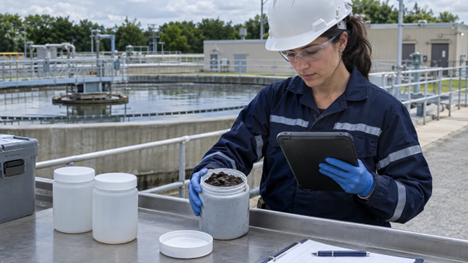
Municipal wastewater utilities face increasingly complex decisions about PFAS in biosolids. They need to understand what is entering their facilities, what laboratory results reveal, and how those findings affect biosolids management. At the same time, they must respond to evolving regulatory expectations and questions from agricultural partners, community members, and utility leadership. Reliable environmental data supports each of these responsibilities. By organizing sampling information, analytical results, and supporting records, utilities can build a clearer understanding of their operations and make better-informed decisions as conditions change. Locus Technologies’ Environmental Information Management (EIM) software provides a foundation for that work.
PFAS can enter wastewater treatment plants through industrial discharges, commercial activities, and household wastewater. EPA identifies sources ranging from industrial operations and commercial laundries to consumer products containing PFAS. Understanding these inputs is an important part of investigating PFAS detected in sewage sludge and biosolids. A utility’s investigation may span industrial discharge locations, treatment processes, biosolids sampling points, and receiving environments. Connecting results across those locations helps teams investigate potential sources, evaluate changes over time, and identify where additional sampling would be useful.
The regulatory context adds another layer of complexity. Federal sewage sludge use and disposal requirements fall under the Clean Water Act and 40 CFR Part 503. In July 2026, EPA released draft guidance offering voluntary recommendations for reducing potential risks from PFOA and PFOS in biosolids. State requirements also warrant close attention. Washington, for example, requires most facilities covered by its statewide biosolids general permit to conduct PFAS sampling during a period beginning January 1, 2027, and ending June 30, 2028. Applicable facilities must submit a sampling and analysis plan for approval at least 60 days before sampling. Developments like these make organized sampling schedules and accessible records an immediate operational need.
For utilities building a PFAS monitoring program, a concentration alone provides an incomplete picture. Each result needs its sample location, collection date, analytical method, units, reporting limit, and laboratory qualifiers. Biosolids results also need a clearly documented reporting basis, including whether concentrations are expressed on a wet-weight or dry-weight basis. These details determine whether results can be compared meaningfully. An apparent change in concentration may reflect different moisture content, analytical methods, or reporting limits. A nondetect must retain its reporting limit so future reviewers can understand what the analysis could establish.
EPA Method 1633A provides a method for measuring 40 PFAS compounds in matrices that include biosolids, wastewater, soil, and groundwater. Preserving the method version and supporting quality-control information helps utilities assess results as their monitoring programs develop. A targeted analytical result also needs to remain associated with the specific compounds tested. Locus EIM helps utilities bring this information together. The platform supports laboratory electronic data deliverables, field measurements, sample planning, unit conversion, error checks, charts, and GIS visualization. Utilities can use these capabilities to organize PFAS information alongside their existing environmental monitoring data and retrieve results by location, sample, or parameter.
PFAS management will continue to demand careful judgment from municipal wastewater utilities. Accessible, well-documented data gives operators, environmental teams, and leadership a stronger basis for that judgment. With Locus EIM, utilities can build an environmental record that supports today’s investigations and remains useful for future planning, reporting, and compliance.
Contact Locus Technologies to learn how EIM can support your utility’s PFAS and biosolids data management program.


Bringing more than two decades of leadership in the water and environmental sectors to Locus Technologies, Laura Underwood leads market segmentation, product development, and revenue growth for the company’s water business unit. Prior to joining Locus, Underwood was the Senior Director of Strategy & Innovation at Veolia. She has also held key roles in water utility management, including serving as the Director of Water Quality & Environmental Compliance. Underwood’s career spans research and development, environmental services, policy, technology, and compliance management. A long-time contributor to the American Water Works Association (AWWA) and a passionate advocate for digital transformation, Laura has built a national reputation for advancing smart, sustainable water practices. Underwood earned a doctoral and master’s degrees in environmental engineering from the University of Edinburgh and a bachelor’s degree in chemistry from the College of Wooster in Ohio, USA.