





01 // Multilingual Support

One platform. Every language your operations require.

02 // GLOBAL OPERATIONS, LOCAL LANGUAGES

Global industrial organizations operate in dozens of languages.

Safety incidents get logged in German. Waste manifests get reviewed in Chinese. Emissions data gets submitted in French. When your EHS platform only speaks English, every one of those interactions becomes a friction point that can lead to real consequences. Locus Technologies built its platform to work the way global operations actually work: in the language of the person doing the job.

03 // THE OPERATIONAL IMPACT

Why language is a compliance issue, not just a UX issue

For multinational organizations, a platform that cannot communicate in local languages creates more than inconvenience. It slows adoption, introduces transcription errors, creates inconsistency between sites, and forces local teams to interpret or re-enter information in a second language. Regional managers lose the ability to standardize processes across borders. Corporate leaders end up managing what are effectively parallel systems across each operating region.

Language barriers in EHS software translate directly into incomplete records, delayed reporting, and increased compliance risk. The solution is Locus Platform which delivers the same structured, consistent experience to every user, regardless of where they work and what language they speak.

Locus multilingual support: built in, not bolted on

04 // PLATFORM-WIDE LOCALIZATION

One localization framework across every module

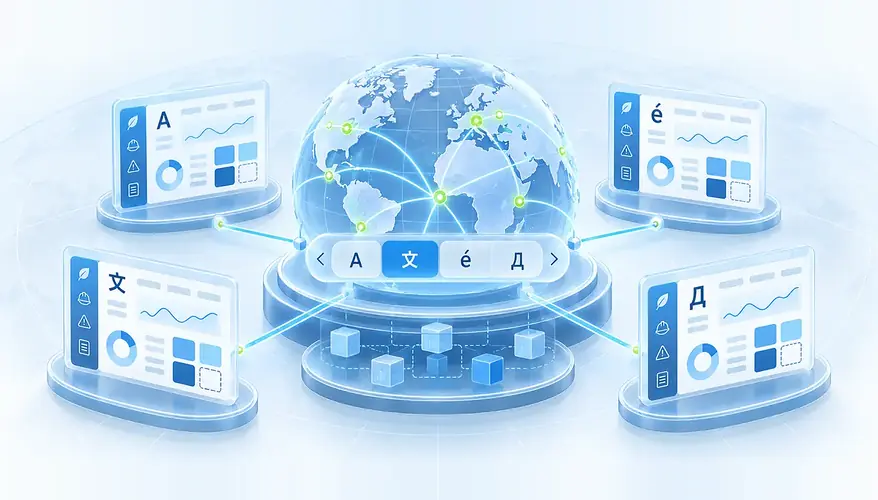
Multilingual capability at Locus is a core architectural decision, not a feature added after the fact. The localization framework is embedded throughout the platform, which means every module, every field label, every workflow step, and every interface element participates in language translation. There is no partial localization. When a language is deployed on Locus Platform, it is deployed comprehensively, and users in that language experience a fully consistent interface from the moment they log in.


Locus already supports nine languages, with more to come

Locus Platform currently supports nine languages across its global customer base:

→ English
→ German
→ French
→ Spanish
→ Croatian
→ Chinese
→ Polish
→ Portuguese
→ Ukrainian

This coverage spans North America, Western and Central Europe, Eastern Europe, and the Asia-Pacific region, making Locus a practical choice for enterprises with truly distributed operations. Support for additional languages continues to expand in direct response to customer demand.

05 // How Language Localization Works on the Locus Platform

Adding a new language on the Locus Platform is designed to be fast and operationally straightforward.

The process is built around a familiar, exportable format that organizations can manage themselves.

Launch each language on your terminology and timeline

06 // CUSTOMER-CONTROLLED LOCALIZATION

Export, translate, import

Users export a translation template in Excel format directly from the platform. That template captures every translatable string in the interface. Organizations then populate translations using their preferred method, including AI-powered translation tools. Once the translations are entered, the updated file is imported back into the platform and the new language becomes available across all applicable modules.

This approach removes dependency on Locus engineering resources for each new language rollout, giving customers meaningful control over the pace and scope of their own localization. It also means that organizations with specialized regulatory or technical vocabulary can apply domain-specific translations rather than accepting generic outputs.

Rapid rollout, minimal engineering overhead

Adding a new language requires minimal code changes and can be completed quickly. For organizations expanding into new markets or acquiring businesses in new regions, this means that language support can be configured as part of a standard implementation rather than treated as a separate, costly project. The Locus localization infrastructure was designed with scale in mind, as evidenced by how efficiently new languages can be brought online.

07 // Consistency

What global teams actually experience

When a field technician in Kraków opens a safety inspection form, it appears in Polish. When a compliance officer in Shenzhen reviews an emissions data entry, she works in Chinese. When a site manager in Porto submits a discharge monitoring report, the workflow steps, field labels, and help text all appear in Portuguese. The data they enter flows into the same unified platform that headquarters monitors in English or any other configured language.

This consistency across sites and languages is what global program managers are actually trying to achieve. One platform. One data model. Multiple languages, all operating within the same structure and governance framework.

A global team behind a global platform

Locus Technologies operates around the clock from offices in Silicon Valley, Croatia, India, and Vietnam. This international presence is not incidental; it reflects the same commitment to global reach that shaped our platform's multilingual architecture. The Locus team includes professionals who speak the languages the platform supports, who understand the regulatory environments in the regions it serves, and who bring firsthand experience with the environmental and compliance challenges facing organizations worldwide.

For customers, this means multilingual platform support backed by a team that genuinely understands international operations, not one working from a distance.

09 // ADOPTION, ACCURACY & AUDIT READINESS

The case for a multilingual EHS platform

Organizations evaluating EHS software for global deployments often underestimate the cost of a single-language platform. Translating the cost into practical terms:

  • - Local teams working in a second language take longer to complete data entry tasks and are more likely to make errors.

  • - Training programs delivered in a non-native language require more time and higher repetition to achieve the same comprehension.

  • - Adoption rates for enterprise software are demonstrably lower when users cannot navigate the interface naturally.

  • - And audit readiness suffers when site-level records contain transcription inconsistencies rooted in language mismatches.


A multilingual platform eliminates these costs at scale. It also signals to local teams that the organization invested in an EHS program built for them, not merely extended to them, and that improved perception is a driver of adoption and reporting completeness.

10 // Software Demonstration

One platform. Your language. Your operations.

Managing environmental and safety compliance across borders requires software that meets your teams where they are, not where it is most convenient for the vendor. Locus Technologies delivers a multilingual EHS and sustainability platform that supports nine languages today, expands efficiently to new ones, and maintains full platform consistency across every site, region, and reporting layer.
Book a demo

Frequently Asked Questions

11 // FAQ

The Locus platform currently supports English, German, French, Spanish, Croatian, Chinese, Polish, Portuguese, and Ukrainian. Additional languages are added on an ongoing basis in response to customer needs.

Yes. The Locus localization architecture is designed for rapid language expansion. Adding a new language requires minimal code changes and can be accomplished quickly using the platform's export-translate-import workflow.

Translation covers every module, field label, workflow step, and interface element across the platform. The intent is a complete and consistent experience in each supported language, with no partially translated areas.

Yes. The Excel-based translation template can be populated using AI-powered translation tools, professional translation services, or in-house linguists. The platform accepts the completed template regardless of how the translations were generated.

No. Data is stored in a single unified data model regardless of the language used to enter it. This means global program managers and corporate EHS teams can view and report on data from all sites in a consistent structure, even when that data was entered by teams working in different languages.