



01 // AI FOR EHS, ESG, AND WATER

You can trust Locus AI because of the decades of validated data behind it.

AI and computer engineering reviewing environmental data and AI models

AI is only as reliable as the data it runs on

Artificial intelligence is reshaping how business gets done, with a pace of change not seen since the dot-com era. In EHS, ESG, and water management, that transformation is real but so is the hype. The difference between AI that delivers regulatory-grade insights and AI that produces plausible-sounding noise comes down to one thing: data. Locus Technologies recognized this before "AI" was a boardroom talking point. With roots at Carnegie Mellon — widely regarded as one of the original artificial intelligence research hubs — and a cloud-native SaaS architecture deployed in 1999, Locus has spent decades building the data foundation that makes its AI meaningful. The Locus AI Innovation Task Force continues that legacy today, advancing machine learning capabilities across compliance, permitting, water quality, and ESG reporting.

03 // solid foundation

Nearly three decades of validated environmental data from labs, field instruments, and regulatory systems across hundreds of customers is what separates Locus AI from the rest of the market.

Anyone can access an AI model. Not everyone has the data to make it perform.

04 // The risks of siloed data

Why validated data is the real differentiator in AI for EHS

Consider what happens when environmental compliance data lives in siloed software systems. Wastewater results from one system, air permit records in another, GHG emissions in a third, safety records somewhere else entirely. AI poured into that environment is like water poured over sealed jars — it flows everywhere but penetrates nothing. Insights that require connecting those datasets simply cannot happen.

This is why bolt-on and post-acquisition software stacks consistently underperform. When AI is layered on top of disconnected modules, it is limited to summarizing what it can see. It cannot reason across programs, link cause and effect, or trigger automated responses. That is "AI as a feature," not AI as a platform capability.
Farmer using mobile device

Locus takes a fundamentally different approach

05 // AI you can trust

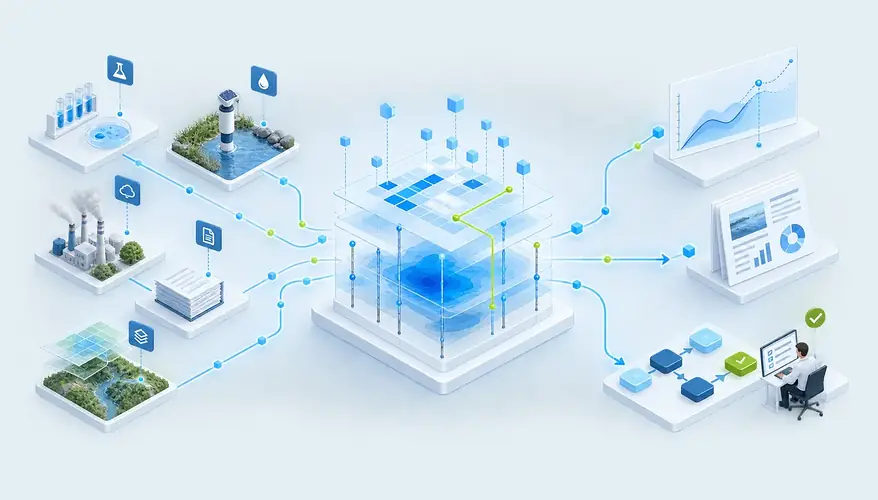
Because the Locus Platform and all Locus apps share a true multitenant architecture with a common metadata model, workflow engine, and data validation framework, AI has a unified, consistent frame of reference across all environmental data. It does not have to reconcile disparate sources; it works from a single harmonized dataset that has been growing and improving for more than two decades.

Data quality is equally decisive. Environmental data is inherently complex: it arrives from certified laboratories, field instruments, manual entry, IoT sensors, and regulatory reporting systems. Without rigorous validation at the point of entry, AI models trained on that data produce unreliable output. Locus EIM (Environmental Information Management) prioritizes data integrity as a core platform function, ensuring that the data feeding Locus AI is clean, structured, and defensible.

The multitenant architecture and metadata model make this possible.

06 // Practical Examples

How Locus AI works in practice

  • 1. Predictive analytics and machine learning forecasting
  • Man working on laptop as demonstration of AI for EHS and ESG
  • 2. Natural language access to complex environmental data
  • 3. Compliance and reporting automation
  • EHS compliance manager working on computer
  • 4. Agentic AI and closed-loop automation
  • Professional working on laptop beside servers

What Locus AI does and how it works in practice

07 // AI for EHS & ESG

EHS Director in the office

Predictive analytics and machine learning forecasting

Most EHS software tells you what has already happened. Locus AI tells you what is about to happen, giving your team time to act. Locus deploys advanced machine learning models purpose-built for time series environmental data: pH measurements, benzene concentrations, lead levels, groundwater elevations, GHG emission rates, and dozens of other parameters that compliance programs monitor continuously. These models are trained on more than 100 billion time series observations — a dataset scale that general-purpose AI tools cannot match for domain-specific environmental forecasting.

In practice, this capability works across several distinct use cases. Contaminant trajectory forecasting analyzes historical measurement data and models the expected future path of concentrations against regulatory action levels and cleanup goals. Users receive proactive alerts before thresholds are approached, with enough lead time to adjust sampling frequency, accelerate treatment, or notify the appropriate agency under voluntary disclosure protocols — all of which tend to produce better regulatory outcomes than reactive reporting after an exceedance has already occurred.

The inverse is equally valuable. When a remediation program or operational change is underway, Locus predictive models can demonstrate that earlier interventions are working — showing regulators and internal stakeholders a defensible, data-backed trajectory toward compliance ahead of schedule.

Anomaly detection runs continuously across all data streams, flagging measurements that deviate from expected patterns before they become reportable events. This includes cross-program anomalies: a spike in a groundwater parameter that correlates with an operational change tracked in a separate Locus app, or an emissions trend that intersects with weather data from an integrated SCADA feed. Because Locus AI has access to data across the entire platform, it can identify these multi-variable relationships that siloed tools will always miss. Risk scoring translates all of this into prioritized action queues. EHS managers do not need to triage raw alerts — Locus AI ranks identified risks by severity, regulatory consequence, and likelihood of escalation, so teams spend their attention where it produces the most compliance value.

Natural language access to complex environmental data

For most of the history of enterprise EHS software, getting a precise answer out of a complex environmental dataset required either a data specialist with SQL expertise or a pre-built report that someone configured months ago. If the question was slightly different from the report template, the answer was not immediately available.

Locus AI eliminates that constraint. Through natural language processing integrated directly into the platform, any authorized user — a field chemist, a sustainability manager preparing an investor ESG report, a health and safety director reviewing incident trends, or a business analyst building a board presentation — can query the Locus Platform in plain English and receive accurate, structured results in real time.

The system interprets the scope of the question, selects the appropriate datasets, applies the correct filters and time parameters, and returns results without requiring the user to understand the underlying data model.

This capability addresses one of the most significant barriers to AI adoption in regulated industries: the gap between the people who understand the data and the people who need to use it. When a compliance manager at a water utility can simply ask "Which sampling locations have shown lead readings above 5 ppb in the last six months, and how do they compare to the same period last year?" and receive an immediate, accurate answer, the time savings compound across every reporting cycle, permit renewal, and regulatory inquiry. Locus continues to support complex SQL queries for technical users and data teams who prefer precise programmatic control. The platform accommodates both access modes simultaneously — natural language for breadth of access, SQL for depth of precision — without forcing users to choose one or the other.

The natural language interface also extends to report generation. A user can instruct Locus AI in plain English to produce a report formatted for a specific regulatory framework, combine data from multiple programs, or summarize compliance status across a portfolio of facilities. The system interprets the instruction, assembles the relevant data, applies the correct formatting rules, and delivers a report-ready output — a process that historically required hours of manual assembly.

Young EHS and ESG professionals working on AI and environmental data

Compliance and reporting automation

The administrative burden of environmental compliance reporting is one of the most consistent pain points Locus customers name before switching software. Generating a discharge monitoring report, a Title V deviation report, an OSHA 300 log, or a CSRD disclosure traditionally requires pulling data from multiple sources, reformatting it for the specific regulatory framework, validating figures against permit limits, reconciling discrepancies, and routing drafts through internal review. Each of those steps introduces delay, human error, and compliance risk. Locus AI automates the assembly portion of this cycle end to end.

From a single natural language prompt, Locus can generate properly formatted reports for multiple regulatory frameworks simultaneously, drawing from the validated data already living in the platform. A sustainability manager preparing an annual GHG disclosure does not need to export data, manipulate spreadsheets, and manually apply emission factors; the system does all of that, referencing the appropriate calculation methodology, applying the correct reporting boundaries, and flagging any data gaps that require human review before submission.

Permit management is a particular strength. Locus AI synthesizes the full body of a customer's active permits — conditions, monitoring requirements, reporting deadlines, frequency schedules, and applicable regulatory references — and uses that synthesis to recommend next steps. When a regulatory update affects permit conditions, Locus AI identifies the affected permits across a customer's entire facility portfolio and surfaces the compliance actions required, rather than leaving that discovery to a manual permit review process. The platform also monitors compliance calendars continuously. Upcoming deadlines, overdue submittals, and unresolved compliance tasks are surfaced proactively with AI-generated recommendations for resolution rather than simple reminders. This shifts compliance management from reactive calendar tracking to proactive risk management.

Early projections from AI adoption in comparable professional service contexts suggest that this type of automation has the potential to accelerate EHS compliance and ESG reporting cycles by 75% or more, freeing teams to redirect capacity toward operational improvement rather than administrative assembly.

EHS manager working on desktop computer with AI and environmental data

Agentic AI and closed-loop automation

The most transformative advance in enterprise AI is the shift from advisory to agentic — from a system that generates recommendations for humans to act on, to a system that takes action itself across the full operational cycle. Locus AI is built for this. Because Locus AI is embedded directly inside the platform's core engines (e.g. the workflow engine, compliance rules engine, data validation engine, calculation engine, and reporting framework) rather than sitting as a layer on top of them, a Locus AI agent can complete an entire compliance response cycle without manual handoffs between systems or human intervention at each step.

When a Locus AI agent detects a compliance risk or data anomaly, it does not stop at an alert. It pulls the relevant supporting evidence from validated historical records. It checks the applicable rules, permit limits, and regulatory thresholds. It evaluates the severity and context of the risk, accounting for the full operational picture across all connected programs. It recommends a specific set of actions, ranked by priority and regulatory consequence. It launches corrective workflows directly within the platform, assigning tasks, setting deadlines, and notifying responsible parties. It tracks completion through resolution and updates compliance reporting automatically once the corrective action is closed.

No handoffs. No disparate systems. No custom integration code required to make it work. This closed-loop model extends to complex tradeoff analysis. Locus AI can evaluate situations where the right action in one environmental program creates unintended consequences in another. In groundwater remediation, for example, pump-and-treat systems reduce contaminant concentrations but also consume significant energy and increase GHG emissions. Locus AI can analyze real-time operational data — contaminant concentrations, treatment efficiency, energy consumption, and emissions output — to identify the precise inflection point where continuing a treatment strategy produces more environmental cost than benefit. It can then model alternative approaches and recommend the strategy that optimizes total environmental impact across all programs simultaneously. This level of cross-domain reasoning is only possible on a platform where all of the relevant data (i.e., water quality, energy consumption, emissions, operational records) exists in a unified, validated database with a consistent semantic model. Platforms assembled from acquired modules cannot traverse the seams between those modules. Their AI, however sophisticated the underlying model, remains trapped in the data it can see.

12 // spatial intelligence

Locus AI and GIS+

When AI-driven predictive analytics combines with Locus GIS+, the result extends beyond tabular data into spatial forecasting. Locus AI can project the future path of contamination plumes across a site or watershed, giving organizations and communities lead time to act before problems spread. Machine learning also enables more sophisticated identification of legacy lead piping locations, optimization of sampling strategies based on historical pattern analysis, and mapping of contamination patterns relative to sensitive receptors including schools, drinking water intakes, and residential areas.

GIS & Spatial Intelligence

AI that EHS professionals can trust and defend

13 // Audit-grade AI

Compliance professionals and auditors discussing reports

In regulated industries, a black-box AI model is worse than no AI at all. If an EHS manager cannot explain to a regulator how a reported figure was calculated or how a compliance decision was made, the output is not just unhelpful, it is a liability. Locus builds auditability into its AI from the ground up. Every insight, prediction, and recommendation generated by Locus AI is traceable to its source data and the rules applied. Because that data lives in a validated, governed platform, the provenance chain is intact. EHS professionals can defend their AI-assisted decisions to regulators, auditors, and boards with the same confidence they would bring to any manually prepared report.

Locus's partnership with AWS further strengthens this foundation. Through a pay-as-you-go model, Locus customers access advanced AI capabilities in a secure, scalable environment without significant upfront infrastructure investment. The partnership also means Locus can deploy and scale new AI capabilities rapidly as the technology continues to evolve.

14 // Case in point

1.1 million lead and copper results

In a comprehensive analysis across all Locus Water customers, Locus surfaced 446,012 copper results and 710,291 lead results — more than 1.1 million data points related to two of the most heavily regulated contaminants in water systems. That analysis was possible because all Locus Water customers run on a single multitenant platform, making it possible to apply machine learning and AI models across a large, normalized, federated dataset.

16 // Leaders in the field

No other environmental software provider has this depth of water quality data coverage.

No other provider has the underlying architecture to use it. When it comes to water quality data for AI model training, Locus has no peers. This same principle applies across every environmental domain Locus manages: air, soil, waste, GHG, safety, and sustainability data, unified and validated over nearly three decades.

17 // Locus EHS Buyer Intelligence Series

Questions to ask any EHS software vendor about AI

  1. Is your AI built into the platform architecture, or bolted on top of a legacy system?
  2. What data was your AI trained on and how is that data validated, governed, and maintained before training?
  3. Can your AI take automated action and launch corrective workflows, or does it only generate recommendations that humans must then act on manually?
  4. Is every AI-generated output fully auditable and defensible for regulatory review — and can you demonstrate that provenance chain in a demo?
  5. How does your AI perform when relevant compliance data exists in multiple disconnected systems that were never designed to share a data model?
Business man in corporate conference room with ESG presentation

18 // connected data fabric

API integrations and third-party data

Organizations rarely run on a single platform. Locus APIs connect with ERP systems, IoT devices, smart meters, continuous emissions monitors, and HR systems — and they do more than simply access that data. Locus APIs contextualize third-party data, making it available to the Locus AI engine as part of a unified analytical picture. The result is compliance insights and sustainability reports that reflect the full operational picture, not just the slice managed inside Locus directly.

Data Connectivity & Integrations