




01 // Platform & Apps Model

One platform. Any apps. Your configuration.

02 // Your Ideal Solution

The result is an EHS&S solution that fits your organization hand-in-glove.

Your Ideal Solution.
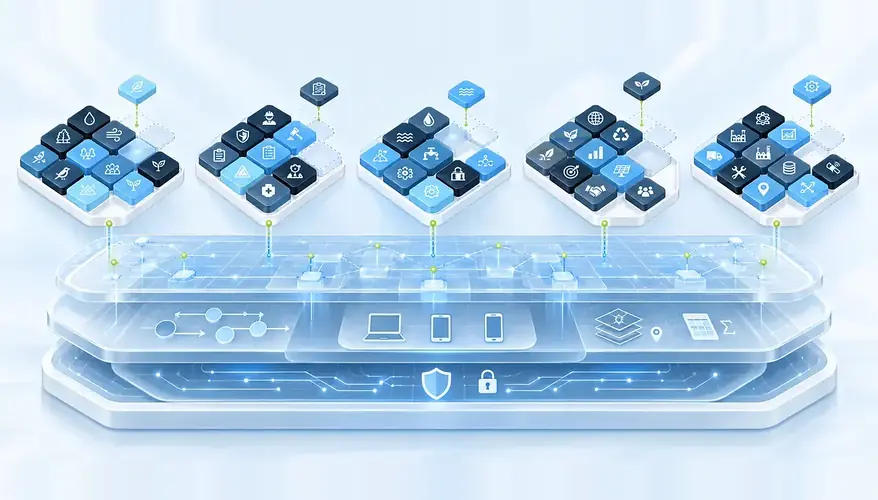
Locus Platform is the enterprise foundation on which your organization's entire EHS, ESG, and water program runs. On top of it sits a growing ecosystem of more than 30 purpose-built Locus apps. Together, these three layers — Platform, pre-built apps, and user-configured apps — give organizations unprecedented control over what their EHS&S software does, what it looks like, and how it behaves.

Platform Overview

Our Platform + Our Apps or Your Apps

03 // The Locus Model

Locus Platform

The Enterprise Foundation
Every Locus customer starts in the same place: a robust, 100% cloud-native SaaS platform that handles the heavy lifting of complex environmental, health, safety, and sustainability data management and compliance. Locus Platform is engineered to scale from the smallest water utility to the largest global chemical manufacturer, and it does not need to be installed, patched, or managed by your IT department.

The platform delivers shared services across all applications: workflow automation, configurable dashboards, role-based reporting, GIS mapping, mobile data collection, powerful search, hundreds of unit conversions, and support for universal scientific formulas. Every piece of data entered into any Locus app lives in this unified environment — entered once, available everywhere.

Your configurations never touch the underlying code, and every customer always runs the latest version of the platform without forced update cycles or disruption.


Platform Overview

Locus Apps

Purpose-Built for EHS&S Professionals
Locus Platform supports an ecosystem of more than 30 purpose-built apps, each designed around the specific workflows, data types, and compliance requirements of real EHS&S work. These are not generic modules retrofitted for environmental use. They were built from scratch by software architects and in-house scientists who specialize in air quality, waste management, water quality, greenhouse gas reporting, incident management, and more.

Organizations select the apps that match their current priorities and assemble them into a cohesive solution. As priorities shift, apps can be added or adjusted without rebuilding anything. Locus Platform holds it all together.

Locus app collections are organized around five core practice areas: Sustainability Apps, Compliance Apps, Water Apps, Environmental Monitoring Apps, and Operations Apps.

Every app maintains a consistent user experience within the Locus Platform environment. Users navigate a familiar interface regardless of which app they are working in, and data flows freely across apps without redundant entry or manual reconciliation.

Locus Ecosystem

The Configuration Workbench

When Your Needs Go Beyond the App Catalog
Locus apps are built around best practices, but no two organizations are identical. When your operations require something that no pre-built app covers — a specialized data collection form, a workflow unique to your operations, a reporting format built around an internal standard — Locus power users can build it themselves using the Configuration Workbench. No vendor ticket. No coding. No waiting.

Custom apps built in the workbench are fully integrated with all standard Locus Platform features, including workflow, dashboards, reporting, mobile enablement, and role-based access. One client used the workbench to build an app tracking the daily particulate matter of chickens. Another built supply chain-surveys to support Scope 3 emissions tracking. This is the Locus Unified Platform + Apps Model at its finest: an enterprise foundation that ships with world-class domain apps and still leaves room for your organization to build exactly what you need.

Configuration Workbench

04 //

Why This Model Matters to an Enterprise

The Locus Unified Platform + Apps Model is only as valuable as the platform itself. Locus Platform is purpose-built for the demands of enterprise environmental data, engineered for security, reliability, and continuous delivery of new functionality.

Most enterprise software forces a choice between a monolithic suite where you pay for functionality you will never use, or a collection of point solutions where data lives in silos and reporting requires manual reconciliation. Locus Technologies offers a third path.

The Locus model gives organizations surgical control over scope. You activate the apps that address your current priorities. You configure each one to reflect your policies, your terminology, your workflows, and your reporting obligations. You add apps as your program grows or as regulatory requirements evolve. And if a gap emerges that no pre-built app addresses, you have the option to fill the gap yourself.

The Locus app model is designed for complexity — not just the complexity of regulated industries, but the organizational complexity of large enterprises where EHS, sustainability, operations, and facilities teams often have different workflows, different data needs, and different reporting audiences.

A large manufacturer might run Locus Air for Title V permit tracking in its environmental compliance group, Locus Waste for hazardous waste manifests in operations, and Locus GHG for Scope 1 and Scope 2 emissions reporting in its sustainability team — all on the same platform, with shared underlying data and a unified audit trail. The safety team runs incident management. The facilities group tracks assets. Every team operates within a configuration tuned to their work, and every dataset contributes to the organization's single source of truth. This cross-functional flexibility extends beyond EHS&S. Because Locus Platform supports open-ended app creation through the Configuration Workbench, organizations have used Locus to build tools for workflows that are adjacent to or supportive of their EHS&S programs but do not fit neatly into a standard environmental software category. IT service management, service orders, supply chain surveys for Scope 3 data collection, and custom intake forms for vendor compliance programs are all examples of how Locus clients have extended the platform to serve organizational needs that fall outside the traditional EHS catalog.

The practical result is that Locus can consolidate tools and reduce the number of separate software platforms an enterprise manages, with each piece of the solution sharing a data layer, a security model, and a consistent user experience.

Because all Locus apps run on the same platform and share the same data layer, organizations gain something that multi-vendor stacks cannot offer: a single, unified record of environmental, health, safety, and sustainability data. There are no data integration projects between your air quality app and your ESG reporting tool. There is no reconciliation exercise before an audit. Data entered in the field via the Locus mobile app is available immediately from dashboards, reports, and compliance workflows.

This unified data environment is also the practical foundation for AI and advanced analytics. The quality and structure of the underlying data determines how much value AI tools can deliver, and Locus Platform is engineered for AI. Connected data inputs including RESTful API integrations, IoT and SCADA device connections, laboratory electronic data deliverables (EDDs), and mobile collection bring data into the platform from across the enterprise without duplication or manual handling.

05 // Software Demostration

See the Locus model in action

The most effective way to understand how the Locus Unified Platform + Apps Model works for an organization like yours is to see it live. Locus implementation specialists work with prospective clients to identify the right app combination, demonstrate relevant configurations, and scope a solution against actual operational requirements.
Book a demo

Frequently Asked Questions

06 // FAQ

It means that all Locus applications — across EHS compliance, ESG and sustainability, water quality, waste management, air quality, safety, and more — run on a single underlying platform with a shared data model, shared user management, shared workflow engine, and shared reporting layer. There are no integrations between modules, no separate logins, and no siloed data stores. What is entered in one application is immediately available to every other application on the platform.

Locus offers 30+ purpose-built applications covering the full EHS and sustainability spectrum. Each app is ready to deploy out of the box and is configurable without code by your own team. New applications — including those built entirely by your organization — can be added to the same platform without any integration work.

You can start with any single application and expand at any time. Because all apps share the same platform foundation, adding a new application means activating it within your existing tenant — not purchasing, implementing, and integrating a separate system.

Integrated point solutions, even when sold by the same vendor, each have their own data model, their own user interface conventions, and their own release cycle. Integration between them requires ongoing maintenance and creates potential failure points. The Locus unified platform shares a single data layer, so data flows freely across all applications without transformation, mapping, or middleware.

Yes. Locus supports API-based integrations with third-party systems including ERPs, laboratory information management systems (LIMS), SCADA systems, IoT sensors, and smart meters. These integrations bring external data into the Locus platform's validated data environment, rather than requiring Locus to push data out to fragmented external systems.

Nothing changes about your existing data. Because all applications share the same platform and the same data model, a newly activated application immediately has access to all relevant data already in your tenant. There is no migration, no mapping, and no data duplication.