
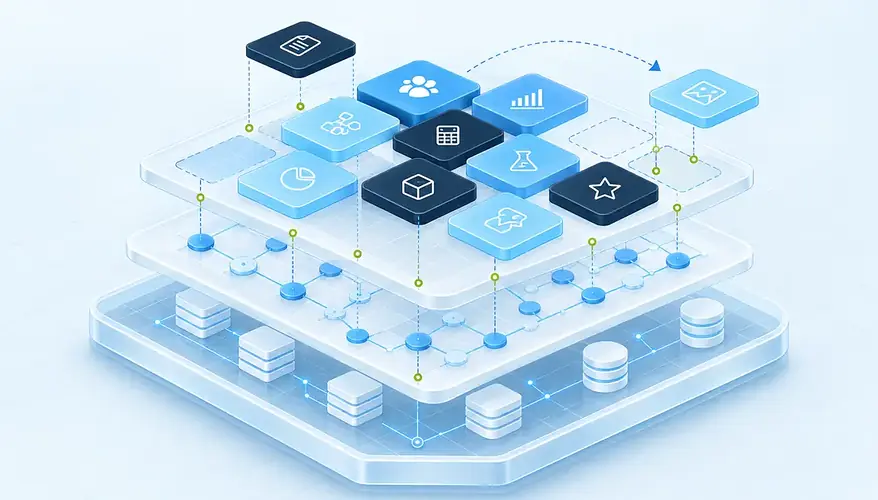




01 // Metadata-Driven

Your software. Your rules. No code required.

02 // Make it Yours

Locus Platform's metadata-driven architecture gives your environmental and EHS team direct control over forms, workflows, calculations, and applications.

No vendor dependency. No IT tickets. No waiting on anyone.
When regulations shift, your operations change, or a new reporting requirement lands on your desk, the typical question is: how long does it take to get your software to reflect the new reality? For most EHS platforms, the answer is measured in weeks or months. You submit a change request. A vendor scopes it. Someone prices it. A development team queues it. You wait.

At Locus Technologies, the answer is measured in hours or minutes. Your power users open the Configuration Workbench, make the change, and publish it. Done. That is metadata-driven architecture in practice. It is one of the most commercially significant capabilities in the Locus Platform.

Book a demo

03 // Metadata is data that describes other data

The engine stays constant. Your configuration defines the experience.

In a metadata-driven platform, the rules, forms, workflows, and business logic that define how your software behaves are stored as configuration data rather than as hard-coded software instructions baked into the application itself.

Think of the Locus Platform as a high-performance engine. Locus maintains the mechanics: data processing, calculations, security architecture, AI capabilities, and infrastructure. Your organization tailors the driving experience: the forms your team fills out, the workflows that govern your processes, the reports your regulators see, and the apps that address your most specific operational challenges.

Change your configuration and the engine keeps running. Update the engine and your configuration is untouched. The two layers are independent by design.
Photo of multiple cars in different colors and trim styles

04 // Key Takeaway

This separation is what gives Locus customers a level of control that most EHS software buyers have never experienced. It is also what makes every Locus Platform update seamless with no disruptions. Your configurations remain through every release, automatically, with nothing required from your team.

Modify Locus software independently

05 // Empowering Power Users

Modify Interfaces, Fields, and Forms Add a field for a new chemical category. Build a Scope 3 supply chain survey. Adjust form terminology to match your organization's language. Any team member with access to Locus Configuration Workbench can create or modify input forms in minutes, without coding experience and without involving Locus.
Adjust Business Logic and Workflows Set a rule that triggers a supervisor review when a specific chemical exceeds a threshold. Add an approval step for incidents at certain facility types. Modify the sequence of a compliance calendar task. These are configuration changes made directly in the platform, and they are live the moment your power user saves them.
Configure Dashboards and Disclosure Reports Need to add a new water metric to your CSRD disclosure report? Want to restructure an executive dashboard to reflect a new ESG framework? Your sustainability team adjusts data sources, layouts, and report templates directly in the platform. No vendor involvement. No delay.
Build Entirely New Application Using the Locus Configuration Workbench and visual design wizard, your team can build purpose-built compliance applications for highly specific operational needs, from chemical bench sheets to particulate matter tracking programs, without writing a single line of code. A working application can be ready in as little as ten minutes.

What metadata-driven architecture delivers for your organization

06 // Key Benefits

When a new EPA requirement, CSRD obligation, or state permit condition arrives, your team does not file a change request and wait six weeks for a vendor. They open the Configuration Workbench and update the relevant form, threshold, or workflow themselves. Regulatory response time goes from months to hours.


Man working on laptop as demonstration of AI for EHS and ESG

Your workflows, rules, and forms are stored as metadata rather than custom code. Every Locus Platform update leaves them completely intact. No compatibility testing. No migration work. No version lock. The investment your team makes in configuring the platform is permanent.

Man working on laptop as demonstration of AI for EHS and ESG

No change orders. No custom development invoices. No consulting fees every time operations shift or regulations change. Your team owns the configuration layer. The hours and budget that vendor-driven changes used to consume stay in your program.

Man working on laptop as demonstration of AI for EHS and ESG

The Locus metadata model handles GHG emissions calculations, water quality limit comparisons, chemical inventory thresholds, and embodied carbon logic as configurable rule sets rather than hard-coded formulas. Your environmental scientists define, review, and update the calculation logic directly.

Man working on laptop as demonstration of AI for EHS and ESG

Adding a new facility, program, or regulatory requirement does not require a new implementation project. You configure the additions within the existing platform. Locus customers routinely expand their deployments by adding new apps, locations, and data types without disrupting existing workflows.

Man working on laptop as demonstration of AI for EHS and ESG

Every rule your team defines, every form they build, and every calculation they configure contributes to a structured, validated data model. That model is the foundation for AI capabilities that grow more precise as your data grows more complete. Clean metadata in. Credible insights out.

Man working on laptop as demonstration of AI for EHS and ESG

07 // Configure vs. customize

Many EHS software vendors use the word "configurable" to mean something specific: you can request a change, they will scope it, price it, and deliver it on their timeline.

That is not configuration. That is vendor-controlled customization. The distinction has direct business consequences. Locus Platform was built on the principle of user configurability from day one.

08 // the prerequisite for AI

Structured data is the difference between AI that advises and AI that automates

Metadata-driven architecture does more than enable configurability. It produces a data foundation that is consistent, validated, and structured: the prerequisite for genuine AI capability.

Because every data element in Locus Platform is defined by the same metadata model, the platform's AI operates on data with consistent semantics, validated relationships, and auditable provenance. Locus currently manages over 500 million real-time analytical records, all structured through this model. That foundation is what separates Locus AI from tools bolted onto fragmented data.
AI & Agents

09 // Gaining Clarity

Five Questions that Reveal Whether an EHS Platform is Truly Configurable

Ask these questions in every software demo. The answers will tell you more than the marketing will.

If I need to add a new field to a form today, what is the process?
In a metadata-driven platform, your power user opens the configuration tool, adds the field, defines its behavior, and publishes it today at no additional cost. Any answer that involves a support ticket, a development timeline, or a fee reveals a customization model, not a configuration model.

What happens to our custom workflows when you release a platform update?
In a metadata-driven platform, configurations are stored separately from platform code and are unaffected by updates. Answers that mention migration testing or working with the implementation team to preserve customizations indicate that the modifications are code-level, not metadata-level.

Can our team build a new application on the platform without a developer?
Locus customers build new compliance applications using drag-and-drop tools without writing code. If the answer requires developer involvement or professional services, the platform is not built on a genuine metadata-driven foundation.

How long does it typically take to configure the platform for a new regulatory requirement?
Locus customers make regulatory configuration changes in hours to days, entirely by their own teams. If the answer is measured in sprint cycles or weeks, the configurability is vendor-controlled rather than user-controlled.

If I configure a custom calculation, is that stored as code or as data?
In a metadata-driven system, calculation rules are stored as data. They are reviewable and modifiable by business users without developer involvement. In a hard-coded system, calculations are embedded in application logic, and any change requires a developer.

10 // Configuration Demo

Your team knows your operations better than any vendor does

The organizations that adapt fastest to regulatory change, scale their EHS programs with the least friction, and get the most from AI are the ones whose software works for them rather than against them.

Locus Platform's metadata-driven architecture is the reason Locus customers add new facilities, programs, and capabilities on their own timelines. It is the reason configurations built years ago still work perfectly today. It is the reason a Fortune 500 chemical company and a regional water utility can both run on the same platform without either one compromising on what they need.
Schedule a Configuration Demo

Frequently Asked Questions

11 // FAQ

A power user is any team member with domain knowledge, such as an EHS manager, environmental scientist, compliance officer, or sustainability director, who uses the Locus Configuration Workbench. No programming experience is required. If you can build a spreadsheet with formulas, design a flowchart, or lay out a slide deck, you can build and modify applications in Locus Platform. Locus provides onboarding support to get your power users productive quickly.

For complex requirements, Locus implementation experts work alongside your team. A software development kit (SDK) is also available for organizations with technical staff who want deeper access. All of these tools operate within the metadata layer. None require modifying Locus Platform's core code, which means all configurations are preserved through every platform update.

They are complementary architectural principles. Multitenancy means every Locus customer runs on the same platform code and receives continuous updates simultaneously. Metadata-driven architecture means each customer's configurations are stored separately from that shared code, so updates never disrupt individual configurations. Together, they produce a platform that improves continuously for all customers while remaining tailored to each organization's specific operations. For a full explanation, see the companion page on true multitenancy.

Locus addresses this through role-based access controls in the Configuration Workbench, audit logging of all configuration changes, a sandbox environment for testing before publishing, and governance frameworks established during implementation. Enterprise customers routinely deploy tiered permission structures where facility-level configuration is permitted within boundaries set at the enterprise level.

Yes. Within a Locus customer tenant, configurations including forms, workflows, calculation rules, and report templates can be published and reused across multiple facilities, programs, or business units while still allowing facility-level variation where operations differ.