




01 // Use Case: Environmental Monitoring

Environmental information management when data defensibility is non-negotiable

Locus EIM software has been the environmental data management platform of choice for Fortune 500 companies, water utilities, and the US Department of Energy since 1999. With more than 527 million analytical records under active management — covering soil, groundwater, surface water, sediment, air, and biological media — Locus EIM is the platform that environmental professionals trust when the data must be right, the audit trail must be complete, and the program may run for decades.

02 // DEFINING THE CATEGORY

Locus EIM software is the data foundation that EHS compliance and ESG disclosure are built on

Environmental information management software — Locus EIM software — is the specialized category that manages the raw scientific data produced by environmental sampling programs, laboratory analyses, and field investigations. It is distinct from EHS compliance software (which manages permit conditions, incidents, and regulatory tasks) and ESG software (which manages aggregated sustainability disclosures). EIM is the science-based engine underneath — the system where actual measured environmental data lives, gets validated, and becomes defensible.

03 // Built for Complexity

A groundwater monitoring program at a petroleum refinery

... generates hundreds of sampling events per year, each producing dozens of analytical parameters measured at parts-per-billion or parts-per-trillion detection limits. A CERCLA remediation site may accumulate decades of historical analytical data spanning multiple investigation phases, multiple laboratories, and multiple regulatory reporting periods. A water utility managing PFAS compliance under UCMR 5 and the new MCL rule generates PFAS results for 29 compounds across every entry point in its distribution system, all of which must be compared to EPA action levels, stored with full chain-of-custody documentation, and submitted to SDWARS. None of this can be managed in a spreadsheet without accepting significant data quality, auditability, and regulatory defensibility risk.

Locus EIM was built specifically for this level of complexity. It has managed environmental analytical data since 1999, and it remains the only platform purpose-built for the intersection of scientific data management rigor and regulatory compliance defensibility that real EIM programs demand.

The scope of Locus environmental information management

04 // Science-Grade Software

Laboratory data and analytical records

Locus manages Electronic Data Deliverables (EDDs) from multiple laboratories in standard and lab-specific formats — importing, validating, and consolidating analytical results from all sources into a unified, auditable record. Every result carries its associated method, detection limit, result qualifier, laboratory name, and analysis date. Holding time validation, method-specific detection limit checks, and blank contamination flags are applied automatically at import. Chain-of-custody documentation is maintained throughout. Locus has processed more than 358,000 EDDs under active management.

Explore Analytical & Laboratory Data


PFAS data management

Locus manages more than 4.8 million PFAS records across 38,500+ global sites, covering all EPA-identified PFAS compounds with method-specific detection limit handling, non-detect statistical treatment, site-specific comparison to applicable MCLs and action levels, and regulatory reporting. The platform's PFAS capabilities were built in direct response to UCMR 5 monitoring requirements and the EPA final PFAS MCLs that took effect in 2024. Locus has demonstrated PFAS data management capability at the scale that large water utilities, industrial facilities, and government programs require.

Explore PFAS Monitoring

GIS mapping and spatial analysis

Locus GIS mapping integrates directly with the EIM data environment — not through a separate GIS platform or a data export process. Monitoring wells, sampling locations, contaminant plume extents, surface water monitoring stations, and site boundary features are all mapped in the same system that stores the analytical data associated with each location. Scientists can navigate directly from a mapped monitoring well to its full analytical record history, trend plots, and regulatory threshold comparison without leaving the Locus environment. Augmented reality field navigation capabilities, developed with doctoral-level GIS expertise, enable field teams to navigate to precise sampling locations using device cameras.

Explore Locus GIS Mapping

Vapor intrusion management

Vapor intrusion investigations require specialized data management such as sub-slab pressure differentials, indoor air concentrations, soil gas results, and the complex statistical and modeling analysis needed to assess exposure risk. Locus manages vapor intrusion investigation data within the same EIM environment as other site media data, with configurable data entry forms, automated comparison to indoor air and soil gas screening levels, and GIS visualization of investigation results across building footprints.

Explore Vapor Intrusion
Safety Inspection
Radionuclide compliance hero

Radionuclide and nuclear data management

Locus manages radiological analytical data including radionuclide results with decay corrections, gross alpha and beta measurements, and isotope-specific comparisons to EPA drinking water MCLs and NRC limits within the same validated EIM framework as chemical analytical data. Los Alamos National Laboratory and SLAC National Accelerator Laboratory use Locus for environmental data management programs that include radiological data.

Explore Radionuclide Compliance

Reporting and data visualization

Locus generates regulatory-format reports, statistical summary tables, time series trend plots, exceedance summaries, and GIS-integrated site figures directly from the EIM data environment — without exporting to a separate reporting tool. Report templates are configurable by your team to match agency-specific formats and project-specific data presentation requirements. More than 527 million records in active management demonstrate the platform's capacity to generate reports at enterprise scale without performance degradation.

Explore Locus Reporting
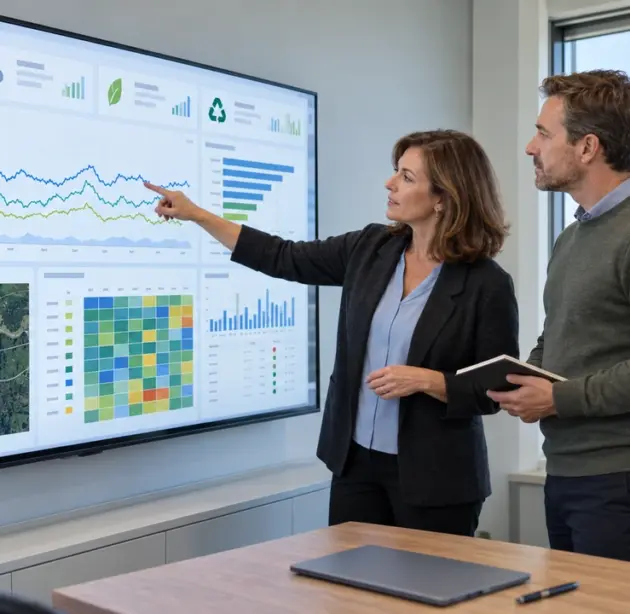
Environmental professionals analyzing trends, facility comparisons, and monitoring maps on a shared dashboard.

05 // Field Tested

Trusted for the most complex environmental data programs in the world

Chevron uses Locus EIM for environmental data management, with team members citing the platform's ability to scale to Chevron's needs without problems. Los Alamos National Laboratory and SLAC National Accelerator Laboratory use Locus for environmental data management programs that span radiological, chemical, and water quality monitoring data. San Jose Water Company — Silicon Valley's largest investor-owned water utility — uses Locus EIM to manage drinking water quality compliance data across its service territory.

These programs share a common characteristic: they are long-lived, high-stakes, and legally defensible in ways that most enterprise software never needs to be. Environmental data at a Superfund site may be used in litigation decades after it is collected. Drinking water analytical data is scrutinized by state agencies, the EPA, and the public simultaneously. Radiological data at a national laboratory is subject to federal oversight with the highest possible standards for data documentation. Locus EIM was designed for these conditions, and the organizations that operate under them have trusted it since 1999.

06 // Testimonials

National Research Laboratory

High-quality environmental data is one of the key drivers that will help us meet our cleanup goals. Moving forward, our data will help us be more sustainable and better stewards of the environment. Organizing these massive volumes of data, and making them available to the public, will help demonstrate our commitment to openness and environmental compliance. Organizing these massive volumes of data, and making them available to the public, will help demonstrate our commitment to openness and environmental compliance.

Alison Dorries Division leader for Waste and Environmental Services, Los Alamos National Laboratory

US Department of Energy Site

Overall Locus EIM is providing us with the ability to have a cloud-based data system that is compliant and functional with today's ever changing software technology. The transition to this system from our old one has improved the stability of the data and is making cross-training very easy for our team.

J. Matthew Barnett Environmental Radiation Task Lead, Pacific Northwest National Laboratory

Oil Field Services Company

Throughout my long career, I have worked with many vendors to enhance our EHS systems, but none have impressed me as much as Locus Technologies. Locus leveraged their software technologies to automate processes across all aspects of our EHS challenges—most notably in water management, traditionally one of the most complex segments of oil and gas exploration and groundwater management. Locus excelled in this area, and I could not have managed our program without them.

Tom Jones Director EHS Compliance and Remediation, Schlumberger

07 // Software Demonstration

The environmental data that regulators audit, lawyers discover, and scientists depend on

Every Locus EIM demo is led by a professional with direct environmental data management experience — someone who has managed site investigation data, worked with laboratory EDDs, and understands what it means when environmental data must be legally defensible.
Book a demo

Frequently Asked Questions

08 // FAQ

Environmental information management (EIM) software is a specialized platform for collecting, validating, storing, analyzing, and reporting on environmental analytical data including groundwater, soil, surface water, sediment, air, and biological sampling results. EIM software is used by environmental consultants, industrial companies, government agencies, national laboratories, and water utilities to manage contaminated site investigations, long-term compliance monitoring, PFAS tracking, and remediation performance monitoring programs. It differs from EHS compliance software (which manages tasks, permits, and incidents) by focusing on the underlying scientific data that compliance programs depend on.

Locus EIM software imports laboratory analytical data (typically via Electronic Data Deliverables), validates results against method-specific criteria and holding times, stores data with complete chain-of-custody documentation, enables spatial visualization through integrated GIS mapping, generates statistical analyses and trend reports, and produces regulatory-format reporting outputs. Modern EIM platforms like Locus also support mobile field data collection, automated PFAS detection limit handling, radionuclide decay correction, and API connectivity to SCADA systems and smart sensors.

LIMS software is designed to manage data within a laboratory such as tracking samples, instruments, tests, and results from sample receipt through laboratory analysis. EIM software manages data from the field through the laboratory and into regulatory reporting — receiving the analytical results from a LIMS (typically via EDD import) and managing everything that happens after analysis, such as validation, storage, spatial analysis, statistical reporting, and regulatory submission. Locus EIM connects to LIMS systems through standard API integrations.

Environmental consulting firms managing contaminated site investigations, remediation programs, and long-term compliance monitoring typically use specialized EIM platforms designed for the complexity of multi-site, multi-media, multi-laboratory environmental data. Locus EIM is among the most widely deployed platforms in this category, used by Fortune 500 companies, government agencies, and national laboratories since 1999. Key evaluation criteria include laboratory EDD import flexibility, GIS integration, PFAS data management capability, regulatory reporting support, and multi-site scalability.

Locus manages PFAS analytical data across all EPA-identified PFAS compounds with method-specific detection limit handling, non-detect statistical treatment options, automated comparison to applicable MCLs and health advisory levels, and GIS visualization of PFAS results across monitoring networks. The platform has managed more than 4.8 million PFAS records across 38,500+ global sites, including UCMR 5 monitoring results, state MCL compliance data, and groundwater investigation results for facilities managing PFAS contamination from AFFF or industrial sources.

Yes. Locus imports EDDs from multiple laboratories in standard formats (including EQuIS, EPA, and custom lab-specific formats) simultaneously, validates each EDD against sample-specific criteria, and consolidates results from all laboratories into a unified, auditable record. This is particularly important for large monitoring networks where samples are split between multiple accredited laboratories or where different media are analyzed by different specialty laboratories.

Locus EIM is designed for long-term data retention. Environmental data at CERCLA sites may be subject to regulatory requirements spanning decades of post-closure monitoring. Locus maintains the full historical record including historical EDDs, field records, and regulatory reports without data degradation or migration issues, because the platform's architecture separates customer data from platform code and preserves it through platform updates.